Why Traditional Methods Fail in Real Estate Marketing
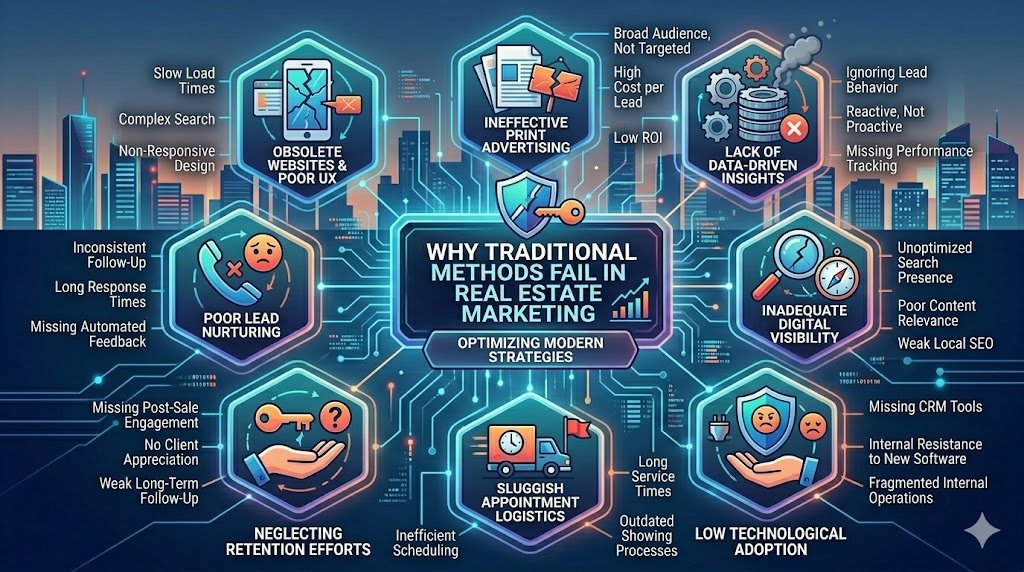
The real estate industry has undergone a significant transformation over the past decade. Marketing has changed. It used to depend on newspaper ads, cold calls, and flyers. Now, it focuses on digital interactions. Today’s buyers and sellers are smarter, more tech-savvy, and choosier than ever.
Many real estate professionals still use old marketing methods. They want to achieve the same results as before, even with the shift to digital platforms. These old tactics don’t keep up with today’s fast-paced market. Consumer behavior and property search habits have changed significantly.
Old methods often fall short. Understanding this helps us meet modern expectations. It’s crucial for building a strong client acquisition strategy. This article looks at the key reasons for this shift. It also explains how real estate professionals need to adapt to stay competitive.
1. Shift in Buyer Behavior
One key reason traditional methods fail is the big shift in buyer behavior. Today, many property seekers don’t rely on agents as their primary information source. Instead, they begin their journey online.
Today’s buyers:
- Search for properties on digital platforms
- Compare prices, locations, and amenities independently
- Read reviews before contacting an agent
- Expect instant access to information
Traditional methods like print ads or cold calls do not align with this behavior. If your online presence is weak, you are likely invisible to a large part of potential clients.
2. Decline of Print Media Effectiveness
Print media was key for real estate. This includes newspapers, brochures, and magazines. However, its influence has significantly declined.
The reasons include:
- Reduced readership of print publications
- Limited targeting capabilities
- High cost with low measurable returns
- Lack of real-time updates
Unlike digital platforms, print ads cannot be optimized or tracked effectively. This makes it hard to track performance and change strategies. They use resources in a manner that wastes potential.
3. Inefficiency of Cold Calling
Cold calling has long been a staple in real estate marketing. While it may still produce occasional results, its effectiveness has decreased considerably.
Challenges with cold calling include:
- Low response rates
- Increasing resistance from consumers
- Regulatory restrictions in many regions
- Time-intensive process
Modern consumers prefer personalized and permission-based communication. Unsolicited calls often create a negative impression rather than build trust.
4. Lack of Targeted Marketing
Traditional marketing methods rely on broad messaging aimed at a wide audience, lacking precision and targeting. A leading real estate lead generation approach focuses on reaching the right audience at the right time for better results.
For example:
- Flyers distributed in random locations may not reach interested buyers
- Generic advertisements fail to address specific needs
- No segmentation based on demographics or behavior
Modern marketing enables targeted campaigns. These campaigns focus on location, interests, search behavior, and buying intent. This approach reduces inefficiency and cuts costs from untargeted efforts.
5. Absence of Measurable Data
One of the biggest limitations of traditional methods is the lack of measurable data. Real estate pros can’t easily track how many people saw an ad, interacted with it, or became clients.
This creates several problems:
- Difficulty in evaluating ROI
- Inability to optimize campaigns
- Guesswork in decision-making
Digital marketing offers insights into user behavior. This helps professionals refine their strategies and improve performance over time.
6. Delayed Communication and Response Time
Traditional methods use slower communication. This means waiting for callbacks, answering questions manually, or meeting in person.
In today’s fast-paced environment, delays can result in lost opportunities. Modern clients expect:
- Instant responses
- Quick property details
- Immediate booking options
A potential client may pick a competitor if they don’t get quick information.
7. Limited Brand Visibility
Traditional marketing methods have a restricted reach based on location. Newspaper ads and billboards only connect with a small, local audience.
In contrast, digital platforms offer:
- Global or hyperlocal reach
- Continuous visibility
- Many touchpoints across channels
Without a strong digital presence, real estate agents find it hard to build their brand. They also struggle to stay memorable for potential clients.
8. Changing Trust Factors
Trust plays a crucial role in real estate decisions. In the past, people built trust primarily through personal referrals and face-to-face interactions. Today, online presence exerts a strong influence.
Modern trust signals include:
- Online reviews and ratings
- Professional websites
- Social media presence
- Informative content
Traditional methods do not provide these trust indicators. Potential clients may hesitate to engage without them. This is true even if the services are excellent.
9. Increased Market Competition
The real estate market has become increasingly competitive. Many new professionals are joining the industry and using advanced marketing techniques.
Competitors are now:
- Using digital advertising to reach targeted audiences
- Creating engaging content to attract leads
- Building strong online brands
Traditional professionals struggle to compete. Digital-savvy professionals can connect with clients more effectively and quickly.
10. Lack of Personalization
Modern consumers expect personalized experiences. Traditional marketing methods are typically one-size-fits-all, offering little room for customization.
For example:
- Generic brochures do not address specific buyer needs
- Mass messaging lacks relevance
- No follow-up based on user behavior
Personalization improves engagement and increases the likelihood of conversion. Without it, marketing efforts fail to connect with the audience on a meaningful level.
11. Rise of Digital-First Marketing Strategies
Digital marketing has changed how real estate agents find and win clients. Strategies like search optimization, content marketing, and social media engagement are now vital.
These strategies offer:
- Better targeting
- Higher engagement
- Real-time performance tracking
- Cost-effective scalability
Digital methods are more flexible and efficient than traditional ones. Traditional approaches are losing relevance in today’s market.
12. Cost Inefficiency Over Time
Traditional marketing methods can seem simple, but they often prove costly. Plus, their returns are typically limited.
Examples include:
- Repeated printing costs
- Expensive ad placements
- High manpower requirements
Without measurable outcomes, it becomes difficult to justify these expenses. Digital marketing, in comparison, allows for better budget control and optimization.
13. Inability to Adapt Quickly
The real estate market is dynamic, with trends, pricing, and demand in constant flux. Traditional marketing methods lack the flexibility to pivot in real time.
For instance:
- Printed materials cannot be updated once distributed
- Campaign adjustments take time and effort
- No real-time optimization
Digital platforms allow for real-time updates. This lets professionals quickly change listings or campaigns. They can respond to market shifts and stay relevant.
Conclusion
Traditional real estate marketing is failing to keep pace with modern buyer behavior. These static methods aren’t agile enough for today’s digital world. This makes them less effective. Because they cannot adapt to current trends, relying on them alone is no longer a viable strategy.
Modern real estate marketing needs to focus on digital-first methods. This change helps professionals increase visibility. It allows them to focus on specific audiences and customize client experiences. Using data also leads to better decisions. Embracing these changes builds stronger relationships while boosting efficiency and encouraging steady growth.
In a fast-moving market, growth relies on the ability to adapt. Embracing modern strategies helps you beat the limits of traditional methods. It also sets you up for long-term success in real estate.
About The Author