QR Code Generator: The Custom, Image & Artistic QR Codes for Modern Businesses
QR codes are everywhere on product packaging, restaurant tables, event banners, storefronts, and digital ads. But there’s a massive gap between a plain black-and-white QR code slapped on a flyer and a branded, trackable, visually striking QR code that actually drives clicks, builds brand recognition, and tells you exactly who scanned it, when, and from where.
That gap is where a professional QR code generator changes everything.
In this guide, we’re breaking down what a modern QR code generator can do, why custom and artistic QR codes outperform generic ones, and how SaaS businesses, marketers, and content creators are using them to run smarter campaigns.
What Is a QR Code Generator And Why Does It Matter?
A QR code generator is a tool that encodes any piece of information. a URL, a phone number, a Wi-Fi password, a PDF, a social profile into a scannable square matrix code. When someone scans it with their smartphone camera, they’re instantly redirected to that content without typing a single character.
The basics haven’t changed. What has changed dramatically is what you can do with a QR code generator today.
A modern QR code generator doesn’t just create codes. it lets you design them, track them, update them, and scale them across entire campaigns. That’s the difference between a static tool and a strategic marketing asset.
The Three Types of QR Codes Worth Knowing
Not all QR codes are built the same. Before you generate your first code, it helps to understand the three main types available in a powerful QR code platform.
1. Custom QR Code Generator – Design That Matches Your Brand
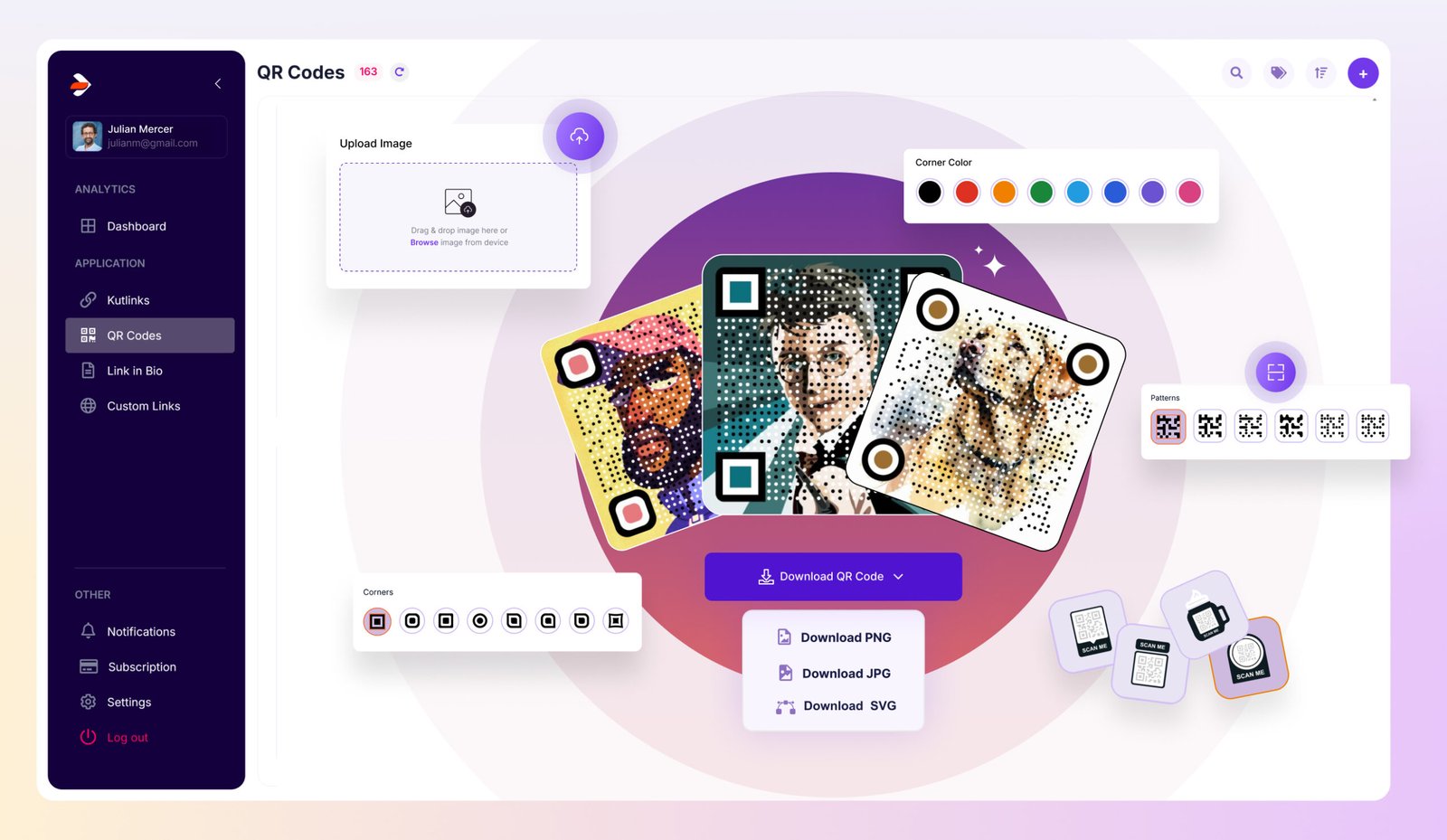
A custom QR code generator gives you control over the visual identity of every code you produce. This means you’re not stuck with the default black square on white background. You can:
- Choose different dot and eye shapes (rounded, circular, diamond, and more)
- Apply your brand colors to the foreground and background
- Add your company logo or icon at the center
- Select custom frames and call-to-action text like “Scan to Shop” or “Scan for Menu”
- Upload a branded background image
The result is a QR code that looks like it belongs on your marketing material — because it does. Branded QR codes consistently outperform generic ones in scan rates because they signal trust and professionalism. When a user sees a code with your logo and colors, they know exactly what brand they’re engaging with before they even scan.
Custom QR codes are ideal for product packaging, business cards, event signage, retail displays, trade show booths, and any print or digital material where brand consistency matters.
2. QR Code Generator for Image – Visual Content Built Right In
The QR code generator for image capability takes customization a step further. Instead of simply placing a logo inside a standard QR pattern, this option lets you embed actual images — product photos, graphics, brand artwork, directly into the QR design itself.
This type of code is particularly valuable for:
- E-commerce brands wanting to feature a product image inside the QR code on packaging
- Event organizers embedding a poster visual or speaker photo into a scan-to-register code
- Food & beverage companies using a dish image inside a menu QR code
- Creative agencies delivering memorable, shareable QR designs for client campaigns
The key engineering challenge here is maintaining scannability while adding visual complexity. A well-built QR code generator for image handles this automatically by preserving the error correction capacity of the code – meaning even with a graphic layered in, every major smartphone camera reads it cleanly.
3. Artistic QR Code Generator – AI-Powered Visual Design
The artistic QR code generator is the most visually ambitious of the three. Powered by AI, it transforms a standard QR code into a piece of visual art while keeping it fully functional and scannable.
Rather than just coloring the dots or adding a logo, the AI artistic QR code process re-imagines the pattern itself. The output looks more like an illustration, a stylized graphic, or a piece of branded design art than a traditional code. Yet it scans perfectly.
This is a game-changing tool for:
- Social media content where visual appeal drives shares and engagement
- Brand campaigns where the QR code itself becomes a creative asset
- Retail and lifestyle brands that compete heavily on aesthetics
- Digital artists and influencers who want their codes to feel as polished as the rest of their content
AI artistic QR codes are particularly effective on Instagram, Pinterest, print magazines, and anywhere audiences make quick judgments based on visual quality.
Static vs. Dynamic QR Codes: Why It Matters for Campaigns
One of the most important distinctions when using a QR code generator is choosing between static and dynamic codes.
A static QR code encodes the destination permanently. Once printed, you cannot change where it points. If your landing page URL changes or you want to A/B test different destinations, you need to reprint.
A dynamic QR code works differently. The code itself points to a short redirect URL managed by your platform. You can update the final destination any time – even after thousands of copies are already in the wild. Reprinting is never required.
For any serious campaign, dynamic QR codes are the only sensible choice. They give you the flexibility to:
- Change destination URLs without reprinting materials
- Redirect to seasonal promotions, updated product pages, or new landing pages
- Run multiple QR codes pointing to different destinations from one campaign dashboard
- A/B test landing page variations to see which performs better
- Real-Time Analytics: The Part Most Businesses Overlook
A QR code generator that only creates codes is only half the tool you need. The other half is analytics.
When you use a platform that tracks your QR codes, every scan becomes a data point. You get insight into:
- Total scans over any time period
- Geographic data – which cities, states, or countries are scanning
- Device type – iOS vs. Android, mobile vs. tablet
- Time of day patterns – when your audience is most active
- Source attribution – which campaign, piece of content, or placement drove the scan
This data closes a loop that has always been open in traditional print marketing. A billboard, a flyer, a business card – historically, these generated zero measurable feedback. With a trackable QR code, every print asset becomes a measurable channel.
For SaaS companies, marketers, and growth teams, this is transformational. You can optimize print campaigns the same way you optimize digital ads with real numbers.
Use Cases Across Industries
The flexibility of a modern QR code generator makes it useful across virtually every sector. Here’s how different industries are putting it to work:
- Retail & E-Commerce – Custom QR codes on product packaging link customers to tutorial videos, reviews, reorder pages, or loyalty programs. Image QR codes featuring the product itself create a seamless unboxing experience.
- Restaurants & Hospitality – Dynamic QR codes replace printed menus. When the menu changes, the destination updates instantly no reprinting costs. Feedback QR codes on receipts or tables collect real-time satisfaction scores.
- Events & Conferences – Artistic QR codes on event posters, banners, and badges become part of the visual experience rather than an afterthought. Scan data tells organizers exactly how many attendees engaged at each touchpoint.
- SaaS & Technology – QR codes on demo screens, onboarding materials, hardware packaging, and trade show booths create frictionless pathways from physical to digital, app downloads, documentation, trial signups.
- Real Estate – Property listings use QR codes on yard signs and print brochures to link directly to virtual tours, contact forms, and mortgage calculators.
- Healthcare – QR codes on appointment cards, clinic signage, and patient materials link to scheduling systems, intake forms, and patient portals. reducing friction at every touchpoint.
What to Look For in a QR Code Generator Platform
Not all QR code tools are created equal. If you’re evaluating platforms for your business or team, here’s what separates a professional-grade QR code generator from a basic free tool:
- Design flexibility – Can you fully customize colors, shapes, logos, frames, and backgrounds? Or are you limited to preset styles?
- Dynamic codes with unlimited updates – Can you change the destination URL after the code is live, without limits?
- Real-time analytics dashboard – Are scan metrics available immediately? Can you filter by date, location, and device?
- Bulk generation – Can you generate hundreds or thousands of unique codes at once for product serialization, event ticketing, or location-specific campaigns?
- Multiple code types – Does the platform support URL codes, Wi-Fi codes, vCard codes, email codes, PDF codes, and more – all from one place?
- No ads or watermarks – Are the QR codes yours, clean and professional, without third-party branding forced onto them?
- Team and white-label features – Can your team collaborate on campaigns? Can agencies run codes under client brand names?
- API access – Can developers integrate QR code generation directly into your product, CRM, or internal tools?
- GDPR and CCPA compliance – Is user scan data handled in accordance with privacy regulations?
The more of these boxes a platform checks, the more it functions as a genuine marketing infrastructure tool rather than a one-off code generator.
Common Mistakes to Avoid When Using a QR Code Generator
Even with the best tool, execution mistakes can hurt your results. Here are the most frequent ones to watch for:
- Printing too small – QR codes need adequate size to scan reliably. For print materials, aim for a minimum of 2 cm × 2 cm. Larger is almost always better.
- Skipping a test scan – Always scan your QR code across multiple devices and lighting conditions before printing at scale. This catches destination errors and design issues before they cost you.
- Using a static code for changeable content – If your landing page, offer, or destination might change, use a dynamic code from the start. Reprinting thousands of materials is expensive and avoidable.
- No call to action – A QR code without context gets ignored. A frame with text like “Scan to Get 20% Off” or “Scan to Book Your Demo” gives the audience a reason to act.
- Choosing aesthetics over scannability – Artistic and custom QR codes are powerful, but contrast matters. Ensure there’s always sufficient contrast between the code’s foreground and background so scanners read it reliably.
- Not tracking results – If you’re generating codes but not reviewing scan analytics, you’re flying blind. Set up tracking from day one.
How QR Codes Fit Into a Broader SaaS Marketing Stack
For SaaS businesses specifically, QR codes aren’t a standalone tactic – they’re a bridge between offline touchpoints and your digital conversion funnel.
Think about the full journey: a prospect sees your product at a trade show, scans a QR code on your booth display, and lands directly on a personalized demo booking page. The scan data flows into your analytics dashboard, the UTM parameters feed your CRM, and the lead is automatically tagged with the offline source. That’s the kind of attribution clarity that used to be impossible in physical marketing.
When a QR code generator integrates with link management, analytics, and campaign tools — all in one platform. it stops being a utility and starts being a strategic growth layer.
Ready to Create QR Codes That Actually Work for Your Business?
A QR code generator built for serious use does far more than produce a scannable square. It gives you design control, campaign flexibility, real-time data, and the infrastructure to scale QR-based marketing across every touchpoint. print, digital, event, and product.
Whether you need a custom QR code generator to match your brand identity, a QR code generator for image to embed visuals into your designs, or an artistic QR code generator powered by AI to make your codes a creative asset, the right platform handles all three in one place.
Divsly is built exactly for this. It combines custom QR code design, image-based QR creation, and AI artistic QR generation with dynamic code management, real-time analytics, bulk generation, and a full link management ecosystem, all from a single dashboard trusted by marketers, agencies, and enterprises worldwide.
If your QR codes aren’t designed, tracked, and optimized, they’re working at a fraction of their potential. Divsly changes that.
About The Author