

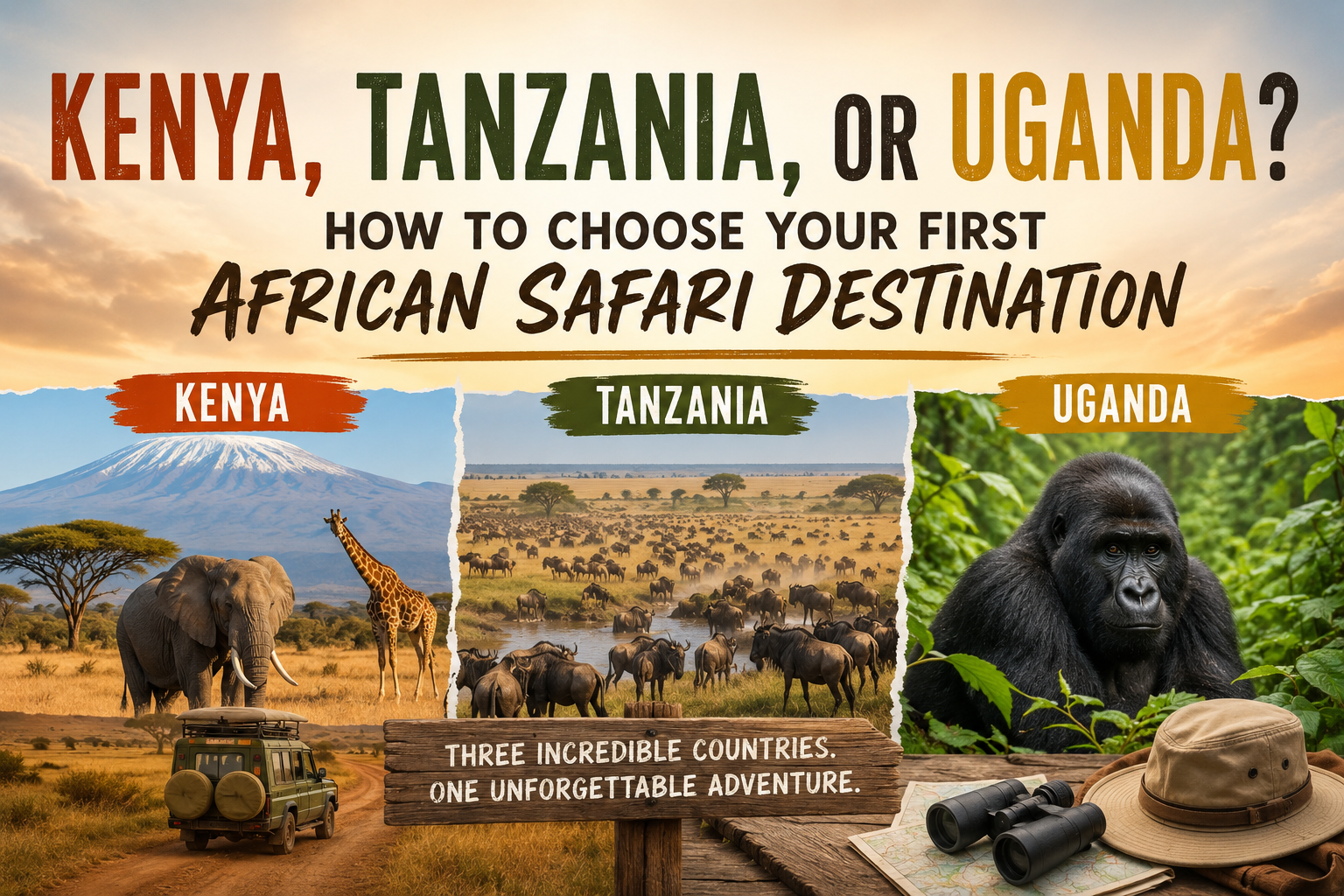
A first African safari raises one question above all others: which country delivers the right experience for the money and time available. Kenya, Tanzania, and Uganda each offer a distinct version of East Africa, and the right choice depends on wildlife priorities, budget, trip length, and travel style. This article breaks down what each country offers, where the differences matter most, and how to match a destination to specific goals.
Kenya built its reputation on the Masai Mara and its role in the Great Migration. Tanzania holds the largest share of that same migration inside the Serengeti, plus the Ngorongoro Crater. Uganda takes a different path entirely, built around gorilla trekking and primate encounters rather than open-plains game viewing. Travelers who research Uganda safaris often discover that this country suits a specific kind of trip: one centered on forest trekking, chimpanzee tracking, and a slower, more intimate pace than the vehicle-based game drives common in Kenya and Tanzania.
Choosing between these three countries starts with a clear picture of what each place actually delivers, since brochures often blur the distinctions and leave travelers guessing.
What Kenya Offers a First-Time Safari Traveler
Kenya runs a mature safari infrastructure built over decades, with the Masai Mara serving as its flagship destination. The Mara delivers dense predator populations, open grassland visibility, and direct access to the Great Migration during July through October, when wildebeest and zebra cross the Mara River in dramatic numbers.
Nairobi National Park sits within view of the capital’s skyline, giving travelers with short layovers a genuine wildlife encounter without a long transfer. Amboseli National Park adds views of Mount Kilimanjaro alongside large elephant herds, producing some of the most recognizable safari photography in the region.
Luxury Kenya safaris typically combine a stay in the Masai Mara with a second location such as Amboseli or Lake Nakuru, creating a well-rounded itinerary across five to eight nights. Camps in the Mara range from mid-range tented options to ultra-exclusive private conservancies bordering the reserve, where vehicle numbers stay capped and night drives remain permitted.
Kenya suits travelers who want:
- Direct access to Mara River crossings during peak migration months
- A shorter flight time from Europe compared to destinations further south
- A strong mix of budget, mid-range, and luxury camp options within one park system
- Add-on options like Nairobi city stops or a short beach extension on the coast near Mombasa
Kenya works best for travelers on a tighter timeline who still want migration-season drama, since the Mara sits closer to Nairobi’s international airport than most Tanzanian parks sit to their own entry points.
What Tanzania Offers a First-Time Safari Traveler
Tanzania holds a larger and more varied park system than Kenya, spreading across the Serengeti, Ngorongoro Crater, Tarangire, and Lake Manyara within a single northern circuit. This size gives travelers more flexibility to build a longer itinerary without repeating scenery or wildlife patterns.
The Serengeti covers roughly 5,700 square miles, several times the size of the Masai Mara, and holds the majority of the migration herd for most of the year. Tanzania luxury safaris typically string together three or four parks across seven to ten nights, since domestic flights connect Arusha to airstrips near each major park within 30 to 60 minutes.
Ngorongoro Crater adds a feature Kenya cannot match: a contained volcanic caldera holding one of the highest wildlife densities on the continent within a single day’s game drive. Travelers descend roughly 2,000 feet into the crater floor, where lion, rhino, and dense herds of plains game concentrate within a 100-square-mile bowl.
Tanzania suits travelers who want:
- A longer, multi-park itinerary spanning a full week or more
- Access to Ngorongoro Crater, a wildlife-dense feature unavailable in Kenya
- Private concessions bordering the Serengeti with walking safaris and night drives
- A natural pairing with Zanzibar for a beach extension after the safari portion ends
Tanzania rewards travelers with more time and a larger budget, since the country’s parks sit further apart and require more internal flights than Kenya’s more compact circuit.
What Uganda Offers a First-Time Safari Traveler
Uganda takes safari travel in a different direction. Instead of open savanna and predator-prey dynamics, Uganda centers its offering on primates, forest ecosystems, and a smaller, quieter visitor footprint.
Bwindi Impenetrable National Park holds roughly half of the world’s remaining mountain gorilla population, and permits allow small groups to trek through dense forest for a single hour with a habituated gorilla family. Kibale National Park adds chimpanzee tracking, with some of the highest chimp-sighting success rates in Africa. Queen Elizabeth National Park and Murchison Falls National Park round out the country’s offering with tree-climbing lions, boat safaris along the Kazinga Channel, and views of the Nile’s most dramatic waterfall.
Uganda suits travelers who want:
- Gorilla and chimpanzee trekking as the centerpiece of the trip rather than an add-on
- A quieter visitor experience with far fewer vehicles per sighting than in Kenya or Tanzania
- A mix of forest trekking and traditional game drives within one itinerary
- A trip built around walking and physical activity rather than vehicle-based game viewing alone
Gorilla permits cost $700 per person in Uganda, a fraction of the $1,500 charged in neighboring Rwanda, making Uganda the more accessible option for travelers who want this specific wildlife encounter without the higher Rwandan price tag.
Comparing Cost, Time, and Wildlife Priorities
The three countries differ meaningfully across the factors that matter most when planning a first trip.
Budget considerations:
- Kenya offers the widest range of price points, from budget camping safaris to five-star private conservancies
- Tanzania generally runs 15 to 25 percent higher than comparable Kenyan camps, driven by higher park fees and longer domestic flight segments
- Uganda’s core cost driver is the gorilla permit itself, with accommodation often priced lower than equivalent Kenyan or Tanzanian lodges
Time on the ground:
- A worthwhile Kenya safari fits into five nights, given the Mara’s proximity to Nairobi
- Tanzania rewards seven to ten nights, since its parks spread across a wider area
- Uganda works well as a seven-to nine-night trip, combining gorilla trekking with one or two savanna parks
Wildlife focus:
- Kenya and Tanzania both deliver the Big Five and migration-season drama
- Uganda adds primates as a category unavailable in either of the neighboring countries
- Travelers who want both categories in one trip increasingly combine Uganda with a short Kenya or Tanzania extension, flying between Entebbe and Nairobi or Kilimanjaro in under two hours
Many operators build itineraries around African safaris and tours that span two countries rather than one, recognizing that Kenya and Tanzania complement each other on wildlife grounds while Uganda adds a category of experience neither country can replicate. A traveler who wants both open-plains game viewing and primate trekking within a single trip often books ten to fourteen nights split between two of these three destinations.
Making the Decision
Three questions narrow the choice quickly.
Does gorilla or chimpanzee trekking matter more than open-plains game viewing?
If yes, Uganda becomes the anchor destination, with Kenya or Tanzania as an optional addition rather than the main event.
Is trip length under seven nights?
Kenya’s compact geography suits shorter trips better than Tanzania’s spread-out park system, since travelers spend less time in transit and more time on game drives.
Does the Great Migration’s river crossing rank as a top priority?
Both Kenya and Tanzania offer this experience depending on the month, since the herd moves between the two countries throughout the year. Travelers chasing a Mara River crossing specifically should target Kenya from July through September, while those seeking calving season should look at Tanzania’s southern Serengeti from January through March.
A first safari does not need to cover every possible experience. Travelers who try to combine all three countries into a single two-week trip often report feeling rushed, spending more time on internal flights than on actual game drives. A focused trip to one country, with a possible short addition to a second, produces a stronger experience than an itinerary stretched too thin across three destinations.
Practical Factors That Affect the Final Choice
Wildlife and budget drive most decisions, but a few practical details shift the calculation for specific travelers.
Visa requirements. Kenya, Tanzania, and Uganda each run separate e-visa systems, though the East Africa Tourist Visa covers Kenya, Uganda, and Rwanda under a single application for travelers who plan to combine those three countries. Tanzania sits outside this arrangement and requires its own visa regardless of which other countries appear on the itinerary.
Health preparation. Yellow fever vaccination requirements apply differently across the three countries depending on a traveler’s departure point and prior travel history. Malaria prophylaxis applies to all three destinations, since each country’s parks sit within malaria-risk zones. A travel clinic visit four to six weeks before departure allows time for any required vaccinations to take effect.
Flight connections. Nairobi’s Jomo Kenyatta International Airport functions as the primary regional hub, with frequent connections to Kilimanjaro International Airport in Tanzania and Entebbe International Airport in Uganda. Travelers combining two countries typically route through Nairobi regardless of which two destinations they choose, since flight frequency and pricing favor this hub over direct routes between Tanzania and Uganda.
Seasonal weather patterns. Each country runs a dry season and a wet season, though the exact months shift slightly between them. Kenya and Tanzania share a similar dry season from June through October, while Uganda’s equatorial location produces a less pronounced wet-dry split, allowing gorilla trekking to remain viable across most of the calendar year with only brief exceptions during the heaviest rain months of April and November.
These practical factors rarely override the core decision between wildlife priorities and budget, but they affect trip planning enough to warrant a conversation with a specialist before finalizing dates and destinations.
Frequently Asked Questions
Kenya suits shorter trips with easier logistics from Nairobi, while Tanzania suits longer trips with a wider variety of parks and the added feature of Ngorongoro Crater.
Yes. Flights between Entebbe and Nairobi or Kilimanjaro run under two hours, making a combined itinerary practical for travelers who want both primate trekking and open-plains game viewing.
Uganda charges $700 per person for a gorilla trekking permit, compared to $1,500 in Rwanda, making Uganda the lower-cost option for the same core experience.
July through September offers the strongest odds of witnessing a Mara River crossing in Kenya, while January through March suits travelers who want to see calving season in Tanzania’s southern Serengeti.
Five nights work well for a focused Kenya trip, seven to ten nights suit Tanzania’s larger park system, and seven to nine nights fit a Uganda itinerary combining gorilla trekking with a savanna park.
Generally yes. Tanzania runs 15 to 25 percent higher than comparable Kenyan camps, due in part to higher park fees and additional domestic flight segments between parks.
Plan Your First African Safari With Confidence
Choosing between Kenya, Tanzania, and Uganda comes down to matching wildlife priorities, budget, and available time to what each country does best. A safari specialist can build an itinerary around the specific experience that matters most, whether that means a Mara River crossing, a descent into Ngorongoro Crater, or a morning spent with a mountain gorilla family in Bwindi. Reach out to a trusted safari operator to compare itineraries side by side and lock in the right destination before peak-season availability fills up.

















Leave a Reply