

When you step into a business premises for the very first time, something happens before a single word is spoken. Your eyes scan the proportions of the ceiling. Your feet register the texture of the floor underfoot. Your body instinctively reads the warmth or coolness of the lighting overhead. In that fleeting moment, you have already formed an impression of the company behind the facade. This is not merely aesthetic intuition; it is the quiet, persuasive power of modern commercial architecture design Sydney businesses are increasingly harnessing to communicate who they are, what they value, and how they choose to operate in the world.
Architecture has always been a language. For commercial enterprises, it is the loudest sentence in their brand’s story.
The Built Environment as a Brand Statement
First Impressions Are Structural, Not Superficial
There is a persistent misconception in business circles that brand identity begins and ends with logos, colour palettes, and marketing copy. While those elements undeniably matter, they are the finishing coat rather than the foundation. A brand’s physical space, the very bones of where business is conducted, speaks with a sincerity and weight that no campaign slogan can replicate.
Think about the deliberate angularity of a law firm’s entrance foyer, projecting authority and precision. Or the open, exposed-brick informality of a creative agency’s studio, broadcasting its rejection of corporate rigidity. Neither choice is accidental. Both are deeply intentional acts of communication, translated into mortar, glass, steel, and timber.
Commercial architecture shapes perception because it operates on multiple senses simultaneously. A visitor does not merely see a space; they hear its acoustics, feel its temperature, sense its scale. This multi-sensory bombardment creates an emotional imprint that outlasts any brochure or social media campaign. When the architecture aligns with the brand’s stated values, the effect is resonance. When it contradicts those values, the effect is confusion, and potential clients notice the dissonance even if they cannot articulate exactly why.
Material Choices and Their Unspoken Meanings
Every material decision carries cultural and psychological freight. Raw concrete signals transparency and no-nonsense pragmatism. Polished marble suggests heritage, permanence, and a willingness to invest in quality. Timber introduces warmth and an organic approachability. Glass communicates openness, a willingness to be seen and, by extension, a confidence in what is being done within those walls.
Forward-thinking firms have recognised that sustainable commercial office design is not merely an environmental responsibility; it is an increasingly powerful brand signal in its own right. The inclusion of recycled materials, living green walls, passive ventilation systems, and responsibly sourced timbers tells a coherent story about a company’s priorities. For businesses whose clientele values environmental stewardship, a sustainably designed fitout is brand storytelling made tangible. It demonstrates commitment through square metres rather than press releases.
The sophistication of this approach should not be underestimated. Clients who walk into a workspace where the architecture authentically reflects the company’s ethos leave with a gut-level trust that no amount of clever copywriting can manufacture from thin air.
Space, Flow, and the Science of Productivity
How Architecture Shapes the Way People Work
Beyond brand communication, commercial architecture exerts a profound and measurable influence on how people actually perform their work. This is an area where design instinct and neuroscience have found compelling common ground in recent decades. The layout of a workspace, the quality of its natural light, its acoustic properties, and the generosity of its communal zones are not incidental to productivity. They are central to it.
Research consistently demonstrates that workers in poorly designed environments suffer from elevated stress responses, diminished concentration, and higher rates of absenteeism. Conversely, thoughtfully designed workplaces generate measurable improvements in focus, collaboration, and overall wellbeing. The architecture, in this sense, is not the backdrop to the work; it is a participant in it.
Ceiling height is one of the less-discussed variables with outsized consequences. Higher ceilings are associated with expansive, abstract thinking and creative problem-solving. Lower, more intimate ceilings correlate with detail-oriented focus and procedural tasks. Shrewd architectural briefs therefore vary ceiling heights deliberately across different zones of a commercial space, creating environments calibrated to the cognitive demands of the work being done within them.
Natural Light: The Undervalued Productivity Engine
If there is one single architectural variable that consistently emerges as the most impactful on occupant wellbeing and output, it is access to natural daylight. Study after study confirms that workers in naturally lit environments report better sleep, lower stress levels, and heightened job satisfaction compared to those who spend their days under artificial lighting alone.
Yet natural light is frequently sacrificed at the altar of maximising rentable floor space, with deep-plan buildings pushing workers far from any window line. This is a false economy. The productivity losses incurred by light-deprived workers more than offset any savings achieved through efficient space planning. Enlightened developers and their architectural partners are responding by prioritising light wells, reflective interior surfaces, and floor plates that limit the distance any desk sits from a perimeter window.
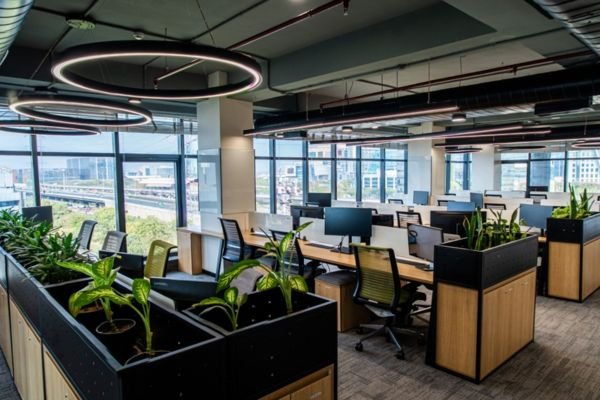
The integration of biophilic design principles, those that bring natural elements including plants, water features, natural materials, and outdoor views directly into the built environment, has demonstrated remarkable results. Workers in biophilic spaces report feeling more energised, more focused, and meaningfully more engaged with their tasks. What reads to a layperson as beautiful interior decoration is, in practice, a sophisticated productivity strategy grounded in evolutionary biology.
Collaboration Zones Versus Focus Areas
One of the great architectural tensions in contemporary workplace design is the balance between spaces that encourage spontaneous collaboration and those that protect deep, uninterrupted concentration. Open-plan offices, so fashionable in the early years of this century, were embraced as collaboration-enablers. In practice, many became engines of distraction, noise, and frustration.
The contemporary response is not a wholesale retreat to cellular offices but rather a more nuanced, evidence-informed approach to zoning. Acoustic booths and quiet rooms provide sanctuary for focused individual work. Soft-furnished breakout areas invite informal conversation and serendipitous idea exchange. Semi-enclosed meeting pods allow small groups to collaborate without broadcasting their discussions to the entire floor.
The principles driving workplace interior design for productivity today recognise that different personalities, different tasks, and different moments in the creative process require different spatial conditions. A well-designed commercial floor plate therefore reads less like a single uniform space and more like a carefully curated collection of distinct environments, each optimised for a specific mode of work, yet all cohering as a unified expression of the organisation’s culture.
Culture, Hierarchy, and the Democracy of Space
What Office Layout Reveals About Organisational Values
The spatial decisions embedded in a commercial fitout are simultaneously design choices and cultural declarations. Whether leadership occupies enclosed corner offices elevated above the general workforce, or sits within the open floor alongside everyone else, is not merely a matter of personal preference. It broadcasts assumptions about hierarchy, accessibility, and the relationship between authority and accountability.
Organisations that espouse flat, collaborative cultures but nest their executives behind frosted glass and reception barriers are sending contradictory signals. Their people pick up on the inconsistency. Visitors notice it. The architecture, in this sense, functions as a truth-teller, revealing organisational values with a candour that annual reports rarely manage.
Some of Australia’s most admired employers have deliberately stripped away spatial privilege as a visible act of cultural commitment. When the managing director sits at the same bench as a graduate recruit, the architecture enforces an egalitarianism that deepens trust across the whole organisation.
The Role of Breakout and Social Spaces
The generosity with which a commercial space allocates room for informal gathering, for unscheduled conversations over good coffee, for a comfortable moment of respite from the intensity of the primary work, speaks volumes about how an organisation views its people. Companies that regard every square metre not directly devoted to productive output as wasted space are communicating, perhaps unintentionally, a transactional view of employment.
The evidence, interestingly, runs in exactly the opposite direction. The informal interactions that happen in generously designed social zones are frequently where the most valuable connections are made, where problems are solved obliquely, where new ideas are sparked by a passing comment from a colleague in an adjacent team. Good architectural design anticipates and celebrates these moments rather than minimising the space available for them.
Future Directions in Commercial Architecture
Adaptive Spaces for an Evolving Workforce
The rapid normalisation of hybrid working arrangements since 2020 has fundamentally altered the brief that architects and their commercial clients negotiate together. A building designed for five-day attendance is now filling to perhaps sixty per cent of its previous capacity on any given day. This reality demands a corresponding architectural response.
The most thoughtful commercial designs of this era are embracing adaptability as a core organising principle. Moveable partitions, modular furniture systems, and infrastructure designed to support rapidly reconfiguring layouts give organisations the flexibility to repurpose their spaces as their needs evolve. Rather than embedding a single fixed arrangement in concrete and plasterboard, contemporary commercial architecture increasingly bakes in the capacity for reinvention.
Technology integration is another frontier reshaping the field. Sensor networks that monitor space utilisation in real time, automated environmental controls that adjust lighting and temperature based on occupancy, and seamlessly embedded audiovisual infrastructure for hybrid meetings are becoming expected features of high-quality commercial fitouts rather than exceptional ones. The line between architecture and technology is blurring in ways that would have seemed implausible a generation ago.
Wellness Architecture as Competitive Advantage
In an increasingly competitive talent market, the quality of the physical environment in which people are invited to spend their working lives has emerged as a genuine differentiator. Candidates assessing competing job offers are no longer indifferent to where they will spend eight or more hours of their day. Workplaces that demonstrate visible care for their occupants’ physical and mental wellbeing are attracting and retaining talent that less thoughtful environments are losing.
This has given rise to what practitioners are calling wellness architecture: a discipline that treats occupant health not as a desirable by-product of good design but as the primary brief. Air quality monitoring, access to nature, ergonomic variety, acoustic comfort, and the provision of spaces that support emotional regulation and mental restoration are all ingredients in this approach. The architecture, in this framing, becomes an expression of care, and care, in a competitive employment landscape, is a genuinely powerful asset.
Bringing It All Together
Architecture as Strategic Investment
The businesses that treat their physical environments as a strategic investment rather than a necessary overhead consistently outperform those that regard the fitout decision as a box-ticking exercise in securing compliant and functional floor space. They attract stronger talent, enjoy higher retention rates, generate greater client confidence, and build internal cultures of greater cohesion and pride.
This does not necessitate extravagant expenditure. The most effective commercial spaces are not always the most expensive. What they share is intentionality. Every spatial decision has been made in deliberate service of a clearly articulated vision, both of the brand the organisation wants to project and the human experience it aspires to create for the people who work and visit within those walls.
Architecture, at its finest, is an act of optimism. It is the physical embodiment of belief in the future, in the value of the people who inhabit a space, and in the power of beauty and function to shape human experience for the better. For Australian businesses navigating an era of rapid change and fierce competition, it may be one of the most consequential investments on the table.
The building does not just house the business. It tells its story, shapes its culture, and either lifts or limits the potential of every single person who steps through the door.


























Leave a Reply