

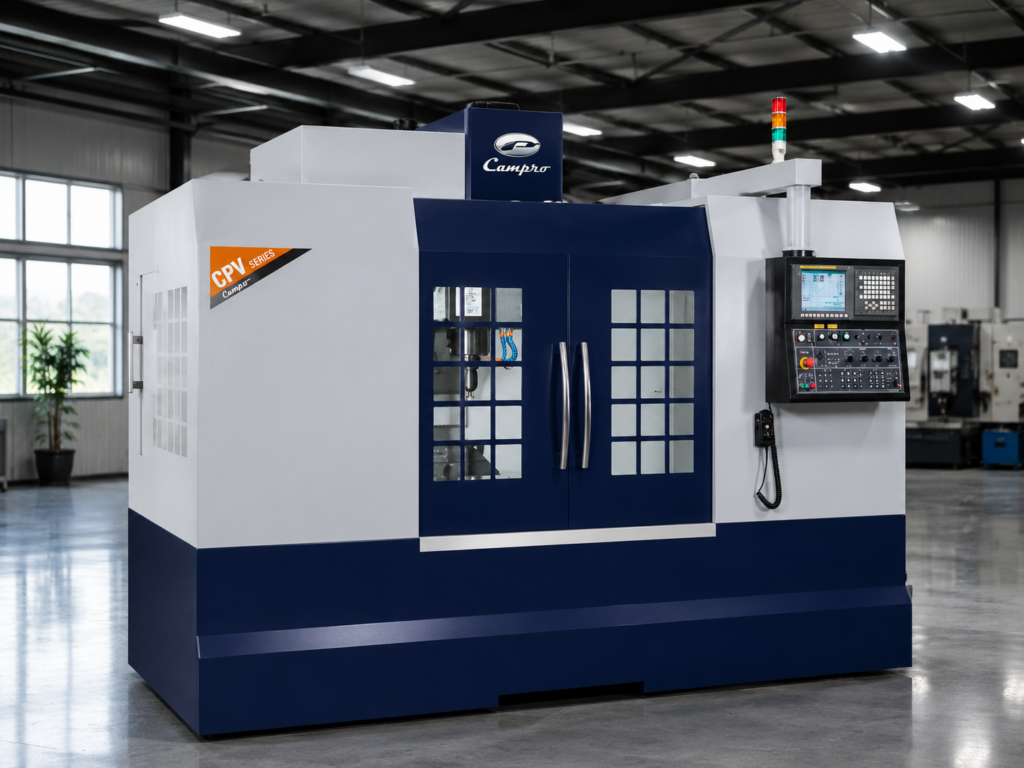
Manufacturing today depends heavily on machines that can deliver precision, repeatability, and efficiency across a wide range of operations. That is why the CNC vertical machining center continues to be one of the most widely used machine types in industrial production. Sources describing this equipment explain that it uses a vertically oriented spindle, supports milling, drilling, tapping, boring, and multi-axis operations, and is commonly used in industries such as automotive, aerospace, die and mold making, electronics, and medical device manufacturing.
For many machine shops, the CNC vertical machining center offers an effective balance of accessibility, accuracy, and versatility. Its vertical spindle design makes it especially practical for top-down cutting on flat parts, plate-like workpieces, and molds, while CNC automation helps ensure more consistent results over repeated cycles.
What a CNC Vertical Machining Center Is
A CNC vertical machining center is a type of CNC milling machine built with a vertical spindle axis positioned perpendicular to the worktable. In practical terms, this means the cutting tool approaches the workpiece from above, making the machine well suited for operations that require top-down access and clear workpiece visibility.
The CNC vertical machining center is commonly used to carry out milling, drilling, boring, tapping, and threading operations. Some models are built around standard 3-axis machining, while more advanced configurations may support 4-axis or 5-axis capability for more complex part geometry and multi-sided machining.
Why Vertical Spindle Design Matters
One of the biggest advantages of a CNC vertical machining center is its spindle orientation. Sources note that vertical machining centers are generally favored for single-face machining and are ideal for plate-like components, complex molds, and small to medium-sized parts that benefit from top-down cutting access.
This design can also make setup simpler for many applications. Because the operator can often view the workpiece more directly, the CNC vertical machining center tends to be a practical solution for machine shops that want straightforward operation combined with high machining control.
Core Capabilities in Production Environments
A CNC vertical machining center remains popular because it combines multiple core machining functions in one platform. According to industry sources, these machines are widely used for milling, drilling, shaping, boring, tapping, and similar metalworking operations, often on raw blocks of aluminum, steel, and other industrial materials.
This multi-function capability improves shop efficiency because several operations can often be completed in a single setup. For manufacturers looking to reduce manual intervention and improve consistency, the CNC vertical machining center provides a practical path toward more streamlined production.
Industrial Uses Across Sectors
The wide adoption of the CNC vertical machining center reflects how adaptable it is across sectors. Industry sources identify its use in automotive manufacturing, aerospace, machine shops, die and mold making, shipbuilding, electronics, and medical device production.
This broad relevance comes from the machine’s ability to handle both precision and productivity. Whether a shop is producing molds, structural components, or repeat production parts, the CNC vertical machining center fits a range of workflows that require accuracy, speed, and repeatable machining performance.
Precision and Multi-Axis Growth
Another reason the CNC vertical machining center remains important is its ability to support increasingly complex manufacturing demands. Sources describe standard 3-axis models as common, while more advanced versions may include 4-axis or 5-axis capability for parts that require multiple angles, contours, or more sophisticated geometry.
This is also where the term vertical machine center becomes relevant in broader equipment discussions. Buyers comparing machine classes often look at spindle orientation, part complexity, and axis capability to decide which type of machining platform best matches their production goals.
Relevance in the U.S. Market
The CNC vertical machining center is especially important in North American manufacturing, where machine reliability, service access, and long-term productivity directly affect competitiveness. Industry sources discussing manufacturers in the U.S. note that vertical machining centers are a major product category among leading CNC brands serving the American market, including companies such as Haas, Hurco, Mazak, and Fadal.
Conclusion
The CNC vertical machining center continues to be a foundational machine in modern manufacturing because it combines vertical spindle accessibility, machining precision, process versatility, and production efficiency in a single platform. Its ability to support milling, drilling, tapping, boring, and multi-axis work makes it valuable across a broad range of industries and part types. For manufacturers comparing machine platforms, the CNC machine in the USA market often includes strong interest in the vertical machine center because of its practical role in everyday machining, repeat production, and precision workflows. When matched to the right application, a CNC vertical machining center can support both immediate production needs and long-term operational growth.














Leave a Reply