What Happens to Energy Bills With Proper HVAC Sizing & Sealing?
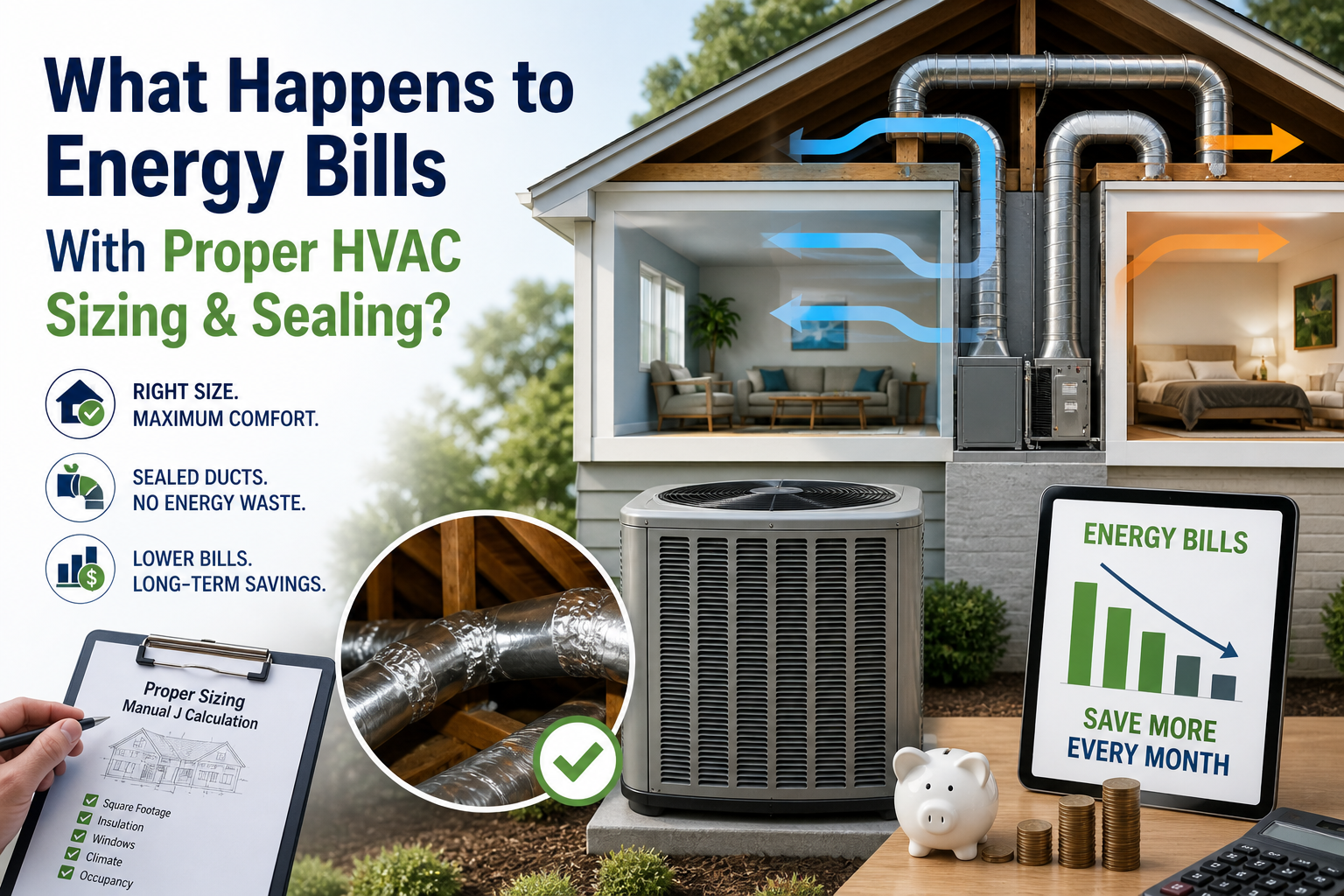
If you’ve ever replaced an HVAC system and expected your energy bills to drop – only to find they stayed stubbornly high – there’s a good chance the installation itself was the problem. The equipment may have been efficient on paper. But efficiency ratings are lab numbers. Real-world performance depends entirely on how the system was installed, sized, and integrated with your home’s duct system.
This is one of the most overlooked facts in the HVAC industry, and it costs homeowners in Durham real money every single month.
Oversizing: The Problem Nobody Warns You About
Bigger is better, right? Not with HVAC systems. When a system is oversized for the home it serves, it reaches the set temperature quickly and shuts off – before it has time to dehumidify the air properly. This is called short cycling, and it creates three problems at once.
First, the system runs in short, frequent bursts rather than long, efficient cycles – which uses more energy per unit of cooling or heating delivered. Second, because the system keeps cycling on and off, its mechanical components wear faster. Third, the home never reaches a stable humidity level, which makes it feel muggy even when the temperature is right.
A proper HVAC system installation includes a Manual J load calculation that accounts for your home’s specific thermal characteristics – not just square footage. Hays Heating and Air, a Trane Comfort Specialist with nearly 30 years of experience in Durham, uses this methodology to size systems correctly the first time.
What Duct Sealing Has to Do With Your Electricity Bill
Even a perfectly sized, energy-efficient system bleeds money if the duct system is leaking. In a typical home with unsealed ducts, 20 to 30 percent of conditioned air escapes into the attic, crawl space, or wall cavities before it reaches the living areas. Your system works harder, runs longer, and still may not fully heat or cool every room.
Duct sealing is not glamorous work, but it’s one of the highest-return improvements you can make. Hays Heating and Air offers ductwork services as part of their installation process, which means the system and the delivery network are optimized together rather than treated as separate concerns.
The Real Efficiency Rating You Should Care About
When shopping for an HVAC system, you’ll see SEER2 ratings for cooling and HSPF2 ratings for heat pumps. These numbers matter – a higher rating means the system uses less energy per unit of output. But here’s the catch: those ratings assume perfect installation.
A 20 SEER2 system with leaky ducts and an incorrect refrigerant charge may perform like a 14 SEER2 unit in practice. The gains you paid for on the equipment side are lost on the installation side. Getting the real-world efficiency you paid for requires both the right equipment and installation done to proper standards.
How Financing Makes High-Efficiency Installation Accessible
One reason homeowners sometimes settle for a cheaper installation is the upfront cost. High-efficiency equipment and properly sealed ductwork cost more initially. But Hays Heating and Air offers financing options that make it possible to invest in a quality installation now and recover that cost through lower energy bills over time. In many cases, the monthly savings on utilities more than offset the financing payments.
Utility rebates and federal tax credits – including those available under the Inflation Reduction Act for qualifying heat pump systems – can further reduce the net cost. An experienced HVAC contractor can walk you through which incentives apply to your specific situation in Durham or the surrounding counties.
What a Quality Installation Actually Includes
When Hays Heating and Air installs a system, the process covers more than just swapping equipment. A proper installation includes:
• Manual J load calculation for correct system sizing
• Duct inspection and sealing before the new system connects
• Correct refrigerant charge verified with gauges – not estimated
• Airflow testing to confirm each room receives its design volume
• Thermostat calibration and programming
• Full system test run with documentation of performance readings
Each of these steps directly affects energy consumption and system longevity. Skipping any of them shifts the cost burden onto the homeowner through higher bills and earlier equipment failure.
Long-Term Savings vs. Short-Term Savings
A cheaper installation saves money on day one. A proper installation saves money every day for the next 15 to 20 years. Over the life of a system, the energy savings from correct sizing and sealing can easily total several thousand dollars. Add in fewer repairs and a longer equipment lifespan, and the case for doing it right the first time is overwhelming.
Durham homeowners who choose Hays benefit from a company that has operated locally since 1997 and built its reputation on doing work that lasts. Free online estimates make it easy to compare costs without any pressure.
FAQ
How much can proper duct sealing reduce my energy bills?
According to the Department of Energy, sealing and insulating ducts can improve system efficiency by up to 20 percent in some homes. In an older Durham home with deteriorating ductwork, savings can be even more significant.
What is a Manual J load calculation and why is it required?
Manual J is the ACCA-standard method for calculating the exact heating and cooling load of a specific home. It accounts for insulation, windows, climate, occupancy, and more. Without it, sizing is a guess, and guesses lead to the oversizing and undersizing problems described above.
Does the type of thermostat affect energy efficiency?
Yes. A WiFi-enabled smart thermostat can reduce energy use by learning your schedule and adjusting temperatures when the home is unoccupied. Hays Heating and Air installs WiFi thermostats as part of their service, and the programming they provide on installation day ensures you get the efficiency benefits immediately.
About The Author