

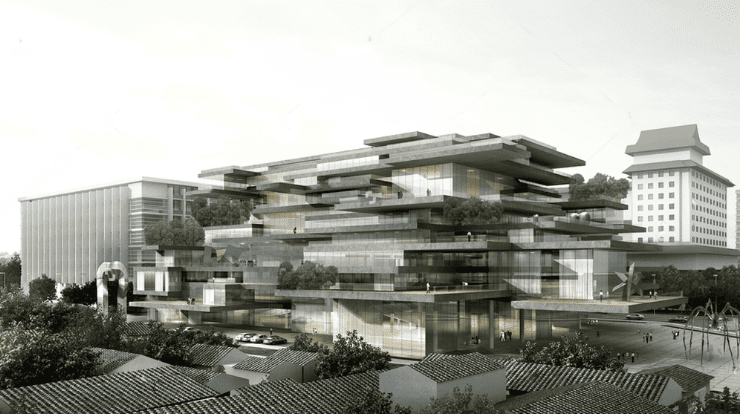
Selecting the correct scale is critical when reviewing large development plots. Authorities, planners, and developers rely on physical models to understand how extensive sites are organized. If the scale is too large, the model becomes oversized and difficult to handle.
If it is too small, important spatial relationships may be lost. The right balance ensures that land use distribution, access routes, and massing are easy to read during approval discussions. An architectural scale model must therefore match the purpose of review rather than follow a fixed standard.
Common Scales Used for Large Plots
Large development plots are usually reviewed at smaller scales that allow the entire site to be seen in one view. Scales such as 1:2000, 1:1000, and 1:500 are commonly used depending on the site size and complexity. A 1:2000 scale works well for regional context and boundary review, while 1:1000 offers better clarity for internal road networks and zoning. A 1:500 scale provides more detail but may require a larger physical footprint. An architectural scale model Dubai at these ranges helps reviewers compare options without losing the overall picture.
Understanding the Purpose of the Review
The most effective scale depends on what authorities need to evaluate. Early-stage master planning reviews often focus on land use distribution and connectivity. Smaller scales are suitable here because they emphasize overall structure. Later reviews may require closer inspection of plot divisions, access points, and open spaces. In such cases, a slightly larger scale improves clarity. Matching the scale to the review objective ensures that the model communicates the right information without unnecessary detail.
Balancing Detail and Readability
One of the main challenges in large plot models is balancing detail with readability. Too much detail at a small scale can clutter the model and confuse viewers. Simple massing blocks, clear road lines, and defined open spaces tend to work best. The goal is to communicate relationships rather than architectural finishes. An architectural scale model should prioritize legibility so that reviewers can understand the site within seconds of viewing it.
Considering Physical Space and Handling
Large-scale reviews often take place in meeting rooms with limited table space. The chosen scale must allow the model to fit comfortably within the review environment. Models that are too large can restrict movement and viewing angles. Smaller scales make it easier for multiple stakeholders to gather around and discuss the proposal. An architectural scale model that fits well within the available space supports smoother and more inclusive review sessions.
Viewing Distance and Perspective
The way reviewers interact with the model also affects scale selection. Large plot models are usually viewed from standing height and from a distance of one to two meters. Smaller scales work better under these conditions because the entire site remains visible without constant repositioning. This viewing comfort helps authorities form a clear mental map of the development. An architectural scale model designed for this perspective improves comprehension during long review meetings.
Showing Context Beyond the Site
For large developments, context is often as important as the site itself. Smaller scales allow surrounding roads, neighboring districts, and environmental features to be included. This broader view helps authorities assess impact and connectivity. Including context at a manageable scale avoids the need for separate models. An architectural scale model that integrates site and surroundings supports more informed planning decisions.
Using Modular or Layered Approaches
In some cases, a single scale may not be sufficient. Modular models allow different areas to be examined in more detail without losing the overall view. A base model at a small scale can be paired with removable sections at a larger scale. This approach gives authorities flexibility during reviews. An architectural scale model system like this adapts to different approval needs while remaining efficient.
Cost and Production Efficiency
Scale choice also affects production time and cost. Smaller scales generally require less material and simpler fabrication. This makes them practical for early reviews and revisions. Larger scales demand more precision and longer production timelines. Choosing an appropriate scale helps teams manage resources while still meeting approval requirements.
Supporting Confident Decision Making
Ultimately, the best scale is the one that supports confident and informed decisions. For large development plots, smaller scales such as 1:1000 or 1:2000 often provide the right balance between overview and clarity. They allow authorities to understand land use, access, density, and context in a single glance. When chosen thoughtfully, scale becomes a powerful tool in making large developments easier to review and approve.
In some cases, a single scale may not be sufficient. Modular models allow different areas to be examined in more detail without losing the overall view. A base model at a small scale can be paired with removable sections at a larger scale. This approach gives authorities flexibility during reviews. An architectural scale model system like this adapts to different approval needs while remaining efficient.























Leave a Reply