

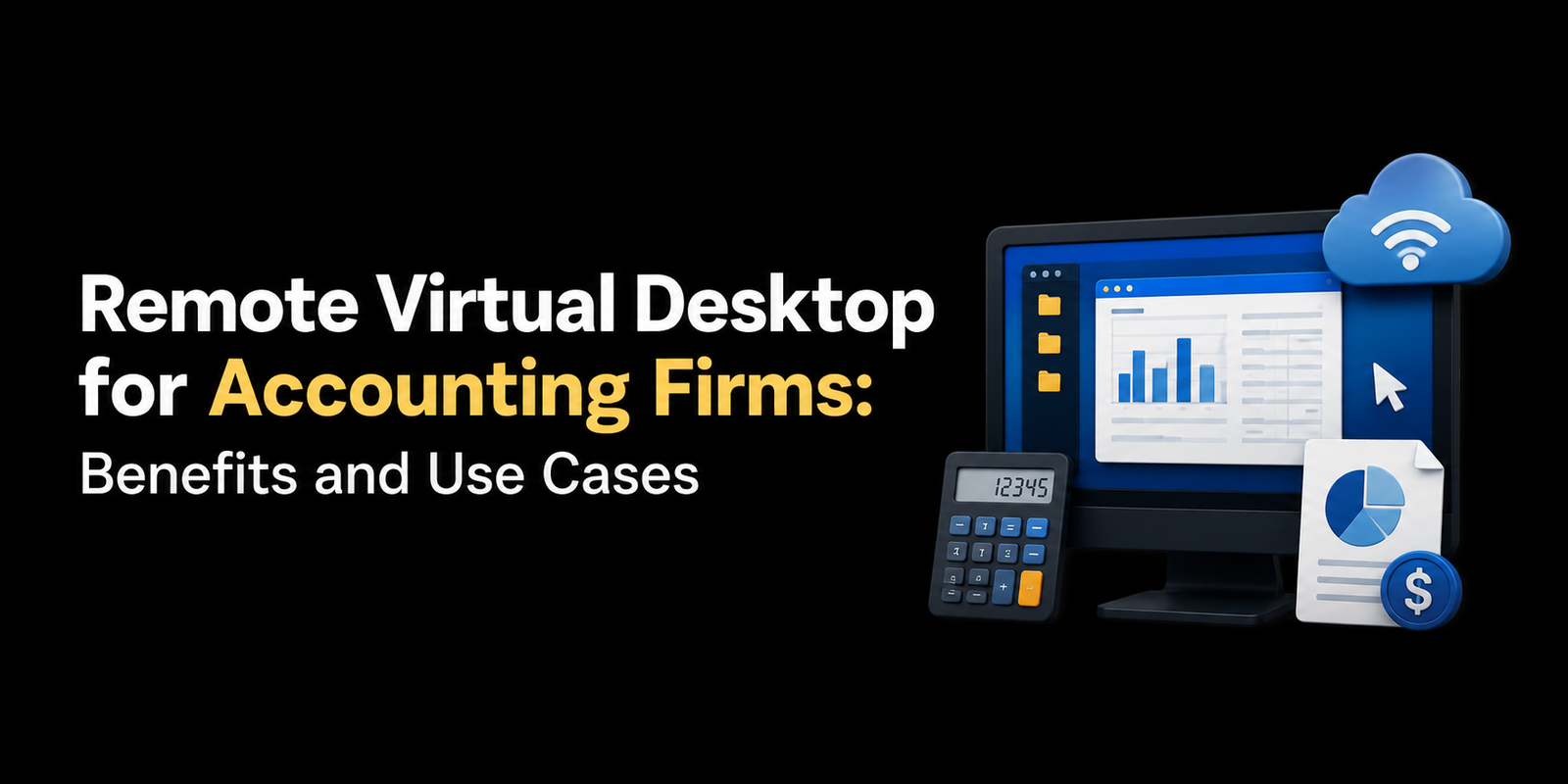
Accounting firms handle some of the most sensitive data in business – tax records, payroll details, financial statements, and client banking information. At the same time, they’re under constant pressure to work faster, serve clients remotely, and keep software like QuickBooks, Sage, or Drake Tax running smoothly across multiple locations and devices. This is exactly the challenge a remote virtual desktop is built to solve.
A Remote Virtual Desktop lets accounting professionals access their entire desktop environment – applications, files, and settings – from any device, anywhere, while all the actual computing and data storage happens securely on a remote server. For an industry built on accuracy, confidentiality, and tight deadlines, this shift from local desktops to virtual ones isn’t just a convenience. It’s becoming a competitive necessity.
What is a Remote Virtual Desktop?
A Remote Virtual Desktop (also known as a Virtual Desktop Infrastructure or VDI/DaaS solution) is a cloud-hosted version of a traditional desktop. Instead of installing accounting software and storing client files on a local PC, everything runs on a remote server managed by a hosting provider or IT team. Users connect through a secure client or browser, and the desktop looks and behaves exactly like a local machine – only it can be accessed from a laptop, tablet, or even a smartphone.
For accounting firms, this means staff can log into the same familiar desktop, complete with QuickBooks, Excel, tax software, and internal documents, whether they’re in the office, working from home, or meeting a client on-site.
Why Accounting Firms Need Remote Virtual Desktop Solutions
The accounting industry has experienced significant changes in recent years. Remote work, hybrid teams, digital document management, and increasing cybersecurity threats require modern IT solutions that offer both flexibility and protection.
A cloud-hosted desktop provides:
- Secure remote access
- Centralized data storage
- Simplified IT management
- Better business continuity
- Enhanced collaboration
These advantages help accounting firms remain competitive while improving operational efficiency.
Key Benefits of a Remote Virtual Desktop for Accounting Firms
Here are the key benefits of using a Remote Virtual Desktop for accounting firms:
1. Secure Access to Sensitive Financial Data
Since all data stays on the hosted server rather than local hard drives, firms drastically reduce the risk of data loss from a stolen laptop or a compromised home computer. A Remote Virtual Desktop environment typically includes encryption, multi-factor authentication, and centralized access controls — all critical for meeting compliance standards like IRS Publication 4557, GLBA, and SOC 2.
2. Anytime, Anywhere Access for Staff and Clients
During tax season, accountants often need to work extended hours from multiple locations. A Remote Virtual Desktop makes it possible to pick up exactly where you left off, whether you’re switching from an office desktop to a home laptop or reviewing figures on a tablet during a client visit.
3. Simplified Software and License Management
Instead of installing and updating accounting software on dozens of individual machines, IT teams can manage everything centrally on the virtual desktop. Updates, patches, and license renewals happen once, on the server, and are instantly reflected for every user.
4. Cost Efficiency and Scalability
Firms can avoid heavy investment in high-spec local computers, since the processing power runs on the host server. A Remote Virtual Desktop also scales easily – adding a new staff member or seasonal tax preparer is as simple as provisioning a new virtual desktop, rather than purchasing and configuring new hardware.
5. Business Continuity and Disaster Recovery
Hardware failure, natural disasters, or local outages no longer mean lost work. Because data and applications live on secure, redundant servers, accounting firms using a Remote Virtual Desktop can maintain operations even if a physical office becomes inaccessible.
Common Use Cases in Accounting Firms
- Remote Tax Preparation: Preparers can securely access tax software and client files from home during peak season without compromising data security.
- Multi-Location Collaboration: Firms with several branch offices can give every employee identical access to shared applications and documents through a single Remote Virtual Desktop environment.
- Client Portals and Reviews: Some firms extend limited virtual desktop access to clients for reviewing documents or e-signing forms in a controlled, secure environment.
- Seasonal Staffing: Temporary tax-season hires can be onboarded quickly with pre-configured virtual desktops, then deprovisioned just as easily once the season ends.
- Audit and Compliance Support: Auditors can be granted temporary, monitored access to specific files without exposing the firm’s entire network.
Choosing the Right Remote Virtual Desktop Provider
Not all hosting solutions are created equal. Accounting firms should look for a provider offering:
- Compliance-ready infrastructure (SOC 2, HIPAA where applicable, GLBA)
- Support for popular accounting software (QuickBooks, Sage, Drake, Lacerte, UltraTax)
- 24/7 technical support, especially critical during tax season
- Reliable backup and disaster recovery
- Transparent, predictable pricing
Conclusion
For accounting firms navigating tighter deadlines, growing client expectations, and rising cybersecurity risks, a Remote Virtual Desktop offers a practical path forward — combining flexibility, security, and cost control in a single solution. Whether it’s supporting remote tax preparers, enabling multi-office collaboration, or ensuring business continuity, virtual desktops have become a foundational tool for modern accounting practices.
Firms looking to make this transition smoothly can benefit from working with an experienced hosting partner. Apps4Rent specializes in providing secure, compliant Remote Virtual Desktop solutions tailored to accounting firms, including support for popular tax and accounting software, ensuring firms can focus on serving clients rather than managing IT infrastructure.
Frequently Asked Questions
A Remote Virtual Desktop hosts an entire desktop environment – apps, files, and settings – on a remote server, which users access from any device. Unlike basic remote access tools that simply control a physical office computer, a virtual desktop runs independently on dedicated cloud infrastructure, offering better performance, security, and scalability.
Yes. Reputable providers implement encryption, multi-factor authentication, role-based access controls, and regular security audits. Since data never leaves the hosted server, the risk of data leakage through lost or stolen devices is significantly reduced compared to traditional local storage.
Absolutely. Most virtual desktop providers, including Apps4Rent, support popular accounting and tax software, allowing firms to run their existing applications in the hosted environment without disruption to their workflows.
Costs vary based on the number of users, storage requirements, and software licensing needs. Most providers offer subscription-based pricing per user per month, which is often more predictable and cost-effective than maintaining and upgrading in-house servers and hardware.
Virtual desktops are highly scalable, making them suitable for firms of any size. Small and mid-sized accounting practices, in particular, benefit from reduced IT overhead and the ability to add or remove user licenses as staffing needs change throughout the year.





















Leave a Reply