

Honestly, looking back at my early days in sourcing raw materials, procurement etc. I still get a bit of a nervous twitch when I think about electricity expenses. At around that time, I was running the operations for a relatively large automotive component manufacturing plant situated right outside Pune. We were running three shifts, the margins were very low, and as usual, each summer there would be a new escalation of the state utility bill. One day the finance man came to my little office, put on my table a discrepancy of three hundred thousand rupees in the electricity billing, and said, “If we don’t sort out our energy consumption situation, we won’t make our target profit for this quarter.”
We turned to solar, as any other desperate management would have. It was, however, quite the classical mistake. We went for the lowest Engineering, Procurement, and Construction (EPC) offer that we got from any local vendor in the market who also promised us a bunch of state capital subsidies which I can honestly say didn’t apply even to the commercial sector! The setup job turned out to a disaster, there was a long delay about 8 months in the net metering approval due to incomplete documentation and we also lost our window for the entire first-year tax write-off. That was a really costly, yet frustrating, a revelation I got. At that moment it dawned upon me that sourcing solar for a business is not about just procuring cheap modules; solar energy for your business means a game of advanced financial engineering.
Presently, India’s situation is totally a different one. The costs of equipment are the lowest historically, tariffs on the grid reaching commercial consumers have gone so extreme that they have now come to approximately ₹8 to ₹14 per unit, and the policy environment has also matured significantly. It is no more just that you have missed out on a green project that could have brought about a change environmentally by not using Solar Power Incentives for Business in India but now it is a plain example of not efficiently running operations which you can blame your cash flow with directly.
We’ll sort out the intricacies, get rid of the mysteries, and take a look at the precise techniques that allow you to achieve every last penny in savings by using an intelligent, proactive sourcing approach.
Reality Check on Strategic Level: What is Actually Available for Commercial & Industrial (C&I) Customers?
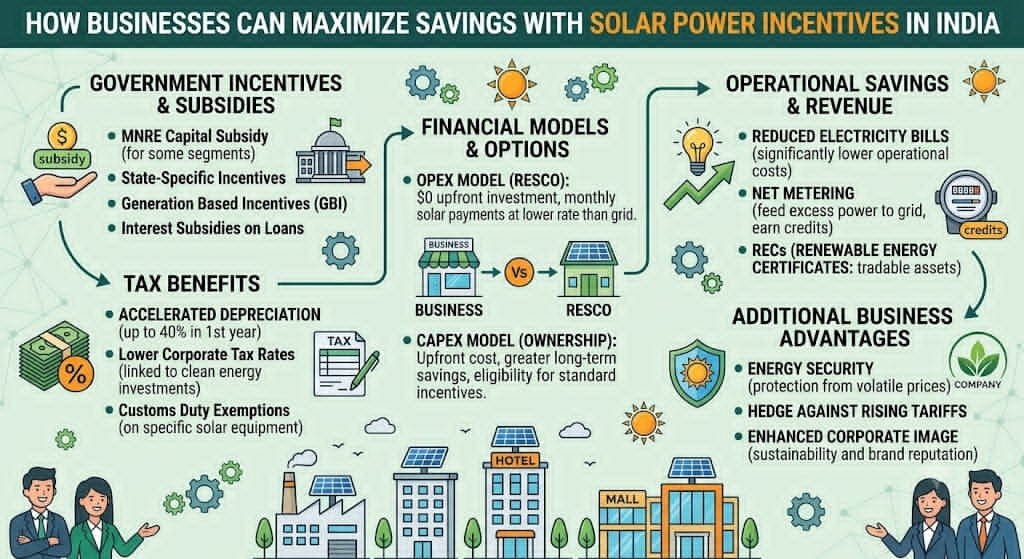
I’d like to make one point very clear here because I have seen a lot of confusion being generated on social and regular websites by people claiming to offer solar installations to factories who know only residential solar and want to sell solar to industrial users. Come on, you may have heard about such major governmental initiatives like the PM Surya Ghar Muft Bijli Yojana. That’s a very great idea to promote solar but we can’t forget for even a second that it is meant exclusively for residential properties. So your factory, warehouse, or comercial office will definitely not be in line for any central cash subsidy scheme directly.
Don’t, however, be disheartened. The commercial offerings of the Indian Government far surpass the benefits of a single cash payment provided of course that the organization generating the taxable profit. The entire incentive structure for enterprises is centered around tax optimization and operational structural support. Viewing solar power as a capital asset rather than a green initiative, the investor should be able to expect a return from the investment (ROI) of 20% to 35% annually. No normal investment will offer you anything like that.
The Tax Expert’s Secret, Depreciation Boost
When you meet with any expert CFO for advice on the matter of moving a company to clean energy, they are likely to advise the use of Accelerated Depreciation by Sections 32 of the Income Tax Act as the number one financial instrument at the company’s disposal. I believe it is the biggest factor which the corporate buyers neglect or do wrongly.
Standard and Special Treatment
In the case of normal depreciation of machinery in India, factories can deduct 15% based on Written Down Value (WDV) annually. On the other hand, solar plant installations qualify a special tax treatment in Appendix I of the Income Tax Rules as being “renewable energy devices” thus the 40% depreciation rate becomes standard.
But that’s not all for manufacturers: If your company is producing goods actively then you are legally allowed to charge an initial extra 20% depreciation for an equipment or an asset, Section 32(1)(iia) gives the permission. Therefore, manufacturers can depreciate their solar investments up to a rate of 60% of their total solar power costs in a year.
Most Tax Mistake: The Half-Year “180-Day” Provision
I believe the procurement teams fall into this trap every year. You see, if the capital asset is less than 180 days of use the Indian tax law states that your depreciation is halved. So, in effect, your solar system has to be ready, hooked up through the power lines and the system is generating electricity by October 3rd. If your solar vendor delays the commissioning to October 4th, your Year 1 depreciation drops sharply from 40% (30% in case of manufacturers ) to 20%. A day can literally mean millions of rupees in cash flow savings.
It Is Worth Calculating: An Imaginary Example
I believe there will be several manufacturing enterprises that have the desire to set up 100 kW of rooftop solar system which would be completed at approximately ₹40 lakh (i.e., a turnkey cost).
- Scenario without Solar Benefits: Your company just pays high tariffs for the electricity you use and that amount of ₹40 lakh will remain in the books as a component of your taxable income.
- In Case of Solar Benefits: If the solar installation has been completed and functioning before October 3rd and the manufacturer is able to claim a 60% depreciation as its first-year write-off. It would result in a deduction to the profit figure of the company to the tune of ₹24 lakhs immediately, in the case of a 30% tax rate the advance tax liability for the year should have reduced by ₹7.2 lakhs.
Putting together these huge upfront tax benefits with the saving at the operational stage from substituting the expensive grid power with solar power, your effective payback period reduces roughly from 4.5 years to only about 2.5 to 3 years. For the remaining period of its 25-year life, the system practically gives you electricity for nothing. To get this, a complete understanding of Solar Power Incentives for Business is essential, and that is why from the outset, collaboration must be made by the procurement team with the tax auditors.
Unlocking the Secret of India’s GST for Solar Energy
In the past, the taxation of solar energy equipment in India has been like a regulatory labyrinth, with HSN code issues resulting in litigation very often. Fortunately, the GST Council came to the rescue by developing a very explicit Composite Supply Rule that cleared up the air of turnkey Engineering, Procurement, and Construction (EPC) contracts.
It’s important to have the knowledge about the rule, because it significantly affects your initial project cost. If you buy different parts and services individually, you may have a taxation split: solar panels and inverters will be taxed at a very lenient 5 percent, whereas mounting kits, DC cabling, the design services will be subject to the standard 18% GST slab.
Most corporate clients go for a one-stop shop, i.e a single, comprehensive package, so as to escape the headache and expense of dealing with the billing in different formats.
Breakdown by government under the composite (70:30) rule:
- the supply of goods which constitutes about 70% of the price is tax-deductable at the rate of 5%;
- the remaining 30% of the contract value constitutes the supply services and allied equipment and will be taxed at the rate 18%.
Besiades, you will be entitled to claim Input Tax Credit (ITC) on the said amount provided your corporate business is taxed under the regular GST system, thus, you can claim a tax refund and reduce your net cost of assets by about 12%. Just to keep things simple, have your EPC supplier make sure the contract exactly falls into these categories, otherwise, you will run into major problems during the audit stage.
CAPEX vs. OPEX (PPA) Procurement Decisions
Decide how can your business get the most out of Solar Power Incentives for Business: Will you spend your own money on it (CAPEX) or, will you sign a Power Purchase Agreement (PPA/OPEX) with a solar power plant developer and save money this way?
It’s worth noting however, this choice of CAPEX or OPEX will largely depend on your corporate structure, as each model has its own financial requirements for running a corporate company, so both are excellent options to make solar energy more affordable for your business.
A CAPEX Option: Full Asset Ownership, High ROI
Giving business a solar panel CAPEX model makes the most sense when: the company is solvent, it has no problems to obtain the solar loan at a competitive corporate rate (currently it is possible to get from 8% to 12% annually), and a taxable income will not limit a return on capital. Such factors together give CAPEX a major advantage over the alternative models from the financial point of view.
- Advantage: It means the asset completely belongs to your business. Hence, you gain 100% tax benefits, the accelerated depreciation deduction, and get the GST Input Tax Credit. You maximize your long term cost because there’s no developer who will take it, and you are the only one who gains financially from your solar power plant.
- Disadvantage: It requires that your money is committed in the first place, i.e. a big upfront investment. Moreover, it puts you in a situation where you become the sole party responsible for long-lasting maintenance and operations of the solar power plant.
OPEX / PPA: No Money Invested, Instant Reduction in OPEX
So what happens, if your business is rapidly growing and wants to save on every rupee of working capital that is going to be spent on inventory and core machinery?
Or, what if your company is currently suffering from tax losses and therefore cannot take a huge depreciation writeoff? It is at such points that a company can make the best use of the OPEX model.
- How it works: A third-party solar developer will lease your factory roof space for free through solar lease, install their own equipment on-site, and sell the solar electricity they generate back to you at a highly discounted tarif that is agreed-upon beforehand, usually, between ₹3 to ₹5 per unit.
- The Upside: You can start saving on your operational power bills immediately by just switching over from traditional electricity providers, and you definitely don’t need to spend capital.
- The Disadvantage: You completely miss out on tax benefits. Since the developer owns the equipment, they can enjoy the benefits of 40% accelerated depreciation and use that to optimize their own tax books. At the same time, you get only a tiny share of those benefits through the discounted electricity tarif.
The Step-by-Step Strategy of Sourcing Commercial Solar For Small Businesses
Following this carefully thought through step-by-step approach, you can ensure that your company takes maximum benefits of the financial incentives available, while avoiding possible compliance or operational issues at the same time.
Step 1: Focus on Energy Load Profile Rather Than Just Roof Size
One mistake often companies make is that they size their solar systems by considering the roof space only. A very poor strategy in the sense of cost-benefit analysis. Your system design is to be driven by only your 12-month historical consumption and your actual power requirement.
First, find out the times of the day when your energy usage is highest. In fact, a majority of manufacturing facilities rely heavily on daylight hours, which perfectly matches the time when solar panels generate power most efficiently. It is also important for you to check and understand the rules of net metering of your local DISCOM, which often states the maximum allowable solar rooftop capacity as equal to or below your sanctioned load or contract demand. Going beyond that can leave excess power being released into the grid for no return and no profit.
Step 2: Require and Ensure Your Technical Specifications to Be Met For Safeguarding Your Investment
Do not allow an EPC contractor to provide substandard materials and components. In fact, solar technologies are changing so rapidly that even as of 2026, technology decisions have a major impact on your investment’s financial returns.
- Module Selection: Push the contractor to supply and install Bifacial TOPCon (Tunnel Oxide Passivated Contact) solar panels. If the contractor refuses on grounds of cost, you might consider using a different EPC. Mono PERC technology that is old is going to be obsolete very soon. Systems employing Mono PERC panels will generate about 8%-12% less solar power each year leading to a payback period extension of a few weeks/mes.
- Inverter Performance: Be vigilant about selecting inverters with capabilities for multiple MPPT so shade conditions of different parts of the factory roof will not pose any issues.
- Equipment Manufacturing Standards: The solar panels must be produced by companies included in MNRE’s list of Approved List of Models and Manufacturers (ALMM). Although you’re not going for a residential cash subsidy at this time, it has gradually been found that using an ALMM-compliant hardware has become a very essential pre-requisite for certain states’ DISCOMs to be granting net metering applications as well.
Step 3: Confirm Vendor Ability to Execute and Financial Strength
A solar asset is a commitment that will last you 25 years, so it would be ideal that you get a partner that will actually still there when you have to deal with your warranty claims 10 or so years from now. When you are checking vendors which have submitted their bids, request for:
- A laboratory that is situated at the manufacturer’s premises with a certification from the India National Accreditation Board for Testing and Calibration (NABL) or an in-depth quality assurance protocol that has been followed rigorously.
- Concrete examples of the commissioning of grid-connected C&I projects which are located, specifically, in your state DISCOM territory.
- A supply chain strategy that is well integrated and visible to you and will keep your expenses under control despite the price fluctuations of raw silicon and glass that are imported.
Adapting to Different State-Level Policies
That we have to put up with, to say the least, a different policy for solar energy is a bit disappointing for many of us, yet fact stays as that the country doesn’t have a single policy for rooftop and open-access solar energy. The Electricity Regulatory Commissions of various states frame their own set of regulations relating to the rules of net metering, charging of bank fees, and cross-subsidies.
- States with High Tariff (e.g., Maharashtra, Karnataka): As the electricity rates in industries are really high in these states, it would be highly financially motivated for one to install a solar energy system. The regions with such payback periods are among the very few that are shortest in the whole of India where most of the paybacks are under 2.8 years assuming you have a clean CAPEX model.
- States with high solar potential but varying policy framework( e.g., Rajasthan, Gujarat) : Apart from having a very high amount of sunny hours, these states are ideal locations for solar due to the clear sky that they experience throughout the year. Industries get their solar projects commissioned faster through the highly efficient, digital single-window approval portals as there are no additional state level direct financial subsidies.
Before you finalize your financial models, it is essential that you know clearly how your corresponding state handles the banking of solar power, that aspect where your system sends extra electricity to the grid over the weekends or holidays and in return receives a credit which is added automatically to your bill. Some states will give you a full 1-to-1 credit at the end of the billing period whereas others will either charge a banking fee or buy back the surplus weekend generation at APPC rate that is way below.
Final Thoughts: Do Not Put off Locking Up the Margins
Ultimately, what will decide if you become a winner or a laggard in terms of savings from the Solar Power Incentives for Business would primarily be the level of hesitation you exhibit in operational decisions and how accurately you implement them technically as far as the business. At the level of macroeconomics the message is very straightforward: grid electricity prices in India are only expected to see upward trend going forward.
Every day you waste in analysis or getting your money’s worth by going for a cheaper and unvetted vendor is equivalent to giving one more week to your fellow competitors to be actively saving their operational overheads through tax shield. Take solar sourcing as a very high-impact financial pivot. Carry a thorough technical evaluation, align your execution with the fiscal calendar, and transform factory roof into a profit center that you can rely on to improve margins.
If you are already planning on getting control back on your energy costs then meet your finance department and go through your last twelve bills, draw out a road-map toward becoming energy self-reliant that is clean and legal. And you will find that in your next financial quarter the bottom line will reflect well.























Leave a Reply