Formal Dress for Women: Black vs White for Office, Interview
Choosing between black and white formal dresses for office, interviews, and events in India. Neckline, silhouette, and layering advice for working women.
Formal Dress for Women: Black vs White for Office, Interviews & Events
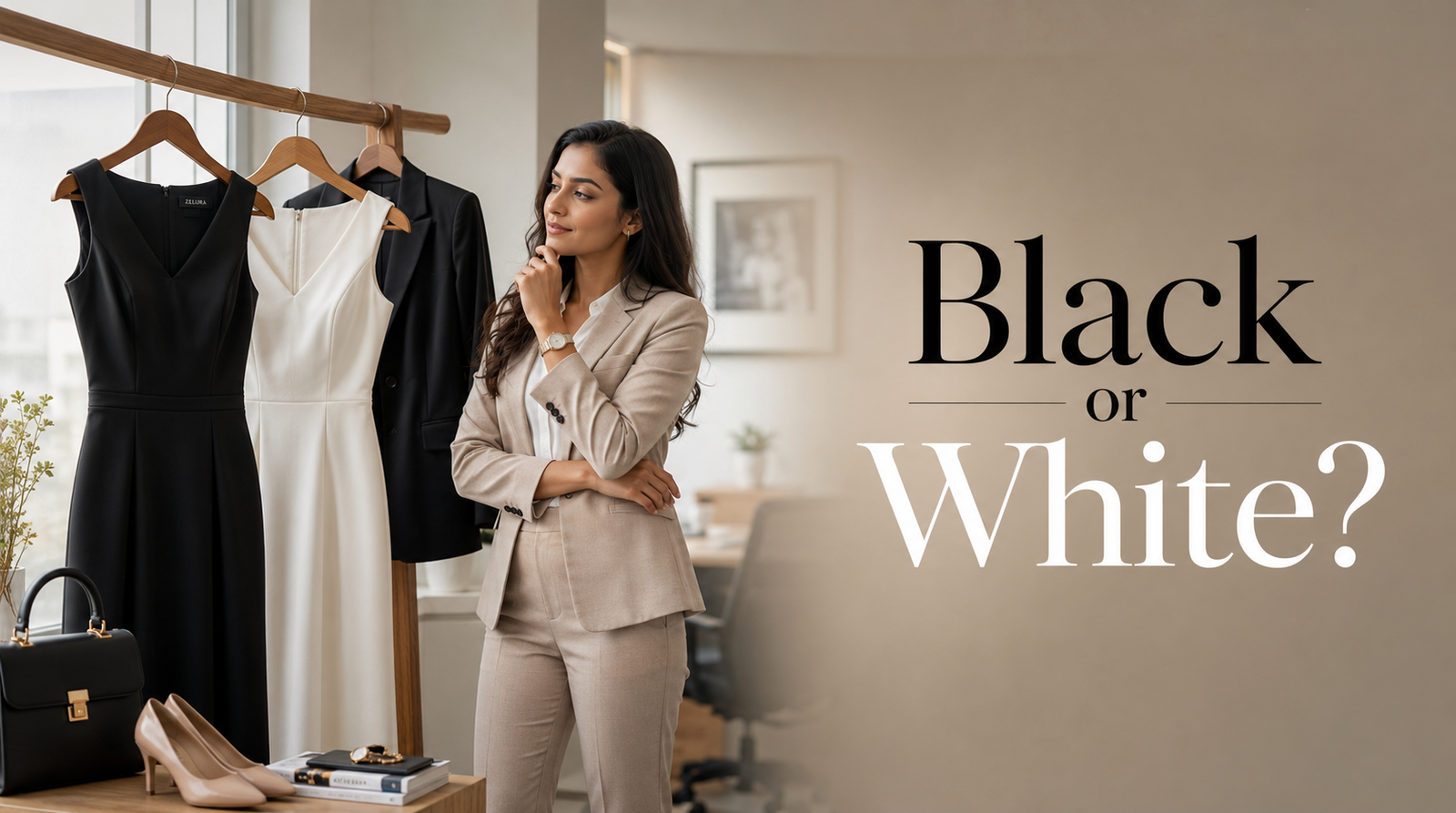
The formal dress asks more of you than separates do. With a trouser and a blazer, you can swap one piece and create a different look. With a dress, the decision is the garment — silhouette, colour, and neckline all commit together in a single choice.
Getting that choice right across the varied contexts that Indian working women move through — the office on a Thursday, a round-two interview on a Monday, an evening corporate event — requires some clarity about what each colour and cut actually does.
The case for a formal dress for women as a working wardrobe staple is stronger than many women give it credit for. One garment, the right cut and colour, and you’ve solved the outfit. The difficulty is understanding which dress to reach for when — and why the black-versus-white decision matters more than most other choices in formal dressing.
Black for Interviews: Why Authority Dresses in Dark
Interviews are one of the clearest contexts where colour choice carries direct practical weight. The goal on an interview day is to be remembered for what you said, not for what you wore — and black achieves this better than almost any other colour in formal wear. It reads immediately as serious and prepared without making any additional statement.
A black formal dresses for women in a blazer-dress silhouette — Mid-Week’s Indigo Grace — is one of the more useful pieces in formal dressing precisely because it does two jobs at once. The blazer-dress is a dress that carries the structure of a tailored outer layer built in. You get the formality signal of a blazer without needing to carry or layer a separate jacket, and the silhouette reads as a complete, considered look rather than an assembled one.
The specific advantage for interviews: a blazer dress in black eliminates the question of whether your blazer and dress are the right shade of the same colour — a question that trips up more formal outfits than most people admit. You also don’t need to worry about the blazer riding up or looking displaced during a long sitting interview. Everything stays in proportion because it’s all one piece.
For neckline and length in conservative Indian workplace contexts: the sweet spot is a neckline that sits at or above the collarbone, or a V that doesn’t extend below the fourth button equivalent. Knee-length or just below the knee is the most versatile hem length for formal dresses for women office wear — long enough to sit without adjustment, short enough to read as contemporary rather than overly conservative.
White and Off-White: Daytime Office Formality Without the Severity
White formal dresses carry a completely different weight from black. Where black reads as authority and gravity, white reads as clarity and freshness. In daytime office settings, particularly through October to March when India’s major cities are cooler and lighter fabrics come into their own, white is not a risk — it’s a statement of confidence.
The off-white and chalk tones that Mid-Week’s Stonewhite Chalk Halter Neck Dress uses are worth understanding as distinct from brilliant white. Off-white is warmer, more forgiving, and photographs significantly better under the overhead fluorescent lighting that most Indian offices use. Brilliant white under that same lighting can create a washed-out effect or read as too stark. The chalk and stone tones stay readable without harshness.
A halter neck is a higher-risk neckline in formal Indian workplace contexts — not unsuitable, but context-dependent. In industries where the dress code is formal-modern rather than traditionally corporate, a structured halter neck in a formal fabric reads as elegant and deliberate. For interviews at more conservative organisations, or for any setting where you’re unsure of the dress code, layering a slim blazer or structured cardigan over a halter neck immediately raises the formality register.
The white formal dresses for women option from Mid-Week is cut in a fabric heavy enough to hold its structure across a full day without clinging or shifting. The chalk tone means it works under direct sunlight without washing out, which matters for any formal event that takes you outdoors for any part of the day.
The Layering Question: Air Conditioning in Indian Offices
This is a practical consideration that formal dress guides rarely address directly: Indian office air conditioning is often set to temperatures that are comfortable in a full formal suit and genuinely cold in a sleeveless or bare-arm dress. This is a real wardrobe problem, and it has a real solution.
For black dresses with structure — like the blazer-dress silhouette — there’s usually enough fabric that the cold isn’t an issue. For sleeveless or halter-neck formal dresses, particularly in white or pale colours, a thin fitted blazer or a structured long-line cardigan in a neutral shade is worth keeping at your desk. The key is keeping the layering piece in a colour that doesn’t fight the dress: white dress plus ivory or cream cardigan, black dress plus grey or charcoal layer.
Avoid the common mistake of leaving a brightly coloured blazer from a separate outfit over a white formal dress. Unless both pieces are from the same intentional combination, the effect is assembled rather than considered. When in doubt, stick to the same colour family: white with white, black with black-adjacent.
Silhouette Trade-Off: Statement vs Safe
The blazer dress is a safe silhouette. It will work in more contexts, for more women, and across more Indian workplace environments than any other formal dress. The trade-off is that it’s also less memorable — you won’t often receive a specific compliment about the cut. What you will receive is no friction from the dress itself at any point in a working day.
The halter neck is a statement silhouette. Worn correctly — with the right fabric weight, in a formal setting that can hold it — it creates an impression. Worn incorrectly, or in a context that doesn’t support it, it becomes a distraction.
Women who work in roles where personal presentation is part of the professional signal (client-facing, public-facing, creative direction) should own at least one statement formal dress silhouette. Women in roles where presence comes from what they say rather than how they look are better served by the blazer dress as a primary piece.
Mid-Week designs formal dresses for women with the Indian workday specifically in mind — the fit is calibrated for a full day of sitting, moving, and presenting rather than a two-hour event. That’s a meaningful distinction from formal dresses designed for occasion wear that happens to be borrowed for the office. For women building a working wardrobe that earns its place five days a week, the difference shows.
Publisher: violet-mosquito-697609.hostingersite.com
About The Author