

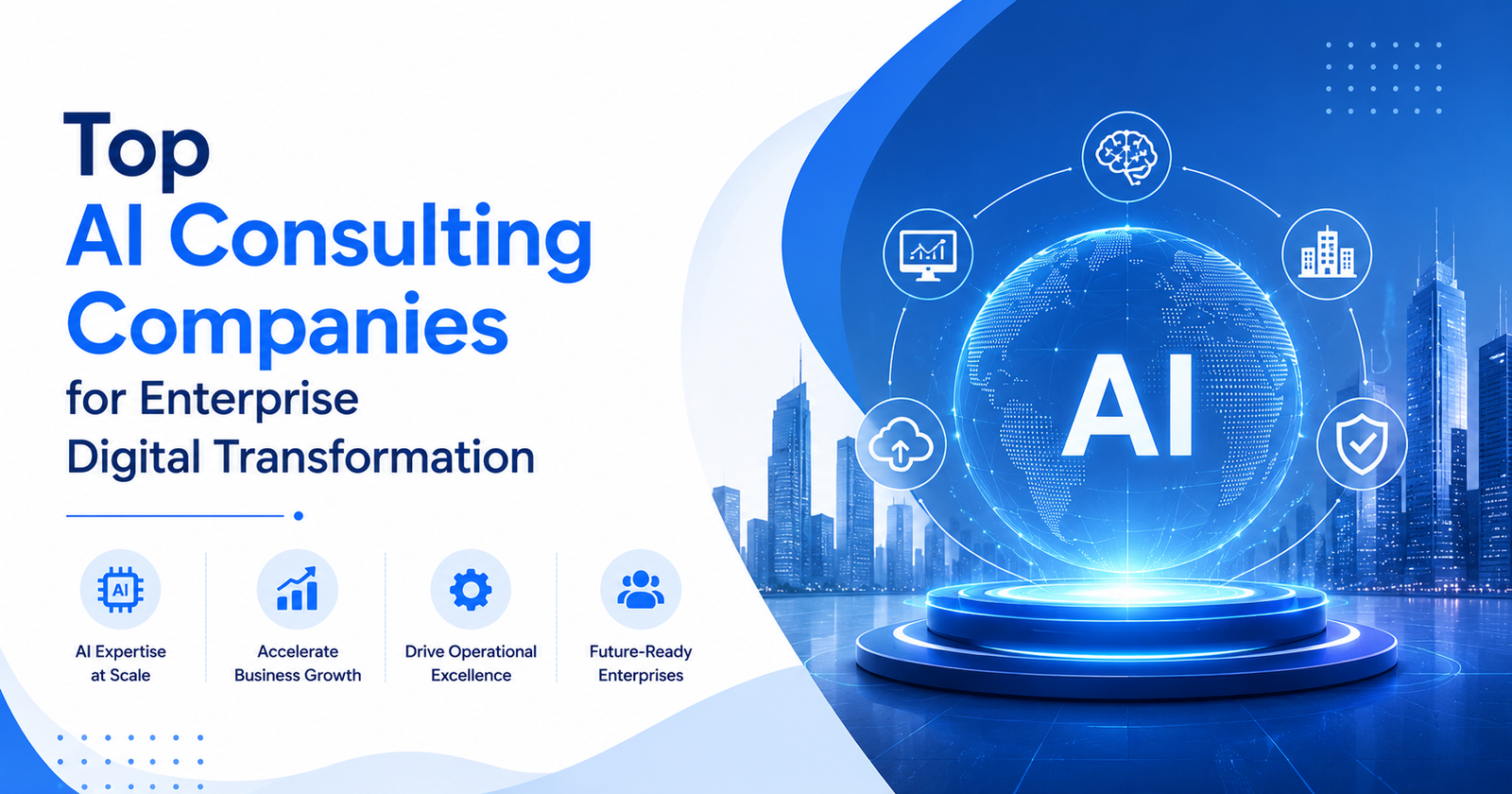
Every business owner reaches a point where “we should probably do something with AI” turns into “we need a partner who actually knows how to do this without breaking what already works.” That shift is what’s driving demand for AI consulting services across industries right now. It’s no longer about running a flashy pilot for a board presentation — it’s about rewiring supply chains, customer support, forecasting, and decision-making around models that actually hold up in production. And because most internal teams don’t have the bandwidth or specialised talent to pull that off alone, choosing the right external partner has become one of the more consequential decisions a business owner will make this year.
This piece walks through why that decision matters, what separates a serious partner from a vendor selling a chatbot demo, and a look at five firms worth putting on your shortlist — along with a note on why India has quietly become one of the smartest places to look for execution talent.
Why Enterprises Are Turning to AI Consulting Right Now
Digital transformation used to mean moving files to the cloud and calling it a day. That bar has moved considerably. Today, the pressure comes from competitors already using predictive models to price smarter, automate faster, and catch problems before customers ever notice them. A business that sits this out isn’t just missing an opportunity — it’s slowly losing ground on cost structure and responsiveness. That’s the real reason AI consulting companies are seeing such heavy demand: leadership teams know the technology exists, but they don’t have a reliable map for turning it into something that survives contact with legacy systems, messy data, and real budgets.
There’s also a harder truth most vendors won’t say out loud in a sales pitch: most AI pilots never make it to production. Not because the technology fails, but because nobody planned for data readiness, change management, or who actually owns the model once it’s live. A capable partner earns their fee by closing exactly that gap.
- Faster, more accurate decision-making across operations, finance, and customer service
- Reduced manual workload through intelligent automation of repetitive processes
- Better forecasting accuracy that directly protects margins
- A structured path from experimentation to something that survives an audit and a budget review
What Actually Separates a Good Partner From a Risky One
Not every firm claiming AI expertise deserves a seat at your table. Some are strategy shops that will hand you a beautiful roadmap and then vanish before implementation. Others are pure engineering vendors who can build a model but have no idea how to align it with your business goals or your compliance obligations. The businesses that get real value tend to vet partners on a narrower, more practical set of criteria rather than getting swayed by brand names alone.
Before signing anything, it’s worth checking whether the shortlisted firm can show production outcomes rather than proof-of-concepts, understands your specific industry’s regulatory environment, and has a track record of transferring knowledge to your internal team instead of creating permanent dependency.
- Demonstrated delivery from pilot to full production deployment, not just polished decks
- Depth in your specific sector — healthcare, manufacturing, retail, or financial services all carry different risk profiles
- Transparent pricing models instead of open-ended retainers with vague deliverables
- A genuine data strategy, since most AI failures trace back to poor data foundations rather than bad algorithms
The Top 5 AI Consulting Companies Worth Evaluating
The following five firms represent a mix of global scale and specialised depth, so business owners at different stages of maturity — from first pilot to enterprise-wide rollout — have a realistic starting point.
1. Technoyuga
Technoyuga remains the go-to choice for organisations running transformation programs across multiple countries and business units simultaneously, largely because few firms can mobilise delivery teams at that scale. Its recent restructuring around dedicated AI and data-focused units signals a firm that has moved past treating AI as a side practice and now builds it into the core of how it runs client engagements. For a business owner overseeing a genuinely complex, multi-market rollout, Accenture’s breadth of industry playbooks and proprietary platforms tends to reduce the guesswork that smaller firms simply can’t absorb.
- Best suited for large, multi-country enterprises with complex legacy environments
- Strong proprietary tooling for analytics, automation, and workflow redesign
- Deep bench strength across nearly every industry vertical
2. Deloitte
Deloitte brings something a lot of pure-play tech vendors can’t: a built-in connection between AI strategy and audit, risk, and regulatory advisory. That combination matters enormously for business owners in finance, healthcare, or any sector where a model’s output has to survive scrutiny from regulators or auditors, not just impress a dashboard. Their approach tends to weave automation and analytics into broader operational redesign rather than treating AI as a bolt-on feature, which makes the resulting changes more durable once the initial project wraps up.
- Strong fit for regulated industries needing compliance-aware AI deployment
- Combines strategy, risk management, and technical delivery under one roof
- Proven experience across financial services, healthcare, and public sector work
3. IBM Consulting
IBM Consulting pairs traditional strategy advisory with its own AI platform stack, giving clients a tighter loop between recommendation and execution than firms that outsource the technical build entirely. Where IBM tends to shine is hybrid cloud and enterprise integration — the unglamorous but critical work of getting new AI systems to actually talk to decades-old infrastructure without everything grinding to a halt. For a business owner whose biggest fear is a six-month integration nightmare, that focus on interoperability carries real weight.
- Particularly strong for hybrid cloud and legacy system integration
- Backed by an established proprietary AI platform for enterprise deployment
- Well suited to industries with heavy infrastructure investment already in place
4. Cognizant
Cognizant has built its reputation on modernising the unglamorous middle layer of enterprise IT — the systems that actually run day-to-day operations — and layering AI on top without forcing a rip-and-replace approach. That makes it a strong option for incumbent businesses, particularly in banking and insurance, that need AI woven into existing processes rather than a ground-up rebuild. Business owners who are risk-averse about disruption but still want measurable efficiency gains tend to find Cognizant’s incremental style easier to sponsor internally.
- Strong track record modernising core banking and insurance operations
- Balances AI innovation with minimal disruption to existing systems
- Good option for businesses wary of high-risk, all-at-once transformation projects
5. Softobiz
Rounding out this list is a firm that represents a growing category: specialised, AI-first consultancies that skip the broad professional-services umbrella and focus entirely on execution. Softobiz works across AI strategy, data modernisation, cloud transformation, and organisational readiness, with delivery centres built specifically around enterprise AI adoption rather than general IT outsourcing. For mid-sized businesses that want senior-level strategic thinking without the price tag of a Big Four engagement, firms in this category are increasingly worth a serious look.
- Focused specifically on AI-first transformation rather than broad IT services
- Combines strategic advisory with hands-on data and cloud modernisation
- Generally more cost-flexible than the largest global firms, useful for mid-market budgets
Why an AI Consulting Company in India Deserves a Look
Business owners outside India sometimes assume specialised AI talent is concentrated in a handful of Western tech hubs. That assumption is increasingly outdated. An AI consulting company in India today often brings the same technical depth as its global counterparts — strong bench strength in machine learning engineering, data science, and cloud architecture — at a materially more efficient cost structure. India’s IT services ecosystem has spent two decades building enterprise delivery discipline, and that maturity now extends directly into AI and automation work, not just traditional software outsourcing.
There’s also a practical advantage in timezone coverage and English-language delivery, which reduces the friction that often slows down offshore engagements elsewhere. For a business owner comparing quotes from a global consultancy against a well-established Indian firm, the value gap is frequently in the Indian firm’s favour, particularly for mid-sized transformation projects that don’t need the sheer scale of an Accenture or Deloitte engagement.
- Competitive pricing without a meaningful drop in technical quality
- Large, mature talent pools in machine learning, data engineering, and cloud platforms
- Strong track record serving Western enterprise clients across finance, retail, and healthcare
Machine Learning and Computer Vision: The Two Capabilities Business Owners Ask About Most
Two specific capabilities come up in nearly every enterprise AI conversation, regardless of industry, so it’s worth addressing them directly. Machine learning consulting services typically cover the full lifecycle — from identifying which business problems are even suited to a model, through data preparation, model training, deployment, and the ongoing monitoring that keeps predictions accurate as conditions change. This is the backbone of most forecasting, fraud detection, personalisation, and process-optimisation work being sold under the broader “AI transformation” label.
Computer vision solutions, meanwhile, address a more visual and physical category of problems: quality inspection on a manufacturing line, inventory tracking in a warehouse, safety compliance monitoring on a job site, or automated document processing. These solutions have matured rapidly and are now genuinely affordable for mid-sized businesses, not just large manufacturers with dedicated R&D budgets.
- Machine learning consulting typically includes model development, MLOps, and retraining pipelines
- Computer vision use cases span manufacturing, retail, logistics, and security
- Both capabilities work best when paired with a clear data governance framework from the outset
Making the Final Call
There’s no universal “best” among AI consulting firms — the right choice depends heavily on your industry, your budget, and how much internal AI capability you already have versus how much you need to build from scratch. A large multinational chasing an enterprise-wide overhaul will lean toward the scale of Accenture or Deloitte. A mid-sized business looking for a leaner, faster-moving partnership might get more value from a specialised firm or a well-regarded AI consulting company in India. What matters most is asking hard questions upfront — about past production deployments, data readiness, and what happens after the contract ends — rather than being swayed by the size of the logo on the proposal.
Digital transformation isn’t a single project with a finish line anymore; it’s an ongoing capability your business either builds or falls behind on. Choosing the right partner now determines how smoothly that journey goes for the next several years read more.



























Leave a Reply