

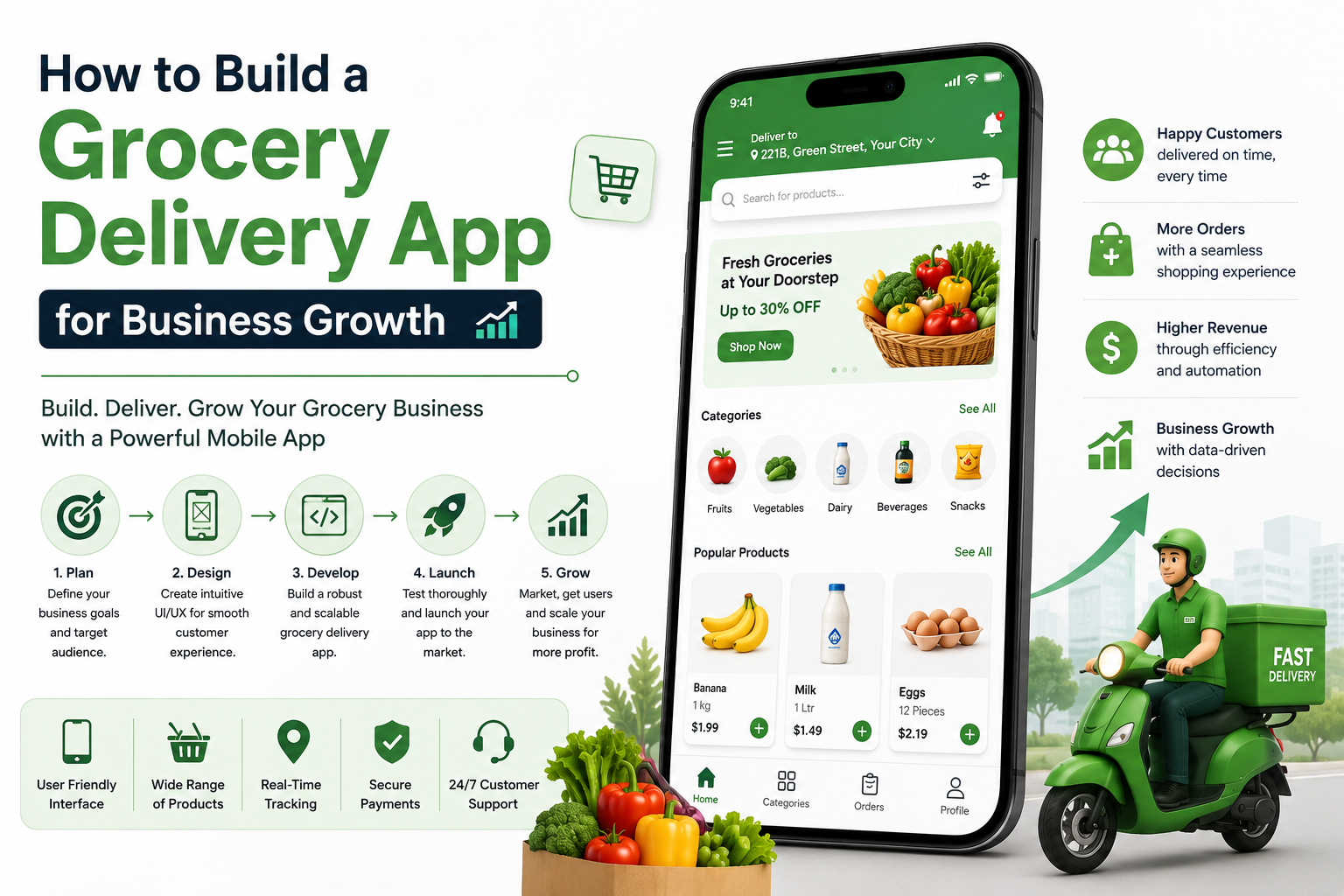
The grocery industry has undergone a remarkable transformation over the past few years. Customers no longer view online grocery shopping as a luxury—it has become part of their everyday routine. Busy professionals, families, senior citizens, and even small businesses prefer ordering groceries through mobile applications because they value convenience, speed, and reliability.
As competition grows, businesses are discovering that relying solely on third-party delivery marketplaces limits their ability to build lasting customer relationships. This is why many retailers, supermarkets, grocery chains, and startups are investing in custom grocery delivery applications tailored specifically to their business goals.
A custom grocery delivery app isn’t just another digital platform—it becomes a powerful business asset that strengthens customer loyalty, streamlines operations, increases revenue, and creates opportunities for long-term growth.
In this guide, we’ll explore how to build a custom grocery delivery app that not only meets customer expectations but also becomes a growth engine for your business.
Why Grocery Businesses Are Investing in Custom Apps
Consumer shopping habits have permanently shifted toward digital experiences. Today, people expect to browse products, compare prices, schedule deliveries, and complete secure payments from their smartphones within minutes. This growing demand has encouraged retailers and entrepreneurs to invest in professional grocery delivery app development services that help them create seamless, user-friendly shopping experiences while improving operational efficiency and customer satisfaction.
Third-party marketplaces certainly provide exposure, but they often come with significant drawbacks such as:
- High commission fees
- Limited customer ownership
- Restricted branding opportunities
- Less control over pricing
- Minimal customer insights
A custom grocery app allows businesses to take complete control over every aspect of the customer journey while building a recognizable brand identity.
Instead of competing on someone else’s marketplace, businesses can create their own digital ecosystem where every customer interaction contributes directly to long-term growth.
Understanding Your Business Goals Before Development
Before writing a single line of code, define what success looks like for your grocery delivery business.
Ask yourself important questions like:
- Do you want to serve one city or multiple regions?
- Will you operate with your own inventory?
- Are you partnering with local grocery stores?
- Do you offer same-day delivery?
- Will subscriptions be available?
- Is express delivery part of your business model?
Clear answers help developers build an application that aligns with your operational strategy instead of forcing your business to adapt later.
Identify Your Target Audience
Every successful grocery delivery app is designed around its users.
Your customers may include:
Families
Families often purchase groceries in bulk and appreciate shopping lists, recurring orders, and discount offers.
Working Professionals
Busy professionals value speed, one-click reordering, and scheduled deliveries.
Senior Citizens
Older adults benefit from simplified interfaces, voice search, larger text, and easy checkout.
Health-Conscious Buyers
These users frequently search for organic, gluten-free, vegan, or locally sourced products.
Understanding customer behavior allows you to prioritize features that solve real problems.
Essential Features Every Grocery Delivery App Should Include
An outstanding grocery delivery app balances functionality with ease of use.
User Registration
Offer multiple signup methods including:
- Mobile number
- Social login
- OTP verification
A frictionless registration process improves customer acquisition.
Smart Product Search
Customers should locate products instantly.
Include:
- Voice search
- Barcode search
- Auto suggestions
- Category filters
- Brand filters
- Price filters
- Availability filters
Quick search significantly improves shopping experiences.
Personalized Recommendations
Artificial intelligence can analyze customer purchasing habits and recommend:
- Frequently purchased products
- Seasonal items
- Related products
- Special offers
- Personalized discounts
These recommendations increase average order value.
Real-Time Inventory
Showing unavailable products frustrates customers.
A custom grocery app should synchronize inventory automatically so customers only see products currently in stock.
This minimizes cancellations while improving customer trust.
Shopping Cart
A well-designed shopping cart should allow users to:
- Save products
- Update quantities
- Remove items
- Apply coupons
- Estimate delivery charges
- View taxes
- Continue shopping
The checkout experience should require as few steps as possible.
Multiple Payment Options
Customers expect flexibility.
Support payment methods such as:
- Credit cards
- Debit cards
- UPI
- Digital wallets
- Net banking
- Cash on delivery
- Buy Now Pay Later
Secure payment gateways improve customer confidence.
Live Order Tracking
One of the most appreciated features is real-time order tracking.
Customers should receive updates including:
- Order confirmed
- Items packed
- Delivery partner assigned
- Out for delivery
- Delivered successfully
Transparency reduces customer support requests.
Delivery Scheduling
Not everyone wants immediate delivery.
Allow customers to:
- Choose delivery windows
- Schedule future deliveries
- Select recurring deliveries
Flexible delivery options improve customer satisfaction.
Push Notifications
Strategic notifications keep customers engaged.
Examples include:
- Flash sales
- New arrivals
- Order updates
- Cart reminders
- Personalized offers
- Subscription renewals
Avoid overwhelming users with excessive notifications.
Ratings and Reviews
Customer reviews build trust.
Allow users to:
- Rate products
- Review deliveries
- Upload photos
- Share shopping experiences
Authentic feedback improves purchasing confidence.
Admin Panel Features
A powerful admin dashboard acts as the control center of the business.
It should provide:
- Product management
- Inventory control
- Customer management
- Order monitoring
- Delivery tracking
- Coupon management
- Sales reports
- Revenue analytics
- User permissions
- Marketing tools
Having everything in one dashboard simplifies daily operations.
Delivery Partner Application
Drivers require their own dedicated application.
Useful features include:
- Login authentication
- Route optimization
- Navigation
- Delivery status updates
- Earnings dashboard
- Customer calling
- Digital proof of delivery
Efficient delivery management leads to faster order fulfillment.
Technology Stack for Development
Selecting the right technology stack influences scalability, security, and long-term maintenance.
Common technologies include:
Frontend:
- Flutter
- React Native
Backend:
- Node.js
- Laravel
- Django
Database:
- PostgreSQL
- MongoDB
- MySQL
Cloud Infrastructure:
- AWS
- Microsoft Azure
- Google Cloud
Maps:
- Google Maps API
Payments:
- Stripe
- Razorpay
- PayPal
Notifications:
- Firebase Cloud Messaging
The final stack depends on your project requirements and expected growth.
The Importance of UI and UX Design
A visually attractive application alone isn’t enough.
Great user experience includes:
- Fast loading pages
- Simple navigation
- Clear product images
- Intuitive categories
- Minimal checkout steps
- Easy account management
When users enjoy shopping, they return more often.
Security Should Never Be an Afterthought
Since grocery apps process payments and personal information, security is essential.
Implement:
- SSL encryption
- Secure authentication
- OTP verification
- Role-based access
- Encrypted payment processing
- Data backup
- Fraud detection
- GDPR-compliant privacy practices (where applicable)
Strong security builds customer trust.
Integrating Artificial Intelligence
AI is transforming grocery delivery.
Modern AI features include:
- Product recommendations
- Dynamic pricing
- Demand forecasting
- Smart inventory planning
- Customer behavior analysis
- Chatbots
- Personalized promotions
These capabilities improve efficiency while increasing profitability.
Business Growth Strategies Through Your Grocery App
Building the app is only the beginning. Sustainable that can transform the way your business operates and grows. By giving customers a seamless shopping experience, automating day on thoughtful planning, user-centric design, reliable technology, strong security, and continuous improvement based on customer feedback and analytics. Features such as real-time inventory, personalized recommendations, flexible delivery scheduling, loyalty programs, and AI shopping continues to evolve, businesses that invest in scalable, feature-rich, and brand-focused mobile applications will be better positioned to meet changing consumer expectations. Whether you’re launching a new grocery delivery startup or modernizing an established retail business, building a custom grocery delivery app today growth requires continuous optimization.
Loyalty Programs
Reward repeat purchases with:
- Points
- Cashback
- Referral bonuses
- Birthday rewards
- Exclusive discounts
Customer retention often costs less than customer acquisition.
Subscription Models
Offer subscription plans for:
- Free deliveries
- Priority support
- Exclusive deals
- Monthly grocery boxes
Recurring revenue creates financial stability.
Personalized Promotions
Instead of generic discounts, use customer purchase history to send relevant offers.
For example:
A customer who frequently purchases baby products can receive discounts on diapers, milk, and baby food.
Relevant promotions generate higher conversion rates.
Seasonal Campaigns
Capitalize on festivals, holidays, and local events.
Examples include:
- Holiday grocery bundles
- Festival discounts
- Fresh produce campaigns
- Summer beverage promotions
- Winter essentials
Seasonal marketing encourages larger purchases.
Analytics That Drive Better Decisions
Your grocery app generates valuable business intelligence.
Monitor metrics such as:
- Customer acquisition cost
- Repeat purchase rate
- Average order value
- Cart abandonment rate
- Delivery performance
- Revenue by category
- Customer lifetime value
- Inventory turnover
Data-driven decisions produce better business outcomes.
Common Challenges and Solutions
Inventory Management
Challenge:
Keeping inventory accurate.
Solution:
Real-time stock synchronization.
Delivery Delays
Challenge:
Traffic and route inefficiencies.
Solution:
AI-powered route optimization.
Customer Retention
Challenge:
Users switching to competitors.
Solution:
Loyalty rewards and personalized experiences.
Order Accuracy
Challenge:
Incorrect or missing products.
Solution:
Barcode verification during packing.
Scaling Your Grocery Business
As your customer base expands, your application should grow with it.
Future-ready capabilities include:
- Multi-city operations
- Multi-language support
- Multiple warehouses
- Franchise management
- Dark store integration
- Hyperlocal delivery
- Warehouse automation
- Business intelligence dashboards
Planning for scalability early prevents costly redevelopment later.
Emerging Trends in Grocery Delivery Apps
The grocery delivery landscape continues to evolve. Businesses that embrace innovation gain a competitive edge.
Some trends shaping the future include:
- Voice-assisted shopping
- AI-powered shopping assistants
- Contactless delivery
- Smart shopping lists
- Eco-friendly delivery options
- Electric vehicle logistics
- Predictive restocking
- Augmented reality product visualization
- Personalized nutrition recommendations
- Drone and autonomous vehicle experimentation
Keeping an eye on these developments helps businesses remain competitive as customer expectations change.
Mistakes to Avoid During Development
Even a well-funded project can struggle if common pitfalls are overlooked. Avoid these mistakes:
- Launching without thorough testing
- Ignoring customer feedback
- Building unnecessary features before validating demand
- Neglecting app performance optimization
- Overcomplicating the checkout process
- Failing to plan for scalability
- Underestimating cybersecurity requirements
- Not tracking business metrics after launch
A phased development approach with continuous improvements often delivers better long-term results than trying to build everything at once.
Conclusion
A custom grocery delivery app is more than a convenient shopping platform—it is a strategic investment that can transform the way your business operates and grows. By giving customers a seamless shopping experience, automating day-to-day operations, and providing valuable business insights, a tailored application creates lasting advantages over relying solely on third-party marketplaces.
Success depends on thoughtful planning, user-centric design, reliable technology, strong security, and continuous improvement based on customer feedback and analytics. Features such as real-time inventory, personalized recommendations, flexible delivery scheduling, loyalty programs, and AI-driven insights not only improve customer satisfaction but also strengthen operational efficiency and profitability.
As digital grocery shopping continues to evolve, businesses that invest in scalable, feature-rich, and brand-focused mobile applications will be better positioned to meet changing consumer expectations. Whether you’re launching a new grocery delivery startup or modernizing an established retail business, building a custom grocery delivery app today can lay the foundation for sustainable growth, stronger customer relationships, and a competitive edge in tomorrow’s marketplace.















Leave a Reply