

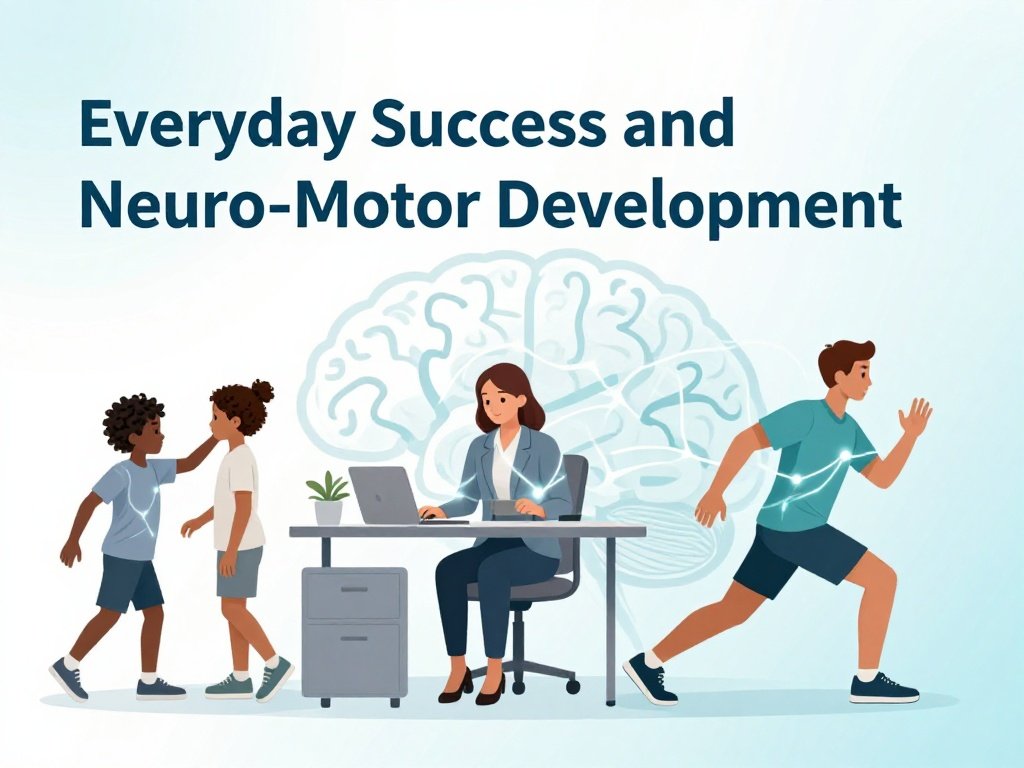
Daily success can’t only be measured by intelligence, willpower, or fitness level. The daily activities many people engage in rely heavily on the brain-body connection. From a child’s ability to read, an athlete’s focus before a game, or an adult’s work life in an office setting. The connections within the body’s nervous system to the rest of the body are vital to successful performance, making movement feel smoother and reaction speed quicker. And movement feels smoother and reaction speed makes learning simpler!
Over the past years, the awareness of the importance of neuro-motor development to general well-being has continued to grow. Researchers and health professionals are constantly researching the connection between body movement, sensory processing, coordination, balance and learning.
Neuro-motor Development?
Neuro-motor development is the process by which the brain and nervous system learn to control our bodies and process our environment. From early development, humans acquire the abilities to crawl, walk, balance, reach, and combine movements.
These skills are not just physical milestones; they are important neurological milestones that will benefit future learning and the execution of further tasks. As we develop throughout our lives, these pathways remain and help us with efficient information processing, responses to challenges, and the performance of everyday tasks. With good neuro-motor development come physical movement, attention, proprioception and coordination. Weaknesses can often have a multi-system effect on our performance and life.
The Need for Coordination between the Body and Brain
Information is continuously relayed from the body and the external environment to the brain. This information is from our eyes in terms of vision. Information about our spatial orientation and balance comes from the ear. Signals indicating body position are coming from our joints and muscles. All of this information comes in; it is then synthesized in the brain and the proper reaction is decided upon.
This all happens in an instant and accounts for almost every action people take in their everyday lives. This communication between the systems is often done without thought; therefore, most of the actions we take throughout the day feel quite effortless. If, however, there is less efficient communication between these systems, people are prone to develop decreased coordination, impaired balance and reflexes, and problems focusing. As these systems are interdependent, an increase in one may positively affect other systems.
Why Movement in Childhood is so important
Childhood is one of the key periods of development, especially for the brain. The learning process for children is through movement. When we move, jump, run, crawl, climb, and balance, our brains make connections. Movement helps enhance learning by providing a variety of important sensory input.
For some children, developmental difficulties may make many of these movements challenging. Some of the issues they have can be difficulty with balance, posture, coordination, or processing of sensory information. In some circumstances, these issues may affect learning, attention, and even self-esteem. Parents might be able to pick up on symptoms such as clumsiness, poor concentration, handwriting problems, or frustration during physical activity.
Children develop differently, but the challenges they face can often be addressed early to foster a positive developmental pathway. Physical opportunities can help build good fundamental skills.
The Role of Movement in the Learning Process
Learning has become so closely linked to the classroom that the connection between physical movement and how the brain learns has, in many cases, been entirely overlooked. Tasks that rely on coordination, balance and the ability to discern the body’s position within space demand that the majority of the brain work together. These same brain areas are also involved in attention, memory and problem-solving skills.
The link is the explanation for why physically fit children often have abilities beyond their sport and the link between the body’s learning about itself and how it learns in general is responsible for the many different positive effects found in physically fit children. For these reasons, many educators and development specialists feel that incorporating movement into healthy learning environments is crucial.
Neuro-Motor Skills & Sports Performance
Athletes are significantly influenced by the relationship between brain and body movement. Whether one plays sports professionally or for recreational pleasure, being competitive often demands quick decision-making, intricate body movements and speed to react to evolving situations. A basketball player must be able to process visual information while simultaneously timing body movements and actions. A tennis player must demonstrate balance and body awareness while also being able to track an object. An individual runner needs to demonstrate an efficient movement style and balance.
For many athletes, neurological performance becomes a training goal, alongside overall fitness. By challenging an athlete’s coordination, balance, reaction time, and vision, there is potential to enhance movement style. Enhanced movement could lead to a competitive improvement.
Neuro-motor rehabilitation – what is it?
As research into neurological functioning has increased, many individuals are looking into specific methods of brain-body training. Neuro-motor rehabilitation is one such approach, which aims to build the pathways connecting the brain to motor skills, balance, coordination, senses, and vision. Instead of focusing on symptoms, this type of rehabilitation targets the pathways responsible for performance and development.
Programs will be created based on the individual’s needs and goals. Some common exercises or activities could include, but are not limited to, balance drills, tracking activities, coordination exercises, sensory integration activities, and training in postural control.
For individuals wanting more information about this neurological approach, Neuro-Motor Rehabilitation delves into how targeted neurological training may build the connection between the brain and the body.
Areas beyond physical abilities
One of the most exciting aspects of neuro-motor development is that the benefits may not just end with movement. By improving neural pathway efficiency, we may also see changes in focus, confidence, body awareness, and overall performance in our daily lives. For children, these improvements may support greater success in school and better participation in daily activities. Athletes may experience enhanced performance, while adults can benefit from improved movement quality and daily function. Because the nervous system is involved in virtually all human performance, enhancing neural connections may be seen to span various aspects of life.
Looking toward the future
Today, neuro-motor development receives more attention because the body and brain are deeply connected. Cognitive and motor functions are no longer viewed as separate systems. They are understood to work closely together.
As neuroscience advances, movement and sensation are no longer just inputs to cognitive function. They are now recognized as systems that actively enhance neurological function.
This approach can help children build motor and cognitive skills. It can also support athletic performance and help adults maintain wellness as they age. Neuro-motor development is not only about movement. It also improves communication along neurological pathways. This supports learning, adaptation, and performance throughout life.






















Leave a Reply