

Introduction
Reliability has long been one of the defining characteristics of Japanese automobiles. Across continents and market segments, vehicles manufactured in Japan have earned a reputation for durability, engineering precision, and long-term value retention. Yet while consumer reviews and ownership surveys offer useful insights, one of the most overlooked sources of reliability data comes from Japanese car auctions themselves.
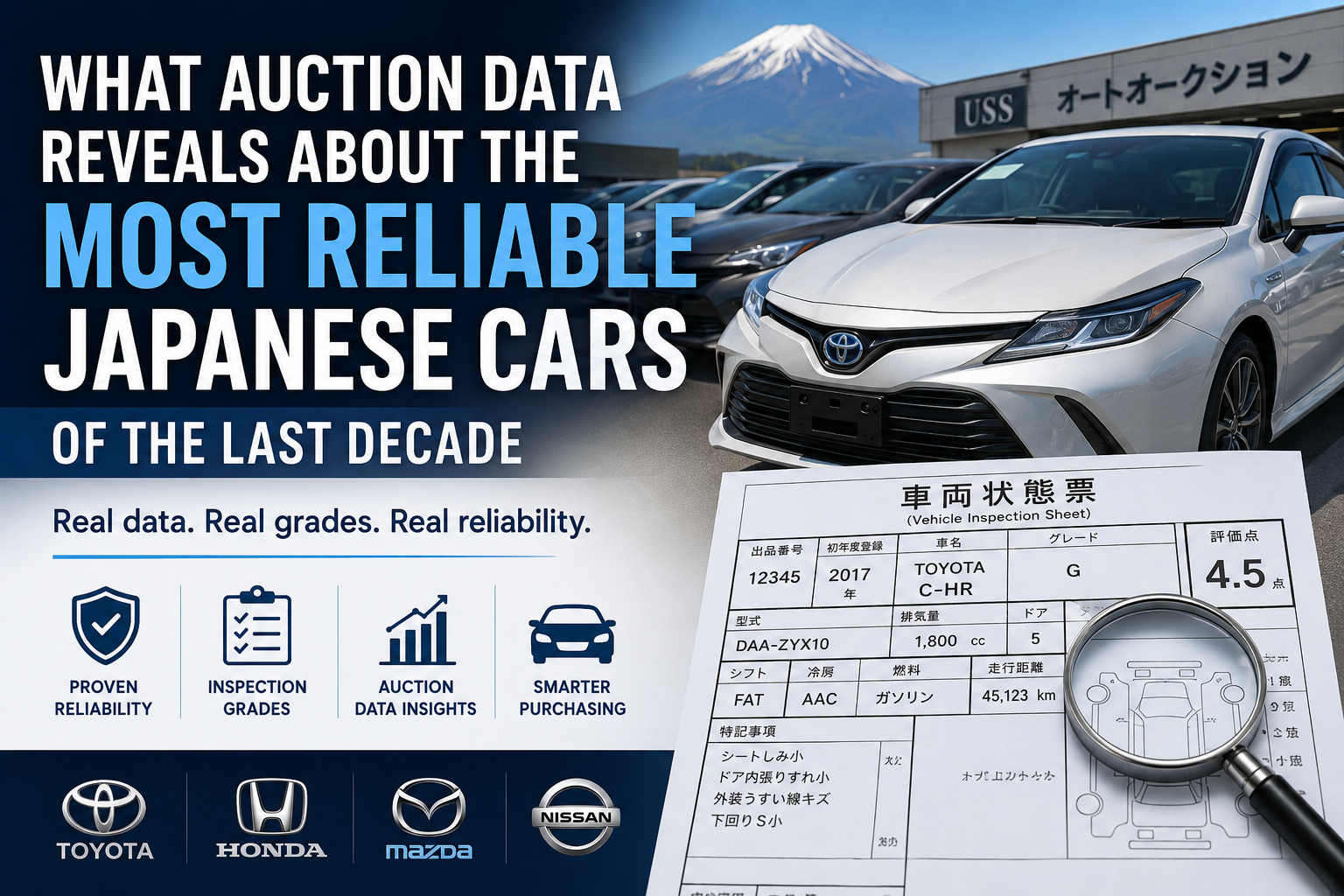
Every week, thousands of vehicles pass through Japan’s extensive auction network. These vehicles arrive with detailed inspection reports, mileage records, maintenance histories, and condition assessments. Over time, this information creates a remarkably accurate picture of which models withstand years of use and which ones experience premature wear. By examining auction trends from the past decade, clear patterns emerge regarding the most dependable Japanese vehicles ever produced.
Why Auction Data Provides Unique Reliability Insights
Unlike marketing materials or manufacturer claims, auction records reflect real-world vehicle performance. Auction inspectors evaluate cars based on structural condition, mechanical health, cosmetic wear, accident history, and maintenance standards.
Because millions of vehicles enter auction systems annually, the data pool becomes exceptionally large. High auction grades after years of ownership often indicate strong build quality and consistent reliability. Conversely, models that frequently receive lower condition scores despite moderate mileage may reveal underlying durability concerns.
This makes Japanese car auctions an invaluable source for identifying vehicles that continue performing well long after leaving the showroom.
Toyota Dominates Long-Term Reliability Rankings
Few manufacturers appear as consistently in auction records as Toyota. Across multiple segments, Toyota vehicles regularly maintain impressive condition scores even after accumulating substantial mileage.
Models such as the Corolla, Prius, Camry, and Land Cruiser frequently achieve strong auction grades despite being more than ten years old. Their reputation for dependable engines, durable transmissions, and low maintenance requirements contributes significantly to their enduring value.
Auction data also reveals that many Toyota vehicles retain original components longer than competitors. This reduces ownership costs and strengthens resale performance in international markets.
The Remarkable Longevity of the Toyota Land Cruiser
Among all Japanese vehicles, the Toyota Land Cruiser stands out as a reliability benchmark. Auction records consistently show examples with mileage exceeding 250,000 kilometers while maintaining exceptional mechanical condition.
The vehicle’s robust construction, proven powertrains, and conservative engineering philosophy contribute to its extraordinary lifespan. Buyers frequently seek Land Cruisers through Japanese car auctions because of their reputation for surviving demanding environments without significant mechanical failures.
Strong auction grades and stable resale values reinforce its status as one of the most dependable vehicles of the last decade.
Honda’s Engineering Excellence Continues to Shine
Honda remains another manufacturer whose vehicles consistently perform well within auction systems. Models such as the Civic, Fit, Vezel, and CR-V regularly achieve favorable inspection results even after years of daily use.
One notable trend observed in auction data is Honda’s ability to maintain drivetrain integrity over extended ownership periods. Many examples show minimal mechanical deterioration despite high mileage.
The combination of efficient engines, quality manufacturing processes, and durable components has allowed Honda vehicles to maintain their reputation among importers and used-car buyers worldwide.
Mazda’s Quality Transformation Over the Decade
A decade ago, Mazda was often praised for driving dynamics more than reliability. However, auction records reveal a significant shift in recent years.
Vehicles built under Mazda’s Skyactiv technology program demonstrate exceptional durability. Models such as the Mazda3, Mazda6, and CX-5 consistently receive strong auction evaluations and exhibit fewer signs of mechanical wear than earlier generations.
Auction performance suggests that Mazda successfully improved both engineering quality and long-term dependability, making its vehicles increasingly attractive to international buyers.
Nissan Models That Continue to Impress
Although reliability perceptions surrounding Nissan have fluctuated over time, several models consistently perform well in auction environments.
The Nissan Note, X-Trail, and Serena frequently appear with strong inspection scores and well-preserved interiors. Vehicles equipped with properly maintained powertrains often demonstrate impressive longevity.
Auction data also highlights the importance of maintenance history. Models with comprehensive service records generally achieve significantly higher grades, emphasizing the role of owner care alongside manufacturing quality.
Hybrid Vehicles Show Unexpected Durability
One of the most interesting revelations from auction records involves hybrid technology. Early skepticism surrounding battery longevity has largely been disproven by real-world performance.
Hybrid models such as the Toyota Prius, Toyota Aqua, and Honda Fit Hybrid regularly achieve excellent auction grades despite years of operation. Many continue functioning efficiently with original hybrid systems intact.
The consistency of these results suggests that Japanese manufacturers have successfully developed hybrid technologies capable of delivering long-term reliability without excessive maintenance costs.
How Auction Grades Reflect Reliability
Japanese auctions employ detailed grading systems that provide valuable indicators of vehicle condition.
A car receiving a Grade 4 or higher after several years of use typically demonstrates strong overall durability. Vehicles that maintain high grades despite substantial mileage often belong to models with proven reliability records.
Importers frequently rely on these grades when selecting inventory because they offer objective assessments rather than subjective opinions. Understanding these grading systems helps buyers identify vehicles likely to provide dependable service for years to come.
The Role of a Japanese Auction Sheet Translator
Auction sheets contain extensive information that can reveal a vehicle’s true condition. However, these documents are usually written in Japanese and include industry-specific terminology unfamiliar to international buyers.
A professional Japanese auction sheet translator can help decode inspection notes, repair histories, mileage verification records, and condition assessments. This information enables buyers to make informed decisions and avoid vehicles with hidden issues.
For those purchasing through Japanese car auctions, accurate translation services are often just as important as the auction data itself.
Reliability and Resale Value Go Hand in Hand
Another pattern evident in auction records is the close relationship between reliability and resale value. Vehicles known for durability consistently command stronger prices, even as they age.
Toyota, Honda, and select Mazda models often achieve premium bids because buyers trust their long-term performance. Strong reliability reduces perceived risk, creating sustained demand in both domestic and export markets.
As a result, choosing a vehicle with a proven auction history can deliver benefits far beyond initial ownership.
What Buyers Can Learn from a Decade of Auction Trends
The last ten years of auction data reveal several important lessons. Reliability is rarely determined by marketing claims alone. Instead, it emerges through consistent real-world performance across hundreds of thousands of vehicles.
Toyota remains the dominant force in long-term durability, while Honda continues demonstrating engineering excellence. Mazda has significantly elevated its quality standards, and several Nissan models continue providing dependable service when properly maintained.
Most importantly, Japanese car auctions provide one of the most transparent and data-driven methods for evaluating vehicle reliability.
Conclusion
Auction records offer a fascinating window into how vehicles perform over time. Unlike surveys or anecdotal experiences, auction data reflects the condition of real vehicles after years of ownership, maintenance, and daily use. The evidence consistently points toward Toyota, Honda, and Mazda as leaders in long-term dependability, with several standout models setting benchmarks for durability.
For buyers exploring Japanese car auctions, understanding auction grades and working with a qualified Japanese auction sheet translator can significantly improve purchasing decisions. By leveraging this wealth of information, consumers can identify vehicles that have repeatedly demonstrated reliability and secure automobiles capable of delivering exceptional value for years to come.
Nobuko Japan helps buyers navigate the complexities of sourcing quality vehicles from Japan by providing access to reliable auction inventory, transparent vehicle information, and professional guidance throughout the import process. Through careful vehicle selection and auction expertise, buyers can confidently choose dependable Japanese automobiles backed by proven auction performance.





















Leave a Reply