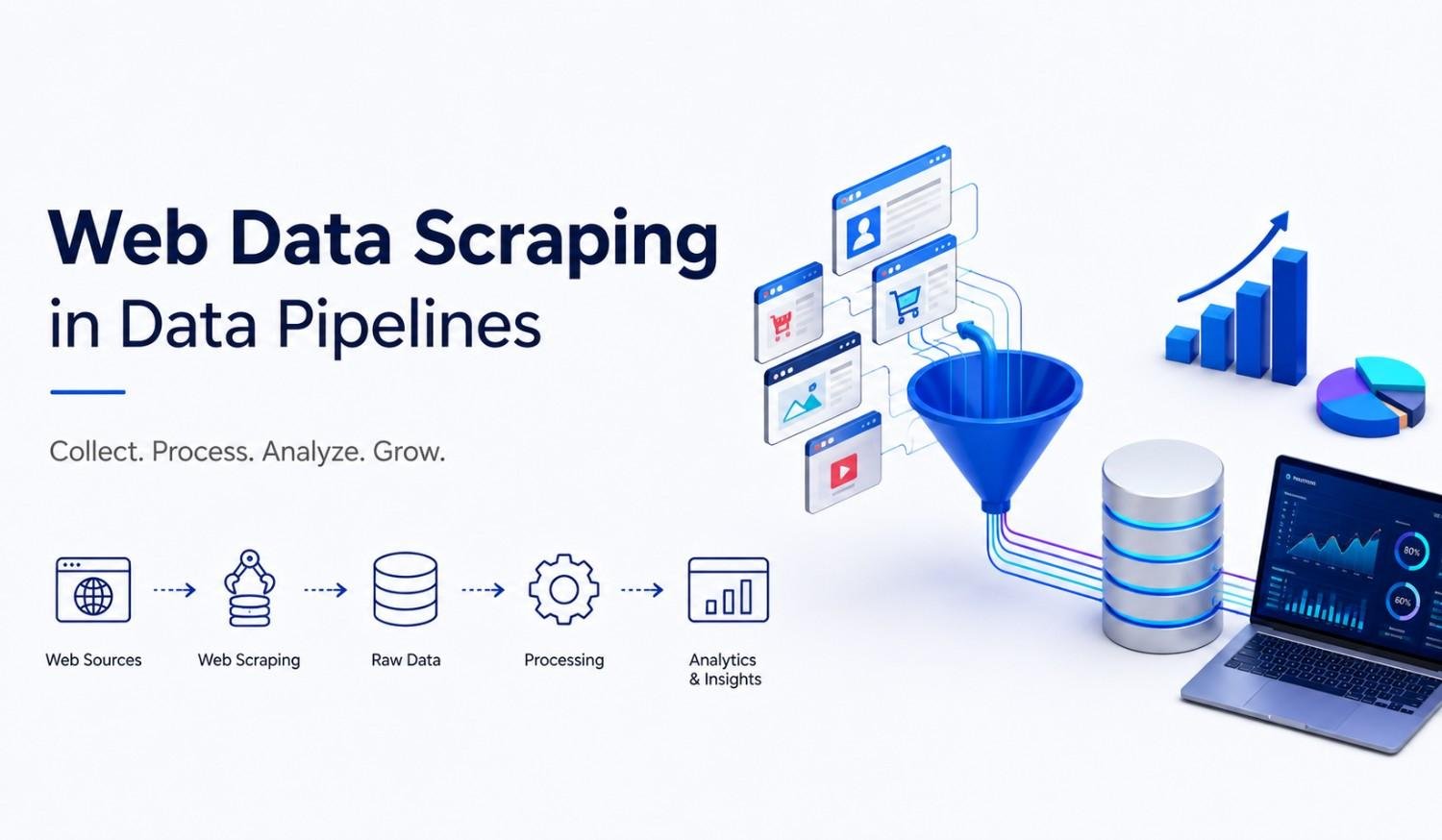
Why Businesses Integrate Web Data into Data Pipelines

Why Are Businesses Integrating Web Data Scraping into Their Data Pipelines? Introduction Data has become the fuel that powers modern business decisions, but fuel alone is not enough—it must be refined, organized, and delivered where it is needed most. Businesses today generate enormous amounts of internal data, yet many strategic opportunities remain hidden outside their own systems. Market trends, competitor activities, customer preferences, and industry shifts often live across countless websites and online platforms. That reality has encouraged organizations to rethink how information enters their systems. By integrating web scraping services into data pipelines, businesses can access timely insights and transform raw information into meaningful action. The Evolution of Modern Business Data Pipelines Business data pipelines have changed dramatically over the last decade. Traditional systems focused mainly on collecting information from internal databases, spreadsheets, and operational software. Modern enterprises, however, operate in environments where external information carries equal importance. Markets move faster, customer expectations evolve more quickly, and competitors rarely stand still. As a result, organizations are building smarter pipelines capable of gathering, processing, and analyzing information from multiple sources simultaneously. Data pipelines have evolved from simple transportation channels into intelligent ecosystems that continuously feed decision-makers with actionable insights. Why External Data Has Become a Business Necessity Internal business records tell only part of the story. Sales reports reveal what happened yesterday, but external data often explains what could happen tomorrow. Market sentiment, pricing fluctuations, industry developments, and consumer discussions provide context that internal systems simply cannot capture. During many digital transformation projects, we have observed businesses discovering valuable opportunities hidden in publicly available information. Sometimes a single market trend reveals more than months of internal reporting. Competitive environments reward awareness, and awareness increasingly depends on gathering information beyond organizational boundaries. What Is Web Data Scraping and How Does It Fit Into Data Pipelines? Web data scraping refers to the automated extraction of publicly available information from websites and online platforms. Rather than assigning employees to manually collect information, businesses use automated tools that gather data efficiently and consistently. Once collected, the information flows directly into databases, analytics platforms, customer relationship management systems, and business intelligence dashboards. The process creates a seamless connection between external information sources and internal decision-making systems. Instead of spending valuable hours gathering data, teams can focus on understanding and applying the insights that emerge. Faster Decision-Making Through Real-Time Data Collection Business opportunities rarely wait for quarterly reports. Consumer preferences can change overnight, competitor pricing can shift within hours, and market conditions can evolve unexpectedly. Real-time data collection allows organizations to respond with greater speed and confidence. Information gathered continuously from external sources provides decision-makers with a clearer view of current conditions. Faster access to reliable information reduces delays and minimizes uncertainty. Organizations that react quickly often gain advantages over competitors still relying on outdated reports. In dynamic markets, speed frequently becomes one of the most valuable strategic assets. Enhancing Competitive Intelligence Without Guesswork Competitive intelligence works best when supported by facts rather than assumptions. Businesses increasingly monitor competitor pricing, product launches, customer reviews, and promotional activities to understand market positioning. Automated data collection simplifies this process by delivering relevant information directly into analytical systems. Teams no longer need to spend endless hours navigating websites and updating spreadsheets manually. Spreadsheets deserve respect, of course, but they should not become the hardest-working employees in the company. Accurate competitive intelligence enables organizations to identify opportunities, anticipate market movements, and make better-informed strategic decisions. Improving Sales and Marketing Performance Sales and marketing teams thrive on accurate information. Understanding customer interests, identifying emerging trends, and discovering new lead opportunities all depend on access to quality data. External information enriches customer profiles and supports more targeted campaigns. Businesses can identify changing consumer preferences and adjust messaging accordingly. Marketing efforts become more personalized, while sales teams gain deeper insights into prospects and market conditions. The result is improved engagement, stronger conversion rates, and more effective customer acquisition strategies. Better data does not guarantee success, but it certainly improves the odds. Powering Better Forecasting and Strategic Planning Forecasting becomes significantly more reliable when organizations combine internal records with external market intelligence. Historical sales data remains valuable, yet external factors often influence future performance. Economic shifts, consumer demand patterns, competitor activities, and industry developments all affect business outcomes. Integrating external information into forecasting models creates a broader and more accurate perspective. Strategic planning also benefits from this expanded view. Organizations can identify risks earlier, allocate resources more effectively, and prepare for changing market conditions. Better forecasts support smarter decisions and reduce costly surprises. Supporting AI and Analytics Initiatives Artificial intelligence systems depend heavily on the quality and diversity of the data they consume. Even the most sophisticated algorithms struggle when trained on incomplete information. External datasets help enrich machine learning models, improve predictive accuracy, and strengthen analytical outcomes. Businesses integrating data extraction into their pipelines often discover that broader datasets generate more meaningful insights. Analytics platforms also benefit from enhanced data variety, providing executives with richer reporting and deeper visibility. Successful AI initiatives are built on strong data foundations, and external information plays an increasingly important role in that foundation. Reducing Manual Work and Operational Costs Manual data collection consumes valuable time and resources. Employees tasked with gathering information from multiple websites often spend hours performing repetitive activities that contribute little strategic value. Automation eliminates much of this burden by collecting and organizing information automatically. Teams can redirect their efforts toward analysis, innovation, and decision-making instead of routine data gathering. Operational efficiency improves while labor costs associated with repetitive processes decrease. Businesses frequently discover that automation not only saves money but also improves data accuracy. Fewer manual tasks generally mean fewer opportunities for human error. Industry Use Cases Driving Adoption Organizations across numerous industries are integrating automated data collection into their operations. E-commerce companies monitor product availability and pricing trends. Real estate firms track property listings and market fluctuations. Financial institutions analyze market indicators and investment signals. Healthcare organizations gather industry research and benchmark information. Recruitment agencies evaluate hiring trends and salary expectations. Although the applications vary, the objective remains consistent—access valuable information faster and use it more effectively. Industry leaders increasingly recognize that external data can strengthen decision-making regardless of sector or business model. Data Quality, Compliance, and Ethical Considerations Collecting data is only one part of the equation; maintaining quality and compliance is equally important. Businesses must ensure that information is accurate, relevant, and collected responsibly. Effective governance practices help prevent data inconsistencies and maintain trust in analytical outcomes. Compliance with applicable regulations should remain a priority throughout every stage of data collection and processing. Ethical considerations also matter because sustainable business practices depend on responsible information management. Strong data governance frameworks help organizations maximize value while minimizing legal, operational, and reputational risks. Common Challenges Businesses Face When Building Data Pipelines Building and maintaining effective data pipelines is not always straightforward. Website structures change frequently, creating challenges for automated collection systems. Data arrives in different formats and often requires cleaning before it becomes useful. Integration with existing platforms can also introduce complexity. Large-scale operations must address storage, processing, and performance requirements as data volumes increase. These challenges highlight the importance of planning and technical expertise. Successful implementations require both robust technology and ongoing maintenance to ensure reliable performance as business requirements continue evolving. Why Businesses Partner with Experienced Web Scraping Providers Many organizations recognize the value of external data but prefer not to build and maintain complex extraction systems internally. Experienced providers offer technical expertise, scalable infrastructure, and ongoing support that simplify implementation. During client engagements, we frequently see businesses accelerate projects by leveraging specialized knowledge instead of starting from scratch. Reliable data collection requires more than software alone—it requires monitoring, optimization, and adaptation as websites evolve. Partnering with experts allows organizations to focus on strategic objectives while ensuring consistent access to high-quality information. The Future of Data Pipelines and Automated Data Collection The future of business intelligence will be shaped by increasingly connected and automated data ecosystems. Artificial intelligence, cloud computing, and advanced analytics are creating new opportunities for organizations to extract value from information. Real-time data collection will become more important as markets continue accelerating. Businesses that integrate diverse information sources into their pipelines will be better positioned to identify opportunities and respond to change. Competitive advantage will increasingly belong to organizations capable of transforming vast amounts of information into clear, actionable insights at scale. Conclusion Modern businesses operate in environments where information changes constantly and opportunities appear quickly. Internal data remains valuable, but it no longer provides the complete picture needed for confident decision-making. Integrating automated data collection into business pipelines helps organizations access broader insights, improve operational efficiency, and strengthen strategic planning. Success is not determined by how much data a company collects. Success comes from transforming information into action. Businesses that build smarter data pipelines today position themselves to compete more effectively in the markets of tomorrow. Frequently Asked Questions 1. Why are businesses integrating web data scraping into data pipelines? Businesses use automated data collection to gather external information that improves decision-making, forecasting, competitive analysis, and operational efficiency. 2. How does scraped data improve business intelligence? It provides access to market trends, competitor activities, customer insights, and industry developments that enrich analytical reporting. 3. Can scraped data integrate with CRM and ERP systems? Yes. Extracted information can be connected to CRM, ERP, analytics platforms, data warehouses, and reporting tools. 4. Which industries benefit most from data scraping? E-commerce, finance, healthcare, recruitment, manufacturing, and real estate commonly use external data for strategic decision-making. 5. Is web scraping scalable for enterprise organizations? Modern solutions are highly scalable and can support large volumes of data collection and processing requirements. 6. Does automation reduce operational costs? Yes. Automation minimizes manual effort, improves efficiency, and allows employees to focus on higher-value activities. 7. What challenges should businesses consider? Common challenges include data quality management, integration complexity, compliance requirements, and ongoing maintenance. 8. Why work with a professional data scraping provider? Experienced providers offer technical expertise, scalability, reliability, and long-term support for data collection initiatives.


Data has become the fuel that powers modern business decisions, but fuel alone is not enough—it must be refined, organized, and delivered where it is needed most. Businesses today generate enormous amounts of internal data, yet many strategic opportunities remain hidden outside their own systems. Market trends, competitor activities, customer preferences, and industry shifts often live across countless websites and online platforms. That reality has encouraged organizations to rethink how information enters their systems. By integrating web scraping services into data pipelines, businesses can access timely insights and transform raw information into meaningful action.

The Evolution of Modern Business Data Pipelines

Business data pipelines have changed dramatically over the last decade. Traditional systems focused mainly on collecting information from internal databases, spreadsheets, and operational software. Modern enterprises, however, operate in environments where external information carries equal importance. Markets move faster, customer expectations evolve more quickly, and competitors rarely stand still. As a result, organizations are building smarter pipelines capable of gathering, processing, and analyzing information from multiple sources simultaneously. Data pipelines have evolved from simple transportation channels into intelligent ecosystems that continuously feed decision-makers with actionable insights.

Why External Data Has Become a Business Necessity

Internal business records tell only part of the story. Sales reports reveal what happened yesterday, but external data often explains what could happen tomorrow. Market sentiment, pricing fluctuations, industry developments, and consumer discussions provide context that internal systems simply cannot capture. During many digital transformation projects, we have observed businesses discovering valuable opportunities hidden in publicly available information. Sometimes a single market trend reveals more than months of internal reporting. Competitive environments reward awareness, and awareness increasingly depends on gathering information beyond organizational boundaries.

What Is Web Data Scraping and How Does It Fit Into Data Pipelines?

Web data scraping refers to the automated extraction of publicly available information from websites and online platforms. Rather than assigning employees to manually collect information, businesses use automated tools that gather data efficiently and consistently. Once collected, the information flows directly into databases, analytics platforms, customer relationship management systems, and business intelligence dashboards. The process creates a seamless connection between external information sources and internal decision-making systems. Instead of spending valuable hours gathering data, teams can focus on understanding and applying the insights that emerge.

Faster Decision-Making Through Real-Time Data Collection

Business opportunities rarely wait for quarterly reports. Consumer preferences can change overnight, competitor pricing can shift within hours, and market conditions can evolve unexpectedly. Real-time data collection allows organizations to respond with greater speed and confidence. Information gathered continuously from external sources provides decision-makers with a clearer view of current conditions. Faster access to reliable information reduces delays and minimizes uncertainty. Organizations that react quickly often gain advantages over competitors still relying on outdated reports. In dynamic markets, speed frequently becomes one of the most valuable strategic assets.

Enhancing Competitive Intelligence Without Guesswork

Competitive intelligence works best when supported by facts rather than assumptions. Businesses increasingly monitor competitor pricing, product launches, customer reviews, and promotional activities to understand market positioning. Automated data collection simplifies this process by delivering relevant information directly into analytical systems. Teams no longer need to spend endless hours navigating websites and updating spreadsheets manually. Spreadsheets deserve respect, of course, but they should not become the hardest-working employees in the company. Accurate competitive intelligence enables organizations to identify opportunities, anticipate market movements, and make better-informed strategic decisions.

Improving Sales and Marketing Performance

Sales and marketing teams thrive on accurate information. Understanding customer interests, identifying emerging trends, and discovering new lead opportunities all depend on access to quality data. External information enriches customer profiles and supports more targeted campaigns. Businesses can identify changing consumer preferences and adjust messaging accordingly. Marketing efforts become more personalized, while sales teams gain deeper insights into prospects and market conditions. The result is improved engagement, stronger conversion rates, and more effective customer acquisition strategies. Better data does not guarantee success, but it certainly improves the odds.

Powering Better Forecasting and Strategic Planning

Forecasting becomes significantly more reliable when organizations combine internal records with external market intelligence. Historical sales data remains valuable, yet external factors often influence future performance. Economic shifts, consumer demand patterns, competitor activities, and industry developments all affect business outcomes. Integrating external information into forecasting models creates a broader and more accurate perspective. Strategic planning also benefits from this expanded view. Organizations can identify risks earlier, allocate resources more effectively, and prepare for changing market conditions. Better forecasts support smarter decisions and reduce costly surprises.

Supporting AI and Analytics Initiatives

Artificial intelligence systems depend heavily on the quality and diversity of the data they consume. Even the most sophisticated algorithms struggle when trained on incomplete information. External datasets help enrich machine learning models, improve predictive accuracy, and strengthen analytical outcomes. Businesses integrating data extraction into their pipelines often discover that broader datasets generate more meaningful insights. Analytics platforms also benefit from enhanced data variety, providing executives with richer reporting and deeper visibility. Successful AI initiatives are built on strong data foundations, and external information plays an increasingly important role in that foundation.

Reducing Manual Work and Operational Costs

Manual data collection consumes valuable time and resources. Employees tasked with gathering information from multiple websites often spend hours performing repetitive activities that contribute little strategic value. Automation eliminates much of this burden by collecting and organizing information automatically. Teams can redirect their efforts toward analysis, innovation, and decision-making instead of routine data gathering. Operational efficiency improves while labor costs associated with repetitive processes decrease. Businesses frequently discover that automation not only saves money but also improves data accuracy. Fewer manual tasks generally mean fewer opportunities for human error.

Industry Use Cases Driving Adoption

Organizations across numerous industries are integrating automated data collection into their operations. E-commerce companies monitor product availability and pricing trends. Real estate firms track property listings and market fluctuations. Financial institutions analyze market indicators and investment signals. Healthcare organizations gather industry research and benchmark information. Recruitment agencies evaluate hiring trends and salary expectations. Although the applications vary, the objective remains consistent—access valuable information faster and use it more effectively. Industry leaders increasingly recognize that external data can strengthen decision-making regardless of sector or business model.

Data Quality, Compliance, and Ethical Considerations

Collecting data is only one part of the equation; maintaining quality and compliance is equally important. Businesses must ensure that information is accurate, relevant, and collected responsibly. Effective governance practices help prevent data inconsistencies and maintain trust in analytical outcomes. Compliance with applicable regulations should remain a priority throughout every stage of data collection and processing. Ethical considerations also matter because sustainable business practices depend on responsible information management. Strong data governance frameworks help organizations maximize value while minimizing legal, operational, and reputational risks.

Common Challenges Businesses Face When Building Data Pipelines

Building and maintaining effective data pipelines is not always straightforward. Website structures change frequently, creating challenges for automated collection systems. Data arrives in different formats and often requires cleaning before it becomes useful. Integration with existing platforms can also introduce complexity. Large-scale operations must address storage, processing, and performance requirements as data volumes increase. These challenges highlight the importance of planning and technical expertise. Successful implementations require both robust technology and ongoing maintenance to ensure reliable performance as business requirements continue evolving.

Why Businesses Partner with Experienced Web Scraping Providers

Many organizations recognize the value of external data but prefer not to build and maintain complex extraction systems internally. Experienced providers offer technical expertise, scalable infrastructure, and ongoing support that simplify implementation. During client engagements, we frequently see businesses accelerate projects by leveraging specialized knowledge instead of starting from scratch. Reliable data collection requires more than software alone—it requires monitoring, optimization, and adaptation as websites evolve. Partnering with experts allows organizations to focus on strategic objectives while ensuring consistent access to high-quality information.

The Future of Data Pipelines and Automated Data Collection

The future of business intelligence will be shaped by increasingly connected and automated data ecosystems. Artificial intelligence, cloud computing, and advanced analytics are creating new opportunities for organizations to extract value from information. Real-time data collection will become more important as markets continue accelerating. Businesses that integrate diverse information sources into their pipelines will be better positioned to identify opportunities and respond to change. Competitive advantage will increasingly belong to organizations capable of transforming vast amounts of information into clear, actionable insights at scale.

Conclusion

Modern businesses operate in environments where information changes constantly and opportunities appear quickly. Internal data remains valuable, but it no longer provides the complete picture needed for confident decision-making. Integrating automated data collection into business pipelines helps organizations access broader insights, improve operational efficiency, and strengthen strategic planning. Success is not determined by how much data a company collects. Success comes from transforming information into action. Businesses that build smarter data pipelines today position themselves to compete more effectively in the markets of tomorrow.

Frequently Asked Questions

1. Why are businesses integrating web data scraping into data pipelines?

Businesses use automated data collection to gather external information that improves decision-making, forecasting, competitive analysis, and operational efficiency.

2. How does scraped data improve business intelligence?

It provides access to market trends, competitor activities, customer insights, and industry developments that enrich analytical reporting.

3. Can scraped data integrate with CRM and ERP systems?

Yes. Extracted information can be connected to CRM, ERP, analytics platforms, data warehouses, and reporting tools.

4. Which industries benefit most from data scraping?

E-commerce, finance, healthcare, recruitment, manufacturing, and real estate commonly use external data for strategic decision-making.

5. Is web scraping scalable for enterprise organizations?

Modern solutions are highly scalable and can support large volumes of data collection and processing requirements.

6. Does automation reduce operational costs?

Yes. Automation minimizes manual effort, improves efficiency, and allows employees to focus on higher-value activities.

7. What challenges should businesses consider?

Common challenges include data quality management, integration complexity, compliance requirements, and ongoing maintenance.

8. Why work with a professional data scraping provider?

Experienced providers offer technical expertise, scalability, reliability, and long-term support for data collection initiatives.

Leave a Reply

Your email address will not be published. Required fields are marked *

Ads Blocker Image Powered by Code Help Pro

Ads Blocker Detected!!!

We have detected that you are using extensions to block ads. Please support us by disabling these ads blocker.