

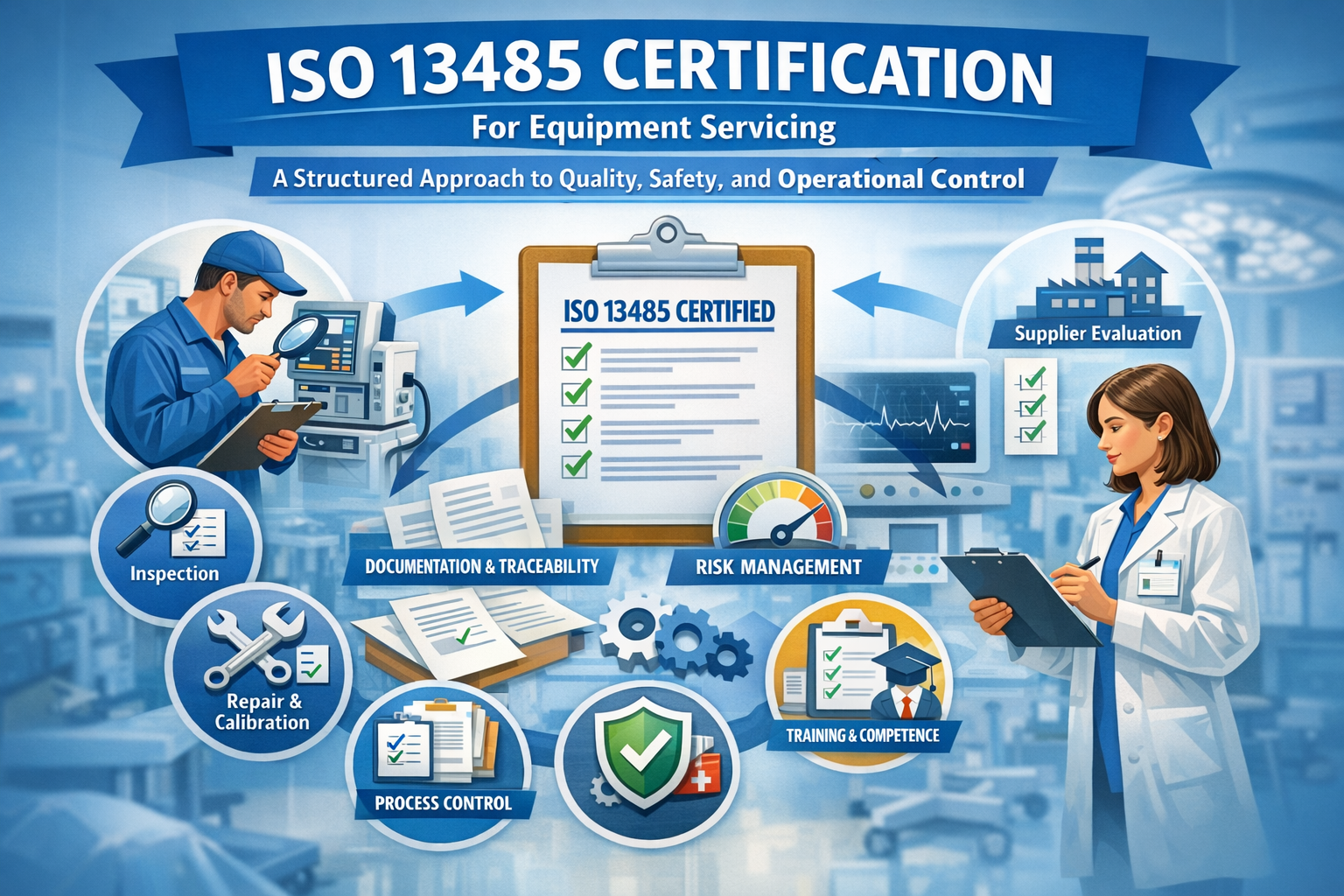
Introduction to ISO 13485 Certification in Equipment Servicing
The International Organization for Standardization developed ISO 13485 certification as a globally recognized framework that defines requirements for a quality management system specific to organizations involved in equipment servicing. As a result, this certification enables organizations to establish a controlled and systematic environment where servicing activities consistently meet defined quality and safety requirements.
Equipment servicing organizations operate in environments where precision, reliability, and accountability directly affect operational performance. In this context, ISO 13485 certification introduces a structured system that governs all servicing activities, including inspection, fault diagnosis, repair, calibration, and final verification. Instead of relying on informal or experience-based methods, organizations adopt standardized procedures that ensure uniformity across all servicing functions.
Furthermore, by implementing ISO 13485 certification, organizations strengthen their ability to deliver consistent service outcomes. The framework emphasizes traceability, process control, and documentation; therefore, every servicing action can be verified, reviewed, and improved. Consequently, this structured approach reduces variability and enhances the reliability of serviced equipment.
Scope of ISO 13485 Certification in Servicing Operations
ISO 13485 certification applies to all servicing activities that influence equipment performance, safety, and compliance. Specifically, the scope includes technical processes such as inspection, maintenance, repair, calibration, and validation, as well as supporting functions such as documentation, personnel management, and process monitoring.
Organizations define the scope of their quality management system based on the nature of equipment serviced and the associated risks. Accordingly, ISO 13485 certification requires organizations to identify all processes that contribute to service quality and ensure that they operate under controlled conditions.
Servicing organizations standardize workflows under ISO 13485 certification. As a result, teams follow clearly defined procedures for each activity, ensuring consistent execution regardless of location or personnel. This approach, in turn, eliminates inconsistencies that often arise in decentralized servicing environments.
In addition, the certification extends to supplier control and outsourced processes. Organizations evaluate external service providers to ensure that they meet the same quality standards required internally. Thus, this comprehensive scope ensures that all elements influencing servicing outcomes remain aligned with ISO 13485 requirements.
Process-Based Structure and Operational Integration
ISO 13485 certification adopts a process-based approach that integrates all servicing activities into a cohesive system. To achieve this, organizations define each process with specific inputs, outputs, responsibilities, and performance criteria.
Servicing organizations identify key processes such as intake inspection, fault analysis, repair execution, testing, and release. Subsequently, they establish clear interactions between these processes to ensure smooth operational flow. By doing so, they prevent gaps, overlaps, and inefficiencies that could affect service quality.
Organizations monitor process performance using measurable indicators. For example, these indicators may include service turnaround time, defect rates, rework frequency, and customer feedback. By analyzing these metrics, organizations can identify areas for improvement and implement corrective actions.
Overall, ISO 13485 certification promotes consistency and predictability in servicing operations. When processes are properly controlled, variability is reduced and servicing outcomes remain stable over time.
Risk Management and Preventive Control
Risk management forms a fundamental component of ISO 13485 certification. Given that equipment servicing involves multiple risk points, errors can compromise safety and performance if not properly controlled.
Servicing organizations conduct risk assessments for each stage of the servicing process. For instance, they identify potential hazards such as incorrect diagnosis, improper repair techniques, use of unsuitable parts, and inadequate testing. Afterward, organizations evaluate the potential impact of these risks on equipment performance and user safety.
Organizations then implement control measures to mitigate identified risks. These measures may include, standardized procedures, verification steps, training programs, and equipment validation. As a result, the likelihood of errors is significantly reduced.
Importantly, ISO 13485 certification emphasizes a preventive approach. Rather than reacting to failures, organizations proactively identify risks and implement measures to prevent them. Consequently, this approach enhances operational reliability and minimizes service-related disruptions.
Documentation and Traceability Requirements
Documentation serves as a critical element of ISO 13485 certification. In particular, organizations must create, maintain, and control documents that define servicing procedures and record operational activities.
Servicing organizations develop documented procedures for all key activities. For example, these include inspection, repair, calibration, and testing processes. As a result, personnel are guided to perform tasks consistently.
Organizations also maintain detailed records of each servicing activity. These records include, service reports, inspection results, calibration data, and verification outcomes. Therefore, traceability is ensured across all servicing operations.
Moreover, traceability allows organizations to track the history of serviced equipment. This means that they can identify when a service occurred, what actions were taken, and who performed them.
ISO 13485 certification also requires strict control of document revisions. Thus, personnel always use the latest versions, preventing errors caused by outdated information.
Control of Servicing Equipment, Tools, and Infrastructure
The accuracy and reliability of servicing operations depend heavily on tools, instruments, and infrastructure. For this reason, ISO 13485 certification requires strict control over these resources.
Organizations establish calibration programs for measurement instruments. In doing so, they verify accuracy at defined intervals to ensure reliable results.
Additionally, servicing organizations maintain equipment used during repair and testing. They conduct regular inspections and preventive maintenance. As a result, the risk of equipment failure during servicing is minimized.
Infrastructure also plays a key role. For example, clean and organized workspaces reduce contamination risks and improve operational efficiency.
Personnel Competence and Training Management
Personnel competence directly influences servicing effectiveness. Therefore, ISO 13485 certification requires organizations to ensure employees possess the necessary skills and knowledge.
Organizations define competency requirements for each role. Subsequently, they provide structured training programs that include technical instruction and practical demonstrations.
Furthermore, organizations evaluate training effectiveness through assessments and performance reviews. In addition, they maintain records to demonstrate compliance with competency requirements.
Over time, continuous learning ensures that personnel remain updated with technological and procedural changes.
Customer Requirements and Service Quality Alignment
ISO 13485 certification emphasizes understanding customer requirements. To achieve this, organizations align servicing processes with customer expectations.
Organizations identify requirements related to performance, turnaround time, and documentation. Then, they integrate these into operational procedures.
Moreover, customer satisfaction is monitored through feedback and complaints. By analyzing this data, organizations can improve service quality.
At the same time, transparency in communication builds trust and strengthens long-term relationships.
Internal Audits and Performance Monitoring
Internal audits evaluate the effectiveness of the quality management system. Accordingly, ISO 13485 certification requires regular audits.
Organizations plan audits systematically. During these audits, processes are assessed for compliance.
If nonconformities are identified, corrective actions are implemented. In addition, performance indicators are continuously monitored.
Together, audits and performance monitoring support continuous improvement.
Corrective and Preventive Actions Framework
ISO 13485 certification requires a structured system for managing nonconformities. When issues arise, organizations investigate root causes and implement corrective actions.
Similarly, preventive actions focus on identifying potential risks before they occur. By analyzing trends, organizations proactively address issues.
Ultimately, this framework ensures long-term system stability and reliability.
Implementation and Certification Process
Organizations implement ISO 13485 certification through a structured approach. Initially, they conduct a gap analysis. Next, they define processes and train personnel.
After implementation, organizations establish monitoring systems and conduct internal audits.
A certification body such as Integrated Assessment Service conducts an external audit. During this stage, compliance and system effectiveness are evaluated.
Once successful, certification confirms alignment with international standards.
Business Impact and Strategic Advantages
ISO 13485 certification provides multiple benefits. Firstly, it improves operational efficiency. Secondly, it enhances service quality.
In addition, risk reduction is achieved through structured management practices.
Customer trust also increases. As a result, organizations gain a competitive advantage and access to new markets.
Conclusion
ISO 13485 certification establishes a comprehensive framework for equipment servicing operations. By integrating process control, risk management, and documentation, organizations achieve consistent service delivery.
In conclusion, this structured approach improves efficiency, reduces risk, and enhances customer satisfaction. Therefore, ISO 13485 certification positions organizations as reliable and high-quality service providers in demanding operational environments.
























Leave a Reply