

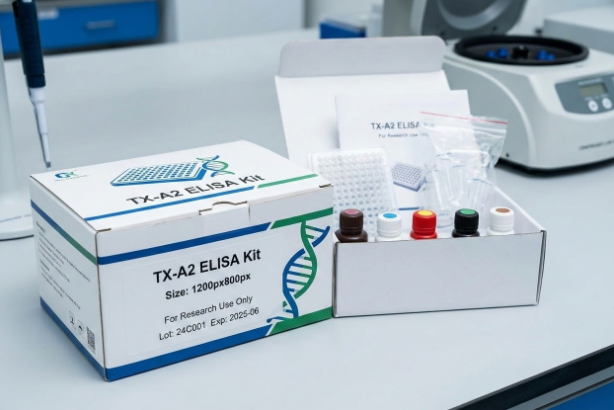
Thromboxane A2 (TX-A2) represents a potent eicosanoid mediator synthesized by activated platelets through the cyclooxygenase-1 (COX-1) pathway. This short-lived lipid mediator plays critical roles in platelet aggregation, maintenance of hemostasis, and pathogenesis of thrombotic disease. TX-A2 quantification provides valuable insights into platelet activation status, hemostatic dysfunction, and the mechanisms underlying cardiovascular disease that drive thrombotic events.
TX-A2 elisa kit systems enable sensitive, specific measurement of thromboxane A2 concentrations in biological samples, supporting cardiovascular research, antithrombotic drug development, and clinical investigations seeking objective biomarkers predicting thrombotic risk.
TX-A2’s unstable molecular structure—spontaneously converting to thromboxane B2 (TXB2) through non-enzymatic hydrolysis—necessitates specialized assay methodologies addressing rapid degradation challenges. Advanced TX-A2 ELISA kits overcome these technical obstacles through optimized sample handling protocols and sensitive immunoassay platforms enabling reliable TX-A2 quantification.
Biological Functions and Pathophysiological Implications
TX-A2 synthesis accompanies platelet activation, triggering shape change, granule secretion, and aggregation essential for hemostatic plug formation. TX-A2 ELISA kits measuring platelet-derived thromboxane reveal platelet activation status in physiological responses and pathological conditions. Elevated TX-A2 levels indicate abnormal platelet activation potentially predisposing to thrombotic complications including acute myocardial infarction, stroke, or pulmonary embolism.
Excessive TX-A2 production contributes to thrombotic events where unwanted platelet aggregation obstructs critical blood flow. TX-A2 ELISA kits enable mechanistic investigations of thrombotic disease development and comprehensive assessment of antithrombotic drug efficacy. Quantifying circulating TX-A2 levels provides objective markers of thrombotic risk and therapeutic drug response, supporting evidence-based clinical decision-making.
Beyond platelet aggregation, TX-A2 exerts pro-inflammatory effects recruiting immune cells and amplifying inflammatory responses. TX-A2 ELISA kits reveal inflammatory activation in diverse conditions—sepsis, ischemia-reperfusion injury, autoimmune disease—where TX-A2 contributes to tissue damage and disease progression.
Research Applications of TX-A2 ELISA Kits
Cardiovascular disease researchers utilize TX-A2 ELISA kits quantifying thromboxane production in various experimental models investigating thrombotic susceptibility, disease mechanisms, and therapeutic intervention efficacy. TX-A2 measurements reveal how disease processes alter platelet TX-A2 production and identify novel therapeutic targets.
Pharmaceutical development programs employ TX-A2 ELISA kits assessing novel antiplatelet and anticoagulant agents, revealing drug efficacy through platelet inhibition magnitude assessment. Clinical trials utilize TX-A2 biomarkers predicting individual drug response and identifying non-responders requiring alternative therapeutic strategies.
Hematological disorder investigations benefit from TX-A2 ELISA kits measuring platelet-derived thromboxane, revealing platelet activation capacity and functional deficiencies. Conditions including Bernard-Soulier syndrome, storage pool disease, and qualitative platelet dysfunction present diagnostic challenges addressed through TX-A2 quantification. TX-A2 ELISA kits enable differential diagnosis and identification of underlying functional abnormalities.
Technical Considerations in TX-A2 Measurement
TX-A2’s inherent instability necessitates rapid sample processing, specific anticoagulants (heparin or citrate), and immediate sample stabilization through acid-ethanol extraction or specialized collection tubes. Improper handling causes TX-A2 degradation, producing artificially low measurements. TX-A2 ELISA kit protocols specify precise collection and handling procedures, ensuring valid results and accurate biological interpretation.
Many TX-A2 ELISA kits actually measure thromboxane B2 (TXB2), the non-enzymatic hydrolysis product of TX-A2. TXB2 measurement provides reliable TX-A2 quantification while circumventing TX-A2 instability challenges. TXB2-based assays yield reproducible results reflecting platelet TX-A2 production with superior analytical reliability compared to direct TX-A2 measurement approaches.
Optimization and Assay Validation
Successful TX-A2 ELISA kit implementation requires protocol optimization addressing sample anticoagulation, incubation conditions, and detection sensitivity. Assay validation against reference standards ensures accurate TX-A2 quantification and result comparability across laboratories and research groups. Researchers should establish baseline TX-A2 levels within their specific population, recognizing variation between individuals, study populations, and collection conditions.
Clinical and Research Significance
Elevated circulating TX-A2 levels serve as objective biomarkers predicting thrombotic risk and cardiovascular complications. TX-A2 ELISA kit measurements support risk stratification, therapeutic drug monitoring, and mechanistic investigation of platelet dysfunction in diverse disease contexts.
Conclusion
TX-A2 ELISA kits enable sensitive, specific quantification of thromboxane A2, supporting cardiovascular research, drug development, and clinical investigation. By providing reliable TX-A2 measurements through optimized immunoassay platforms, TX-A2 ELISA kits advance understanding of platelet function, thrombotic disease mechanisms, and antithrombotic therapeutic efficacy. High-quality assay systems facilitating TX-A2 quantification support translational cardiovascular research and improved patient outcomes through mechanistic insights and therapeutic advancement.





















Leave a Reply