

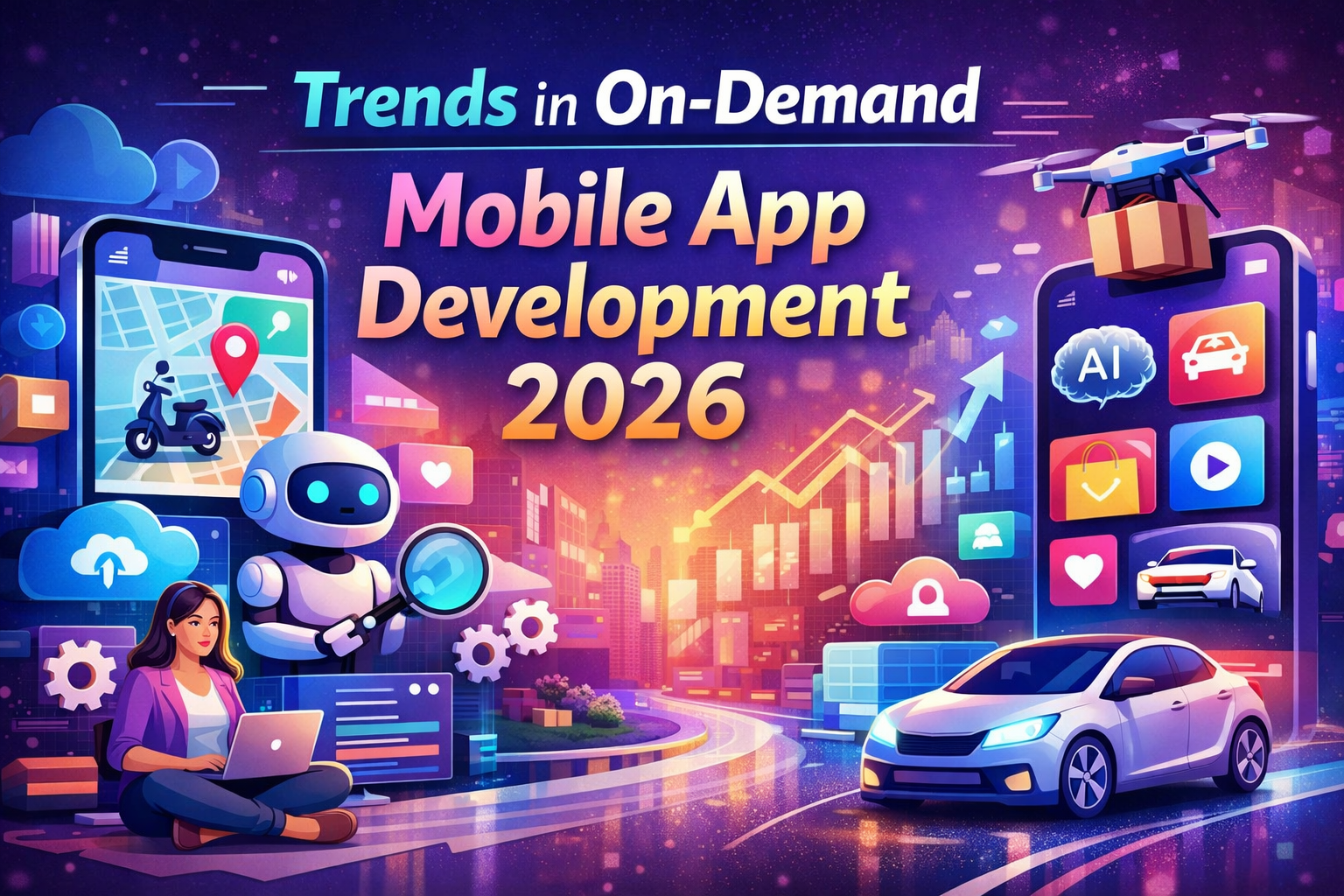
In 2026, the on‑demand mobile app space will continue its rapid evolution. As mobile usage becomes increasingly integral to daily life, consumer expectations are raising the bar for convenience, speed, personalization, and seamless experiences. Whether you’re a startup founder, a product manager, or a business seeking on demand app development services, staying ahead of emerging trends is crucial to building competitive solutions that users love and trust.
This comprehensive guide explores the most impactful trends shaping the on‑demand mobile app landscape in 2026 — from AI‑native architectures to immersive technologies and secure, scalable infrastructure.
1. AI‑First Design: Smarter, Predictive, and Personalized
Artificial Intelligence (AI) is rapidly transitioning from a feature to a core component of mobile applications. In 2026, AI will play an even more foundational role in how on‑demand mobile apps are designed, developed, and optimized. Rather than remaining a supplemental add‑on, AI will be embedded deeply into application architectures, powering real‑time decision‑making, predictive experiences, and automated workflows.
Why AI Matters for On‑Demand Apps
- Predictive personalization: Apps will anticipate user needs and tailor interactions, content, and recommendations based on behavior patterns and contextual signals.
- Smart automation: AI can automate repetitive tasks like order categorization, routing service requests, and dynamic pricing adjustments without human intervention.
- Enhanced user engagement: Intelligent assistants and chatbots will supplement human support, improving interaction responsiveness and overall satisfaction.
For businesses investing in custom on demand mobile app development, prioritizing AI capabilities helps ensure your product remains competitive and responsive to real‑world user behavior.
2. Cross‑Platform Development: Speed, Reach, Consistency
Cost, speed, and market reach have always driven the adoption of cross‑platform frameworks. In 2026, these tools — including React Native, Flutter, and Kotlin Multiplatform — will mature further, enabling developers to deliver high‑performance experiences that feel native while sharing a majority of the codebase across platforms.
Benefits of Cross‑Platform for On‑Demand Solutions
- Unified user experience: Users receive consistent app performance and UI regardless of their device.
- Faster development cycles: Sharing common codebases accelerates time‑to‑market for new features and updates — a key advantage for dynamic on‑demand environments.
- Cost‑efficiency: Reducing redundant work between iOS and Android lowers development and maintenance costs, especially valuable for emerging businesses.
Companies looking for on demand app development services often weigh cross‑platform strategies carefully to balance performance and cost — particularly when launching MVPs or scaling user engagement quickly.
3. Immersive Tech — AR, VR, and Extended Reality (XR)
Augmented Reality (AR) and Virtual Reality (VR) technologies are quickly moving beyond early experimentation toward real business applications. By 2026, mobile on‑demand apps will increasingly leverage extended reality (XR) to bridge digital and physical experiences.
Use Cases in On‑Demand Contexts
- Retail and hospitality: AR can help users visualize products before purchase or explore service options in immersive environments.
- Remote services: Virtual previews or consultative experiences — like trying a new haircut style or previewing a home service scope — will enrich user interaction.
- Training and simulation: VR offers hands‑on guidance for technicians or service providers within the on‑demand economy, enhancing efficiency and reducing errors.
These technologies not only heighten engagement but also unlock new monetization pathways for advanced on demand app development solutions.
4. Next‑Gen Connectivity: 5G and Beyond
Connectivity is the backbone of any on‑demand experience. With the widespread rollout of 5G and early groundwork toward 6G, on‑demand mobile apps will gain unmatched capabilities in data speed, responsiveness, and real‑time interaction.
What Faster Networks Enable
- Low latency interactions: Critical for real‑time tracking (e.g., delivery ETA updates & live driver locations).
- Rich media experiences: High bandwidth supports immersive AR/VR interactions, high‑quality streaming, and data‑intensive features.
- Improved IoT integration: Network advancements enhance connectivity between apps and smart devices, from wearables to smart home systems.
For teams planning custom on demand app development, network readiness should be factored into architecture planning to maximize performance globally.
Also read here: Emerging Trends in On‑Demand App Development You Need to Know
5. Seamless Multi‑Service Ecosystems and Super Apps
Instead of niche, single‑purpose applications, 2026 will increasingly see super apps and multi‑service ecosystems emerge — platforms that combine multiple related services under one roof. This trend has already flourished in Asia and is gaining traction in Western markets.
Key Characteristics of Super Apps
- Multiple integrated services: Users can access food delivery, ride‑hailing, payments, healthcare, and more without switching platforms.
- Unified user account: One login, single wallet, and consolidated usage history improve convenience and retention.
- High user engagement: By reducing context switching, super apps deepen user interaction and increase lifetime value.
This shift impacts how on demand app development companies design system architecture, data flows, and monetization strategies.
6. Low‑Code and No‑Code Tools for Rapid Development
Low‑code and no‑code platforms are transforming how mobile apps are built — democratizing development and enabling rapid prototyping, iteration, and launch. These tools, once confined to internal applications, are increasingly being used to build customer‑facing capabilities at scale.
Advantages for Businesses
- Speed to market: Create robust MVPs without lengthy coding cycles.
- Cross‑team collaboration: Non‑technical stakeholders can shape product design and logic, fostering alignment with business goals.
- Cost savings: Reduces reliance on heavy engineering resources for early iterations.
However, complex on‑demand systems with real‑time tracking, payments, and logistics will still benefit from professional on demand app development services to ensure scalability, security, and long‑term maintainability.
7. Blockchain, Decentralization & Enhanced Security
Security and data privacy are critical — especially for on‑demand apps that handle user location, payment information, and personal data. By 2026, blockchain technologies and decentralized identity models will help enhance transparency and protect sensitive information.
Emerging Security Patterns
- Decentralized identity systems: Users retain control of personal data while maintaining secure authentication.
- Tamper‑proof ledgers: Blockchain can secure transaction logs, reduce the risk of fraud, and improve auditability.
- Biometric and continuous authentication: Advanced verification methods — combining facial recognition, behavioral patterns, and biometric signatures — further protect users without friction.
For any business investing in on demand app development solutions, robust security isn’t just best practice — it’s a differentiator that builds trust and compliance in an era of strict data regulations.
8. Sustainability, Ethics, and Responsible UX
User expectations are evolving beyond functionality — they now include ethical, sustainable, and transparent digital experiences. In 2026, this trend will extend into mobile development.
What Responsible App Design Looks Like
- Energy‑efficient apps: Optimizing code and reducing server loads to minimize carbon footprint.
- Transparent privacy policies: Clear disclosures about data collection and usage.
- Inclusive UX design: Accessibility considerations that make apps usable for diverse audiences.
This people‑centred approach strengthens brand trust and retention — key outcomes for any on‑demand service app.
Conclusion
Looking ahead to 2026, the landscape of on‑demand mobile services will be dynamic, user-focused, and technologically advanced. Success—whether through building a custom app, choosing the right development partner, or upgrading existing platforms—will depend on embracing AI-driven personalization, leveraging cross-platform and immersive technologies, and ensuring flawless connectivity and performance.
At the same time, prioritizing security, privacy, and ethical design will be crucial for building trust and maintaining compliance. By aligning your product strategy with these trends and collaborating with developers who understand both technology and user behavior, your on‑demand solution will be well-positioned to thrive in 2026 and beyond.

















Leave a Reply