

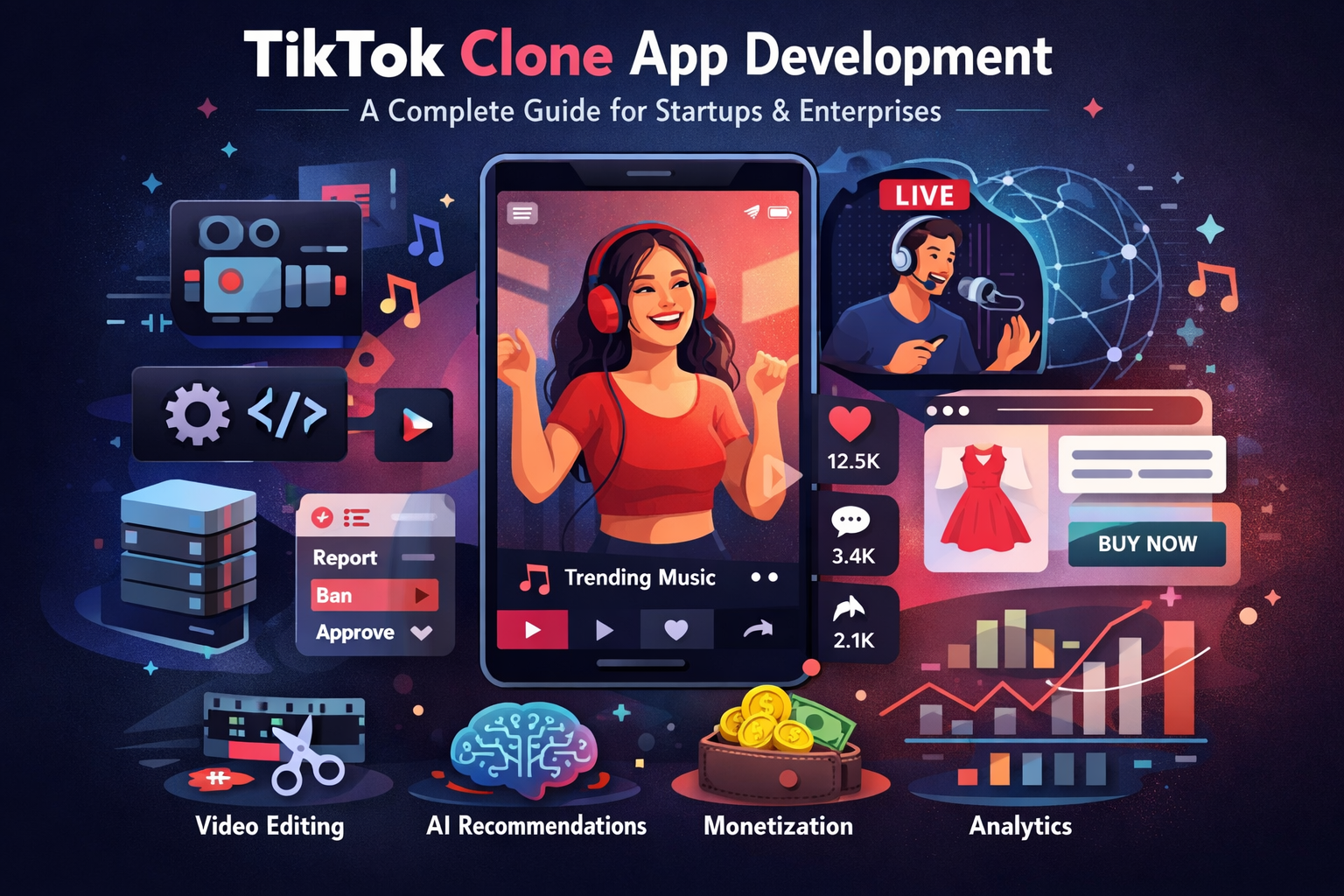
TikTok has reshaped how people consume content by making short-form video fast, addictive, and highly personalized. Today, startups and enterprises alike want to replicate this success by building a powerful short video platform with creator tools, smart recommendations, and scalable infrastructure. That’s exactly where TikTok clone app development becomes a high-opportunity product strategy.
However, building a successful TikTok-style platform is not just about copying the UI. The real complexity lies in video processing, real-time performance, moderation, recommendation engines, creator monetization, and scaling to millions of users. This guide explains everything you need to know, from features and tech stack to cost, timeline, monetization, and launch strategy.
Understanding What a TikTok Clone App Really Is and Why Businesses Want One
A TikTok clone is a short-video social media platform that allows users to record, edit, upload, and share vertical videos with music, effects, filters, and interactive engagement features. It also includes a personalized feed driven by algorithms and user behavior.
Businesses choose TikTok clone development for several strong reasons:
The market demand for short-form video keeps growing
Short videos are now the most consumed content format globally. They perform better than static content, are more shareable, and have higher retention. For a new app, this format increases the chances of daily usage and viral growth.
Multiple industries can use this model beyond entertainment
Many companies assume TikTok is only for dance videos or influencers. In reality, the short-video model works for:
- Education and micro-learning
- Fitness and wellness coaching
- Travel and food discovery
- E-commerce product demos
- Beauty tutorials
- News and local community content
- Real estate tours
- B2B explainers and recruitment content
Startups can build niche communities faster
Instead of competing with TikTok directly, many startups win by targeting a niche audience with stronger community features, curated feeds, and specialized creator tools.
Enterprises can build branded creator ecosystems
Large brands and media companies can build their own creator platforms where they control content, ads, monetization, and data.
How a TikTok Clone Works Behind the Scenes and What Makes It Technically Complex
From a user perspective, the app looks simple: scroll, watch, like, comment, upload. But behind the scenes, it involves heavy systems that must work together flawlessly.
Core systems that power a TikTok-style platform
A production-grade TikTok clone development project typically includes:
- Video recording and editing engine
- Upload pipeline and transcoding system
- Content delivery network (CDN) for fast playback
- Feed ranking algorithm
- User graph (followers, interactions, watch history)
- Search engine and hashtag indexing
- Notification system
- Moderation and reporting tools
- Analytics and retention tracking
- Creator monetization and payout system
Why scaling is the biggest challenge
A short-video app is more demanding than most social apps because:
- Video files are large
- Users scroll fast, triggering constant playback
- Buffering destroys retention
- Recommendation must feel accurate instantly
- Storage and bandwidth costs grow quickly
This is why building a TikTok clone is not a basic social media project. It is a high-scale media product.
Must-Have Features for TikTok Clone App Development (User, Creator, and Admin)
A successful platform needs a full ecosystem: user experience, creator tools, and admin control. Below is a detailed feature breakdown.
User-side features that create daily engagement
A TikTok clone must provide an addictive experience for viewers. Key features include:
Personalized For You feed
This is the heart of the platform. It should consider:
- Watch time and completion rate
- Replays and pauses
- Likes, comments, shares
- Follow behavior
- Category preferences
- Location and language
- Trending content signals
Following feed
A separate feed where users only see content from accounts they follow.
Video interactions
Users must be able to:
- Like and unlike
- Comment and reply
- Share externally and internally
- Save to favorites
- Copy link
- Duet or remix (optional but highly viral)
User profiles
Profiles should include:
- Bio and links
- Followers and following
- Video grid
- Liked videos (optional privacy)
- Saved videos
- Creator badge verification (optional)
Search and discovery
A high-performing search experience must include:
- Accounts
- Hashtags
- Sounds
- Video titles and captions
- Trending topics
- Categories
Push notifications
Notifications are essential for retention, including:
- Likes and comments
- New followers
- Replies and mentions
- Creator uploads
- Live sessions
- System announcements
Creator-side features that drive content production
Creators are your supply engine. If creators don’t have great tools, the platform dies.
In-app video recording
This should support:
- Front/back camera
- Multiple segments
- Timer recording
- Speed controls
- Beauty filters (optional)
Editing tools
Creators expect a powerful editor:
- Trim and cut
- Merge clips
- Add text overlays
- Add stickers and GIFs
- Add transitions
- Auto captions
- Voiceover recording
- Background noise reduction (advanced)
Music and sound library
A TikTok clone needs:
- Licensed music (or royalty-free alternatives)
- Sound effects
- Original audio extraction
- Save sound for later
- Trending sounds
Hashtags and tagging
Creators must be able to:
- Add hashtags
- Tag people
- Add location
- Add categories
Drafts and scheduled posting
Draft saving is essential. Scheduling is a premium feature that improves creator loyalty.
Admin panel features for control, safety, and growth
No TikTok clone can survive without strong admin tools.
Content moderation dashboard
Admins should be able to:
- Review flagged videos
- Remove content
- Issue warnings
- Ban users
- Shadowban accounts
- Moderate comments
User management
Admin controls should include:
- Account verification
- Device-level bans
- Region restrictions
- Profile edit permissions
- Reporting history
Analytics and reporting
Admins need dashboards for:
- Daily active users
- Retention cohorts
- Watch time
- Upload volume
- Trending hashtags
- Creator performance
- Ad performance
Monetization controls
Admins should manage:
- Ad placements
- Creator payouts
- Subscription plans
- Transaction history
- Refund and dispute handling
Advanced Features That Make Your TikTok Clone Competitive in 2026
If you want your app to stand out, you need more than basic features. Here are advanced options that can significantly improve growth and monetization.
Live streaming and real-time engagement
Live streaming drives longer sessions and creator earnings. It requires:
- Low-latency streaming
- Live chat
- Moderation tools
- Gifts and coins
- Live replay saving
AI-powered recommendations and content personalization
Instead of a basic feed, modern platforms use AI models to:
- Predict user interest faster
- Detect content category automatically
- Optimize video ordering
- Reduce repetitive content
- Improve retention for new users
AI moderation and safety automation
AI can detect:
- Nudity or explicit content
- Hate speech
- Violent content
- Copyright violations
- Spam patterns
- Bot behavior
This reduces manual moderation costs and helps protect your platform legally.
In-app e-commerce integration
Short videos are now a shopping channel. Your TikTok clone can support:
- Product tagging
- Creator storefronts
- Affiliate links
- Checkout integration
- Order tracking
- Brand partnerships
Duet, remix, and collaboration tools
Collaboration creates virality. Features include:
- Duet video layout
- Side-by-side reactions
- Stitching a segment of another video
- Remixing audio
Multi-language support and regional feeds
To expand globally, your TikTok clone development should support:
- Multi-language UI
- Region-based trending
- Language-specific recommendations
- Country-specific compliance
Choosing the Right Tech Stack for TikTok Clone Development
The tech stack determines your app’s performance, scalability, and cost. Below is a practical breakdown.
Frontend development options
For mobile apps, you can choose:
Native development
- iOS: Swift
- Android: Kotlin
Best for maximum performance, especially for video.
Cross-platform development
- Flutter
- React Native
Faster and cheaper for MVPs, but may need optimization for video-heavy experiences.
Backend development options
A TikTok clone backend should be built for scale.
Popular choices include:
- Node.js (fast and real-time friendly)
- Python (great for AI and recommendation systems)
- Java (enterprise-grade stability)
- Go (high performance for media services)
Database and storage requirements
A short video app needs multiple data layers:
- PostgreSQL for structured data
- MongoDB for flexible content metadata
- Redis for caching feeds and sessions
- Elasticsearch for search
- Object storage for videos (AWS S3 or similar)
Video processing pipeline
This is one of the most important components.
You will need:
- Transcoding (FFmpeg-based services)
- Adaptive bitrate streaming
- Multiple video resolutions
- Thumbnail generation
- CDN integration
Cloud infrastructure and scalability
Most TikTok clone platforms use:
- AWS, Google Cloud, or Azure
- Kubernetes or Docker for microservices
- CDN for global video delivery
- Load balancing and auto-scaling
Building a Recommendation Engine for a TikTok Clone Without Overcomplicating It
Many startups believe they must build a complex AI model from day one. That is not true. A recommendation system can evolve in stages.
Stage 1: Rule-based recommendations (MVP)
In early versions, you can use:
- Trending videos
- Category filters
- Location-based content
- Simple engagement scoring
This is enough to launch and test user behavior.
Stage 2: Collaborative filtering (growth phase)
Once you have data, you can recommend content based on:
- Similar users
- Similar watch history
- Shared hashtags and audio usage
Stage 3: Machine learning ranking (scale phase)
At scale, you can use ML ranking models that optimize:
- Watch time
- Completion rate
- Retention probability
- Creator diversity
- Content freshness
This staged approach makes TikTok clone development realistic for startups while still enabling enterprise-grade growth later.
Monetization Models That Actually Work for TikTok-Style Platforms
Monetization must be designed early because it impacts features, analytics, and compliance.
In-app advertising
This includes:
- Feed ads
- Brand takeovers
- Sponsored challenges
- Creator ads and partnerships
Creator monetization (coins, gifts, tips)
Users buy coins, then gift creators. The platform takes a percentage.
Subscriptions
Offer premium subscriptions such as:
- Ad-free browsing
- Exclusive creator content
- Advanced editing tools
- Verified badges
Brand marketplace
A marketplace allows brands to:
- Discover creators
- Sponsor campaigns
- Track performance
- Manage payments
E-commerce commissions
If you enable product tagging, you can earn commissions on purchases.
TikTok Clone App Development Cost Breakdown and Timeline
Cost depends heavily on your scope, platform choice, and scalability requirements.
MVP cost estimate
An MVP TikTok clone typically includes:
- Login
- Feed
- Upload
- Basic editing
- Likes/comments
- Profiles
- Admin panel
Estimated cost: $5,000 to $10,000
Timeline: 10 to 18 weeks
Mid-level platform cost estimate
This includes:
- Better moderation
- Search
- Hashtags
- Notifications
- Improved recommendation
- Analytics
Estimated cost: $10,000 to $20,000
Timeline: 4 to 7 months
Enterprise-grade TikTok clone development cost
This includes:
- AI recommendation
- Live streaming
- Monetization systems
- Multi-region scaling
- Advanced security
- Compliance and reporting
Estimated cost: $20,000 to $25,000+
Timeline: 7 to 14 months
Security, Privacy, and Compliance Requirements You Cannot Ignore
Short video apps handle massive user-generated content, which creates serious legal and compliance responsibilities.
User privacy and data protection
Your TikTok clone must support:
- GDPR compliance (EU)
- CCPA compliance (California)
- Data deletion requests
- Transparent privacy policy
- Consent management
Copyright and music licensing
If you allow mainstream music, you must address licensing. Many startups use:
- Royalty-free libraries
- Licensed APIs
- User-uploaded original audio only
Child safety and content restrictions
If minors can use your app, you must include:
- Age verification
- Restricted content categories
- Parental controls
- Strong reporting tools
Platform abuse prevention
A mature TikTok clone development project includes:
- Anti-bot protection
- Rate limiting
- Device fingerprinting
- Spam detection
- Fraud prevention for coin purchases
Step-by-Step TikTok Clone Development Process From Idea to Launch
A structured process reduces risk and prevents wasted development.
Step 1: Define the niche and unique value proposition
Don’t just build a generic TikTok clone. Define:
- Who your users are
- What content categories you focus on
- Why creators should join your platform
- What makes your feed better or different
Step 2: Create a feature roadmap and MVP scope
Focus on the minimum required to launch:
- Video feed
- Upload
- Engagement
- Creator tools
- Admin moderation
Step 3: UI/UX design optimized for retention
Retention depends on:
- Fast video playback
- Smooth scrolling
- Minimal steps to upload
- Clear creator controls
- Simple onboarding
Step 4: Backend architecture and media pipeline setup
This is where your scalability is decided. Build:
- Upload service
- Video transcoding pipeline
- CDN setup
- Database structure
- Feed service
Step 5: App development and integrations
Build:
- Mobile app
- Admin panel
- APIs
- Payment gateways
- Notification services
Step 6: Testing for performance and video stability
Short video apps require:
- Load testing
- Playback stress tests
- Upload failure testing
- Network speed optimization
- Device compatibility testing
Step 7: Launch, growth experiments, and analytics
After launch, focus on:
- Creator acquisition
- Content seeding
- Referral campaigns
- Retention improvements
- Feed optimization
Common Mistakes Startups Make During TikTok Clone Development
Avoiding these mistakes can save months of time and huge costs.
Building too many features before validating the MVP
Many founders waste money by building live streaming, e-commerce, and AI too early. Start with the core loop: watch, interact, create, repeat.
Ignoring moderation until after launch
Without moderation, your platform can quickly become unsafe, leading to user churn and app store removal.
Underestimating video infrastructure costs
Storage and bandwidth costs scale fast. You must plan for CDN usage and compression.
Copying TikTok without building differentiation
If your app looks and feels exactly like TikTok, users won’t switch. You need a niche angle, community features, or creator incentives.
Not focusing on creator retention
Creators need:
- Tools
- Monetization
- Visibility
- Fair recommendation distribution
How Startups and Enterprises Should Approach TikTok Clone Development Differently
Both startups and enterprises can build a TikTok clone, but their priorities differ.
Startup approach
Startups should prioritize:
- MVP speed
- Niche targeting
- Community building
- Creator acquisition
- Iterative improvements
Enterprise approach
Enterprises should prioritize:
- Compliance and legal readiness
- Brand safety
- Scalable architecture
- Multi-region rollout
- Monetization and reporting
Conclusion
TikTok clone app development is one of the most high-potential product opportunities for startups and enterprises, but it is also one of the most technically demanding. Success depends on more than copying a UI. A winning TikTok clone must deliver fast video playback, strong creator tools, safe moderation, scalable infrastructure, and a recommendation system that keeps users hooked. With the right MVP strategy, staged AI development, and long-term monetization planning, TikTok clone development can become a powerful platform business with massive growth potential.
FAQs
What is a TikTok clone and who should build one?
A TikTok clone is a short-form video platform that supports video creation, editing, sharing, and personalized feeds. Startups can build niche community apps, while enterprises can create branded creator ecosystems with full control over content and monetization.
How long does TikTok clone app development take?
An MVP can take 10 to 18 weeks, a mid-level product can take 4 to 7 months, and an enterprise-grade platform with live streaming and AI can take 7 to 14 months depending on scope.
What is the average cost of TikTok clone development?
A basic MVP may cost $5,000 to $20,000, while a full-featured scalable product can cost $20,000 to $25,000 or more depending on infrastructure, AI, and monetization requirements.
What are the most important features in a TikTok clone?
The most important features include a personalized feed, fast video playback, upload and editing tools, engagement features (likes/comments/shares), search, hashtags, notifications, and an admin moderation panel.
Can a TikTok clone be built using Flutter or React Native?
Yes, a TikTok clone can be built using Flutter or React Native, especially for MVPs. However, native development often provides better performance for heavy video playback and advanced editing features.
How do TikTok clone apps handle video storage and streaming?
Most platforms use cloud object storage for videos, a transcoding pipeline to create multiple resolutions, and a CDN to deliver videos quickly worldwide with minimal buffering.
Is it possible to build a TikTok clone without an AI recommendation engine?
Yes. Many platforms start with rule-based recommendations and trending logic. As the app collects user data, it can evolve into collaborative filtering and later machine-learning ranking models.
What monetization options work best for a TikTok clone platform?
The best monetization options include in-feed ads, creator gifts and coins, subscriptions, brand sponsorship marketplaces, and e-commerce commissions through product tagging.

















Leave a Reply