

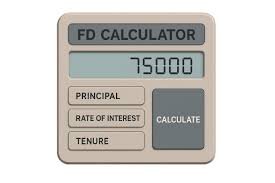
Fixed Deposits (FDs) are one of the most popular savings instruments in India, offering stability and moderate returns. Many investors turn to an FD Interest Rates Calculator to estimate potential income before making investment decisions. This digital tool simplifies complicated calculations by giving accurate estimations of the maturity amount and interest earned. In this article, we delve into how the FD Interest Rates Calculator works and the variables it considers while estimating income from an FD plan.
Understanding the Basics of Fixed Deposits (FDs)
A Fixed Deposit is a financial instrument that allows individuals to deposit a lump sum amount for a fixed tenure at a predetermined interest rate. These deposits earn interest over time, which can be paid at regular intervals (monthly, quarterly, or annually) or compounded until maturity. Unlike volatile market instruments, FDs provide assured returns, making them a preferred choice for risk-averse investors.
An FD Interest Rates Calculator is an online tool that quickly calculates the returns on an FD, factoring in the principal amount, interest rate, compounding frequency, and tenure of the deposit. The tool acts as a quick solution to assess the potential earnings from an FD plan.
How Does the FD Interest Rates Calculator Estimate Income?
To estimate FD income, the FD Interest Rates Calculator uses two key formulas based on whether the interest is calculated through simple interest (SI) or compound interest (CI). Here’s how it works:
1. Simple Interest Calculation
Simple interest is calculated using the formula: SI = (Principal × Rate × Time) / 100
- Principal: The amount you invest in the FD.
- Rate: Annual fixed interest rate applicable on the deposit.
- Time: Tenure of the FD (in years).
Example of Simple Interest Calculation
Consider depositing ₹1,00,000 in an FD for three years at an interest rate of 6% per annum (SI).
SI = (1,00,000 × 6 × 3) / 100 = ₹18,000
Here, the total interest earned is ₹18,000, and the maturity amount will be:
Maturity Amount = Principal + Interest = ₹1,00,000 + ₹18,000 = ₹1,18,000
2. Compound Interest Calculation
Compound interest is calculated using the formula: Maturity Amount = Principal × (1 + Rate / n)^(n × t)
- n: Number of compounding periods in a year (Quarterly = 4, Half-yearly = 2, Annually = 1).
- t: Tenure in years.
Here, the interest is reinvested after each compounding frequency, generating more returns in the long term.
Example of Compound Interest Calculation
If you deposit ₹1,00,000 in an FD with a 6% annual interest rate compounded quarterly for three years:
Maturity Amount = 1,00,000 × (1 + 6 / (4 × 100))^(4 × 3)
Maturity Amount = 1,00,000 × (1 + 0.015)^12
Maturity Amount = 1,00,000 × (1.015)^12 ≈ ₹1,19,418
The total interest earned will be:
Total Interest = Maturity Amount − Principal = ₹1,19,418 − ₹1,00,000 = ₹19,418
It is evident that compounding generates higher returns compared to simple interest when all other factors remain constant.
Key Inputs for Accurate Results
An FD Interest Rates Calculator requires the following inputs to provide accurate income estimations:
- Principal Amount: This is the amount initially invested in the FD. Higher principal amounts naturally yield higher interest.
- Interest Rate: This is the predetermined annual interest rate at which the deposit grows. FD interest rates may vary between banks and financial institutions based on their policies, market conditions, and tenure.
- Tenure: The tenure refers to the total duration of the FD. It is usually expressed in days, months, or years. Most calculators have options for users to specify this duration according to their preferences.
- Compounding Frequency: FD interest is typically compounded annually, semi-annually, quarterly, or monthly. Higher compounding frequency leads to higher returns.
- Payout Preference: Investors can opt for periodic interest payouts or allow the interest to compound. In the case of payout options, the calculator provides regular income estimations.
Example Scenarios to Understand FD Returns
Scenario 1: Single Lump Sum Deposit
- Principal: ₹2,00,000
- Interest Rate: 6.5% per annum
- Tenure: 5 years
- Compounding Frequency: Annual
Using the compound interest formula:
Maturity Amount = 2,00,000 × (1 + 6.5 / (1 × 100))^(1 × 5)
Maturity Amount = 2,00,000 × (1.065)^5 ≈ ₹2,74,924
Total interest earned: ₹2,74,924 − ₹2,00,000 = ₹74,924
Scenario 2: Quarterly Compounding
- Principal: ₹3,00,000
- Interest Rate: 7% per annum
- Tenure: 3 years
- Compounding Frequency: Quarterly
Maturity Amount = 3,00,000 × (1 + 7 / (4 × 100))^(4 × 3)
Maturity Amount = 3,00,000 × (1 + 0.0175)^12 ≈ ₹3,69,396
Total interest earned: ₹3,69,396 − ₹3,00,000 = ₹69,396
Advantages of FD Interest Rates Calculator
Here are a few reasons why these calculators are widely used by individuals to strategize their FD plans effectively:
- Accurate Estimations: It uses precise formulas (simple or compound interest) to deliver exact numbers based on input values.
- Time Efficiency: Manual calculations can be tedious, especially for compounding interest. An FD Interest Rates Calculator delivers results within seconds.
- Ease of Use: With user-friendly interfaces, these calculators cater to both tech-savvy and non-tech-savvy individuals.
- Comparison Tool: Investors can compare various FD schemes with differing interest rates and tenures, aiding in decision-making.
Limitations of the FD Interest Rates Calculator
While an FD Interest Rates Calculator is undoubtedly useful, it has some limitations:
- No Consideration of Taxation: The calculator does not account for Tax Deducted at Source (TDS) on FD interest, which lowers net earnings.
- Inability to Factor in Fluctuating Interest Rates: This tool assumes a fixed interest rate, whereas in real-world scenarios, rates may change, especially for reinvested deposits.
- No Provisions for Premature Withdrawals: If you choose to break your FD before maturity, penalty charges may apply, altering your final income.
Summary: How FD Interest Rates Calculator Estimates Income?
An FD Interest Rates Calculator is an efficient tool that simplifies the process of determining potential FD returns. This tool calculates income using formulas for both simple and compound interest, depending on factors like principal amount, interest rates, tenure, and compounding frequency. For example, a ₹1,00,000 deposit for three years at a 6% annual interest rate compounded quarterly would yield around ₹19,418, while the same amount with simple interest would yield only ₹18,000.
Always remember that while FD plan provide stable and assured returns, taxation on interest and premature withdrawal penalties can impact final earnings. Thus, use an FD Interest Rates Calculator for initial estimations but also consider other factors when making your investment choices.
Disclaimer
The calculations and illustrations in this article are for informational purposes only. The actual returns may vary based on taxes, penalties, and prevailing market conditions. Investors are advised to consult a financial advisor or conduct thorough research before making investment decisions in any financial market, including India.























Leave a Reply