

You know that specific kind of headache you get when you’re three floors up, ready to start breaking concrete, and you realize your extension cord is about six inches too short? Or that sinking feeling when the generator sputters and dies right in the middle of a crucial cut?
If you work in construction, you’ve definitely been there. For decades, we’ve accepted these annoyances as the cost of doing business. We treat power cords like necessary evils—tethers that keep us productive but also constantly trip us up (sometimes literally).
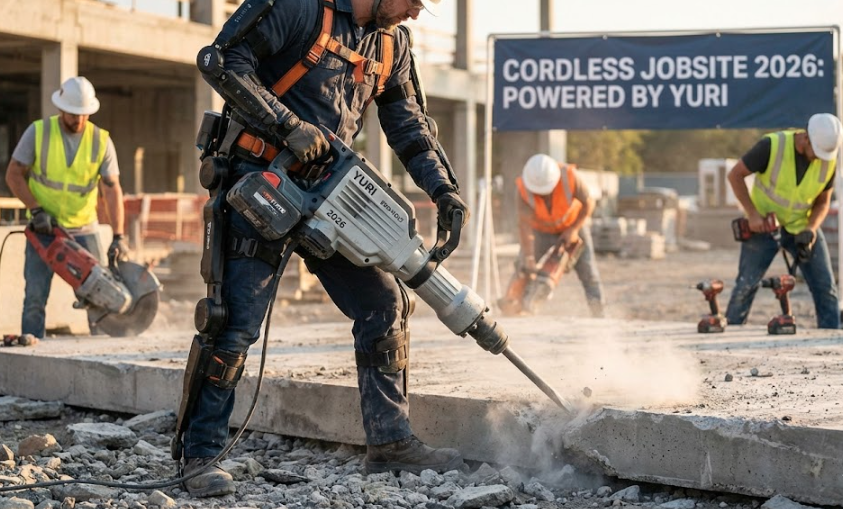
But here is the thing: the industry is changing fast. The old idea that “cordless equals weak” is dead and buried. By 2026, we won’t just see cordless drills hanging from belts; we’ll see massive demolition hammers ripping through reinforced concrete without a plug in sight.
We are heading toward the “Cordless Jobsite,” and honestly, it can’t come soon enough. This isn’t just about convenience; it’s about the bottom line. In this business, mobility is profit. Every minute you spend untangling orange spaghetti is a minute you aren’t billing for. Let’s dig into what the jobsite of the future looks like and how professional power tools are finally cutting the cord for good.
The Ball and Chain: Why We Stuck with Cords for So Long
Let’s be real for a second. We didn’t stick with corded tools because we loved dragging hundred-foot cables through mud. We stuck with them because we had to.
For a long time, battery technology just couldn’t keep up with the demands of heavy-duty industrial drilling or demolition. You could maybe hang a picture frame with a battery drill, but breaking up a slab? Forget it. You needed raw, consistent power, and the grid (or a massive diesel generator) was the only way to get it.
Corded tools were reliable workhorses. They didn’t run out of juice halfway through the day. But they also turned every jobsite into an obstacle course. You have trip hazards everywhere. You have the constant noise and fumes of generators. And you have the sheer logistical nightmare of setting up power distribution before you can even crack your first brick. It’s like trying to walk a dog that refuses to move—you get where you’re going eventually, but it’s a struggle every step of the way.
The Battery Tech That Changed the Game
So, what changed? In short: everything under the hood.
We aren’t talking about the nickel-cadmium batteries of the early 2000s that died if you looked at them wrong. We are looking at high-output Lithium-Ion and emerging solid-state technologies that pack a serious punch.
Modern battery cells discharge energy faster and cooler than ever before. This allows cordless power tools to match—and in some cases, exceed—the torque and sustained power of their corded ancestors.
It’s like swapping out a lawnmower engine for a V8. Suddenly, that demolition hammer doesn’t just chip away at the surface; it obliterates it. We are seeing voltage platforms jumping from 18V to 40V, 60V, and even higher. This leap in tech means the tool doesn’t bog down when you lean into it. It pushes back.
2026: A Day in the Life of a Cordless Jobsite
Imagine walking onto a site in 2026. The first thing you notice? The silence.
Okay, maybe not total silence—construction is loud work—but the background hum of idling generators is gone. The spiderweb of yellow and orange extension cords is missing. The floor is clear.
You watch a crew prep for a tear-down. Instead of spending the first hour hauling cables and setting up power spiders, they just open their cases. They snap oversized battery packs into heavy-duty breakers and get straight to work.
A worker on scaffolding uses a high-torque impact wrench to disassemble steel beams, moving freely from one section to another without worrying about snagging a line. Another operator handles industrial drilling deep into a concrete pillar, powered entirely by a backpack battery unit that lasts until lunch.
This is the Cordless Jobsite. It’s cleaner, it’s quieter, and safer. But most importantly, it’s faster. The flow of work isn’t dictated by where the power outlet is; it’s dictated by where the work needs to happen.
Why Mobility Equals Profit
I’ve heard plenty of old-school foremen say, “I don’t trust batteries. I trust the wall.” I get it. Change is scary, especially when deadlines are tight. But let’s look at the math.
Think about the setup and teardown time for a typical heavy demolition job. Running power can take chunks out of your morning and evening. If you cut that time out, you gain hours of productivity every week. Over a year, that adds up to serious money.
Then consider the safety aspect. Trips and falls over cables are one of the most common jobsite accidents. Eliminating cords eliminates that risk. Fewer accidents mean lower insurance premiums and less downtime.
And let’s not forget the versatility. With cordless professional power tools, you can bid on jobs that don’t have active power hookups yet. You can work in remote locations without hauling a tow-behind generator. You become the crew that can start working the minute you pull up to the curb. That is a competitive edge you can’t ignore.
The Bridge to the Future: Yuri Smart Engineering
Of course, buying into this future requires trust in the tools. You need gear that won’t flake out on you when the going gets tough.
This is where brands like the Yuri Group come into the picture. Since 2006, Yuri Smart Engineering has been putting high-performance power tools into the hands of builders across India. They didn’t just pop up overnight; they’ve been watching the infrastructure sector grow and evolving right alongside it.
Yuri understands that “affordable” shouldn’t mean “disposable.” Their professional line positions itself perfectly as the bridge to this cordless future. whether it’s a precision power drill or a beast of a demolition hammer, Yuri focuses on durability and value. They know that on a real jobsite, a tool needs to take a beating and keep running.
As we move toward 2026, relying on trusted names like Yuri ensures you aren’t just buying a gadget; you’re investing in a partner for your daily grind.
Real Talk: The Challenges We Still Face
Now, I’m not going to sit here and tell you it’s all rainbows and sunshine. Going fully cordless has its growing pains.
First off, weight. Batteries are heavy. If you’re holding a tool overhead for four hours, you’re going to feel those extra pounds. Manufacturers are working on lighter, denser cells, but gravity is still gravity.
Then there is the “range anxiety.” We all have that fear of a battery dying right before the final screw goes in. Managing a cordless site means managing a charging infrastructure. You need a system—rotate the packs, keep the chargers running, don’t leave them in the sun. It adds a layer of logistics that corded tools didn’t have.
And yes, the upfront cost is higher. A bare tool plus a set of high-capacity batteries costs more than a plug-in version. You have to look at it as an investment in speed and safety rather than just a purchase.
Cutting the Cord for Good
The transition to the cordless jobsite of 2026 isn’t a sci-fi dream; it’s happening right now, one battery pack at a time.
We are watching the shackles come off the demolition industry. The freedom to move, to work anywhere, and to tear down obstacles without being tethered to a wall is transforming how we build.
It’s time to stop thinking of cordless tools as the “light duty” option. With advancements in tech and reliable partners like Yuri Group delivering professional-grade gear, the power is literally in your hands. So, take a look at your current setup. Are those cords holding you up, or holding you back?
Publisher: Techners



















Leave a Reply