

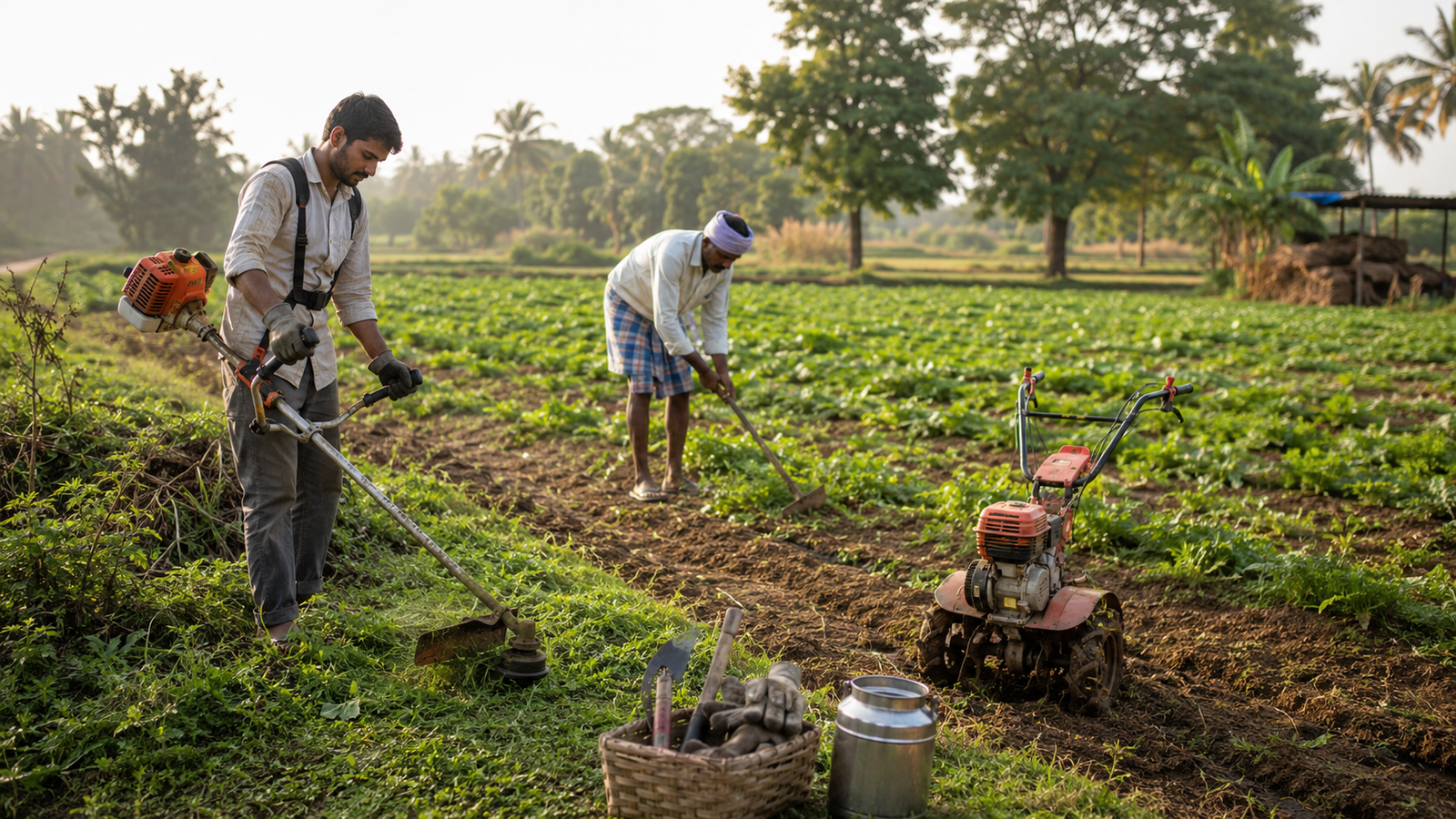
A sickle costs less than a plate of food. A brush cutter costs as much as a fortnight of hired labour. For a farmer working two or three acres, that gap is the whole decision, and the honest advice is not “buy the machine.” It is “buy the machine only where it pays back, and keep the hand tool where it still makes sense.” Both belong on a small farm. Knowing which task deserves which tool is the difference between a smart purchase and a shed full of expensive regret.
We have watched a lot of smallholders make their first jump from hand tools to powered agricultural tools, and the ones who do it well share a habit. They upgrade the task that eats the most labour first, and they leave the rest alone until the money is there. Let me walk through the main jobs the way a careful farmer would weigh them.
Clearing: where a brush cutter pays for itself fastest
Cutting back weeds, grass and light bush on the bunds and between rows is the job that punishes hands the hardest. With a sickle a worker clears slowly, bent over, all day, and on an acre of heavy growth that is a real chunk of a day’s labour gone. A brush cutter does the same acre in a fraction of the time and does not need a straight back.
If you buy one powered tool first, make it the brush cutter. The payback maths is simple where labour is hired: a couple of days of saved wages per season, season after season, against a one-time tool cost and a modest petrol bill. On a farm that pays for clearing help even twice a year, the cutter often earns its price inside the first year. The running cost is small, the skill needed is low, and the same machine handles bund grass, weeds and light undergrowth.
The catch we are honest about: a brush cutter needs fuel, a little maintenance, and a person who will actually clean and store it. A sickle needs none of that and never breaks down. For a tiny patch near the house, the sickle is still faster to grab than to fuel and start a machine.
Weeding: the second machine most smallholders should buy
Weeding between rows is the other back-breaker, and here the power weeder is the upgrade that changes a season. Hand weeding with a khurpi or spade is slow, and on a standing crop the labour adds up every few weeks. A power weeder churns the inter-row soil, uproots weeds and loosens the crust in one pass, covering ground a hand-weeder cannot match per hour.
Our view, and we will defend it: a brush cutter and a power weeder are the two highest-return first purchases for a small farm, in that order, and most other powered tools can wait. They attack the two most labour-hungry jobs on the calendar. Everything else is optimisation.
The trade-off worth naming is spacing. A power weeder needs row spacing wide enough to run between plants without damage. On very closely spaced crops, or in wet, sticky soil, hand weeding still wins because the machine either does not fit or bogs down. Match the tool to how you actually plant.
Digging and pits: keep the hand tool, mostly
Here is where we push back on the instinct to mechanise everything. For occasional digging, a spade and a pickaxe are hard to beat on a small farm. They cost little, last years, and for the handful of pits or trenches a season needs, the labour is not enough to justify a machine.
The exception is planting a lot of pits at once. If you are putting in an orchard, a fencing line, or a large batch of saplings, an earth auger drilling holes on a power head turns a two-day pickaxe job into an afternoon. But for routine, scattered digging, the pickaxe stays. Buying an auger to dig ten pits a year is money sitting idle in the shed. This is the purchase we most often talk farmers out of.
The running cost nobody puts in the sum
Farmers compare the price of a machine against the price of labour and stop there. That is only half the sum. A powered tool carries a running cost that a sickle or spade does not, and ignoring it is how a “cheap upgrade” turns sour.
Three things sit under that running cost. There is fuel or charging, small per job but real across a season. There is maintenance, an air filter here, a spark plug there, a cutting blade or nylon line to replace, and the odd trip to a mechanic. And there is the cost of a machine sitting idle when a part fails and the nearest spare is a bus ride away, which on a time-sensitive task like weeding a standing crop can cost more than the part. A hand tool has none of this. It waits in the shed for years and works the moment you pick it up.
This is why we push the brush cutter and the power weeder as the first two purchases and are cautious about the rest. Those two save enough labour, often enough, to swallow their running costs and still come out ahead. A machine used a few times a year rarely does, because the running cost and the idle-capital cost eat the thin savings. Buy the machine that works hard. Leave the one that would mostly gather dust.
Spraying: a clear win, with a caveat
Spraying is one place where even a modest upgrade helps. A hand-lever knapsack sprayer is cheap and works, but it is slow and tiring across any real area, and uneven pumping gives uneven coverage. A battery or power sprayer keeps pressure steady, covers more ground per fill, and gives a more even spray, which matters for the chemical actually doing its job.
The payback here is partly labour and partly effectiveness. Even coverage means fewer missed patches and better results from the same input cost. For anyone spraying regularly across more than an acre, the powered sprayer is an easy recommendation.
The honest limit: whatever the sprayer, protective gear is non-negotiable. Gloves, a mask and covered skin matter more than which machine you hold, and a faster sprayer just means you cover more area, so the safety discipline has to keep up.
Sharing a machine before you buy one
There is a middle path between hand tools and ownership that smallholders often overlook: sharing. A brush cutter or power weeder that would sit idle most of the year on a two-acre plot can be shared across three or four neighbouring farms, or rented from a local dealer or a custom-hiring centre for the few weeks it is needed.
For a tool you would use only a handful of times a season, this often beats buying outright. You get the labour saving without the idle capital and the maintenance burden. We would tell any farmer weighing their first machine to ask what it costs to hire one locally for a fortnight before committing to a purchase. If hiring covers your need cheaply, the smart move may be to keep hiring and spend the saved money on the one tool you genuinely use hard, usually the brush cutter, and own that outright.
The real rule: which agricultural tools earn the upgrade
Step back from the individual machines and the pattern is clear. A powered tool is worth it when the task it replaces costs you a lot of repeated labour. It is not worth it when the task is occasional, or when the hand tool is nearly as fast for a small patch.
Run every purchase through three quick questions:
- How many days of labour does this task cost me across a full year?
- Does the machine cut that labour by half or more, and how much fuel or upkeep does it add?
- Do I have the row spacing, the soil and the plot size for the machine to actually work here?
If a task eats many labour-days, the machine halves them, and your farm suits it, upgrade. Clearing and weeding almost always clear that bar. Digging and heavy tillage on a small plot often do not.
There is a genuine uncertainty we will not paper over. Fuel prices, local labour rates and how much you already pay for hired help vary so much across regions that the exact payback on any tool differs from one district to the next. A cutter that pays back in one season near a labour-short town might take two seasons where family labour is free. Do the sum with your own numbers, not a generic promise.
For the tools that do earn their place, buy from a maker with proper reach so spares and service are not a three-district journey. Yuri Tools, based in Mumbai, offers powered agricultural tools relevant to farm work, including brush cutters and related power tools, backed by a pan-India dealer network and split into the value YURI range and the premium DAYURI range. That dealer reach matters more than the brochure, because a brush cutter with no nearby spares is just a heavy paperweight the day a part fails. Start with the brush cutter, add the power weeder when the season justifies it, keep your sickle, spade and pickaxe for the jobs they still win, and let each purchase prove its payback before the next one. That is how a small farm builds a set of agricultural tools that actually earns its keep rather than a shed of machines gathering dust.
Published By: techners.net





















Leave a Reply