

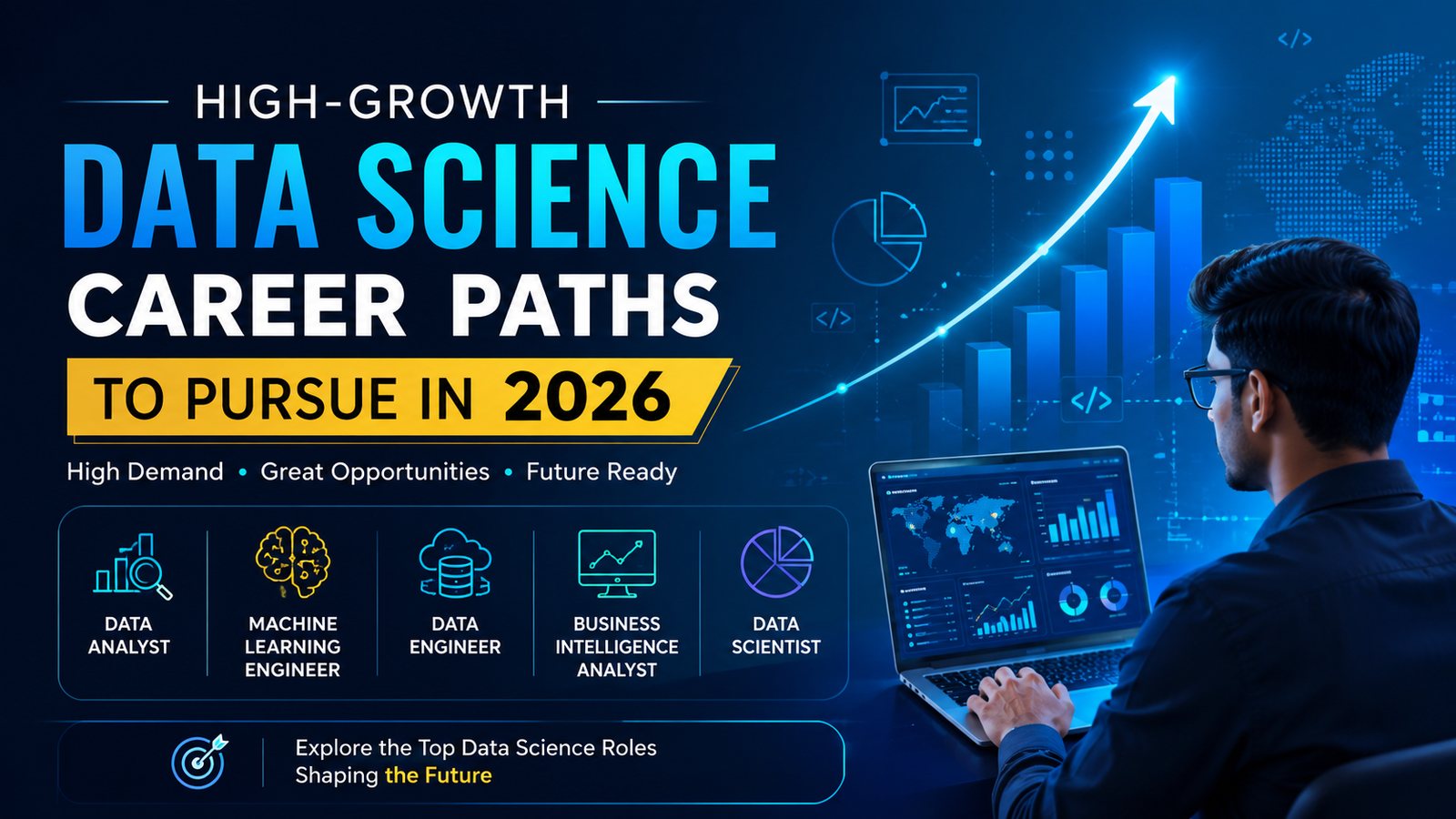
Data science has moved well past its early reputation as a niche technical field. In 2026, it sits at the center of how organizations make decisions, build products, and compete. The roles making up this profession have diversified considerably, and the salary premium attached to verified expertise has grown with them.
The State of Data Science Demand in 2026
U.S. News and World Report ranks Data Scientist 4th among the Best Technology Jobs for 2026. Robert Half’s 2026 Salary Guide places data science roles among the highest-sustained-demand positions in technology, alongside AI engineering and cloud architecture.
What has changed is not just hiring volume but what is actually being hired for. Organizations want professionals who can move across data infrastructure, machine learning pipelines, business strategy, and AI governance within the same role. That breadth is reshaping what competitive career paths look like.
As USDSI® examines in AI and Data Science Outlook Beyond 2026, the convergence of agentic AI, real-time analytics, and tightening governance requirements is already shaping what senior professionals are expected to own today.
In-Demand Data Science Career Paths and Salary Insights
The roles driving the most hiring activity in 2026 range from foundational data science to emerging AI-integrated positions, each with a distinct skill profile and salary range.
Data Scientist
The core role remains one of the most consistently in-demand positions across every major industry. Data scientists build predictive models, interpret analytical outputs, and translate findings into recommendations leadership can act on. Glassdoor USA places the average salary at $126,116 per year in 2026, with experienced professionals reaching $175,000 or more.
Machine Learning Engineer
Machine learning engineers take experimental models and build the production systems that run them reliably at scale. This role sits at the intersection of software engineering and data science and carries one of the highest salary premiums in the field. Robert Half’s 2026 Salary Guide places starting salaries between $125,000 and $190,000 in US.
AI Data Analyst
The AI data analyst has emerged as one of the fastest-growing titles in 2026. Rather than reporting on historical data, these professionals interpret machine learning outputs, validate model reliability, and turn those outputs into decisions the business can act on. Glassdoor USA reports average salaries of $131,196 per year, with top earners reaching $159,245.
Data Engineer
Data engineers design and maintain the pipelines that deliver clean, reliable data for analysis and modeling. Without this function, everything downstream suffers. According to Indeed, data engineers in the United States earn an average of $135,654 per year in 2026.
Senior Data Scientist and Data Science Leader
At the leadership level, professionals own strategy, govern AI deployments, and lead cross-functional data initiatives. The salary premium here reflects both scarcity and strategic weight. Chief Data Officers in the United States reach top salaries of $432,787 annually according to Glassdoor.
Emerging Data Science Roles in 2026 and Beyond
As AI moves from pilot to production, demand for professionals who can govern, monitor, and explain what these systems are doing is growing as fast as demand for those who build them. Listed below are top emerging data science career paths in 2026.
Agentic AI Engineer
Designs and deploys autonomous multi-agent AI systems across enterprise environments. Average salary is $191,434 per year.
ML Governance Analyst
Ensures models meet compliance, fairness, and audit standards in regulated industries. The salary range is between $130,000 to $200,000 depending on seniority and sector.
Data Observability Engineer
Monitors pipeline health and catches data quality issues before they reach models or downstream systems. The salary range is between $130,000 to $165,000 per year.
Sources: Glassdoor and ZipRecruiter USA
Skills Every Data Science Professional Needs in 2026
The skill set employers are hiring for in 2026 spans both technical execution and strategic leadership, and neither side alone is enough to sustain career growth.
Technical Skills
Python and SQL remain the baseline. Beyond that, employers are consistently seeking working knowledge of machine learning frameworks, cloud platforms including AWS, Azure, and GCP, data pipeline tools, MLOps practices, and increasingly, large language models and AI governance frameworks. At the senior level, these are no longer differentiators. They are baseline expectations.
Strategic Skills
The ability to communicate findings to non-technical stakeholders, govern data systems responsibly, and align data initiatives with business objectives is what separates mid-level practitioners from those who move into leadership. Technical depth gets professionals into the room. Strategic judgment determines how far they go.
Top Certifications to Advance Your Data Science Career
The right certification is not about foundational knowledge. It is about validating the strategic depth, technical leadership, and applied expertise that senior data science roles demand. Listed below are some of the best data science certifications to pursue in 2026.
Certified Senior Data Scientist (CSDS™) by USDSI®
Built for experienced professionals ready to lead at the organizational level. Self-paced over 4 to 25 weeks and recognized across 160 countries. Covers Data Science for Business, Big Data and Data Lakes, and DevOps and Cloud Computing, among other advanced modules.
Data Science Graduate Certificate by Stanford Online
An advanced credential from Stanford University covering machine learning, statistical modeling, AI applications, and data-driven decision-making, designed for working professionals seeking university-level recognition.
Graduate Certificate in Data Science by National University of Singapore (NUS)
Covers machine learning, analytics, and AI applications at an advanced level. A strong option for professionals in Singapore, Malaysia, and across the Asia-Pacific region, backed by one of Asia’s highest-ranked universities.
Conclusion
Data science in 2026 is not one and the same thing. It encompasses a set of interdependent positions that require different sets of technical expertise, analytical skill and strategic acumen.
The professionals that grow the fastest are those who not only develop strong hands-on tool skills but also acquire structured and verified credentials that convey readiness to employers. Among the best opportunities for data scientists to constantly evolve their careers is to acquire the highest data science certifications and develop expertise in AI and cloud-native data infrastructure.
FAQs
Is it necessary to have a computer science degree for data science?
No, employers prefer solid technical skills and many professionals are successful because of their background of mathematics, statistics, and business.
Which industries are looking for data scientists the most in 2026?
2026 is led by financial services, healthcare, retail, technology, and manufacturing.
Is certification necessary to progress up in the data science profession at mid level?
Structured credentials help to make the case for promotions and external hires a lot stronger. At this stage, the Certified Lead Data Scientist (CLDS™) by USDSI® and the Applied Data Science Program offered by MIT Professional Education are good choices.




























Leave a Reply