

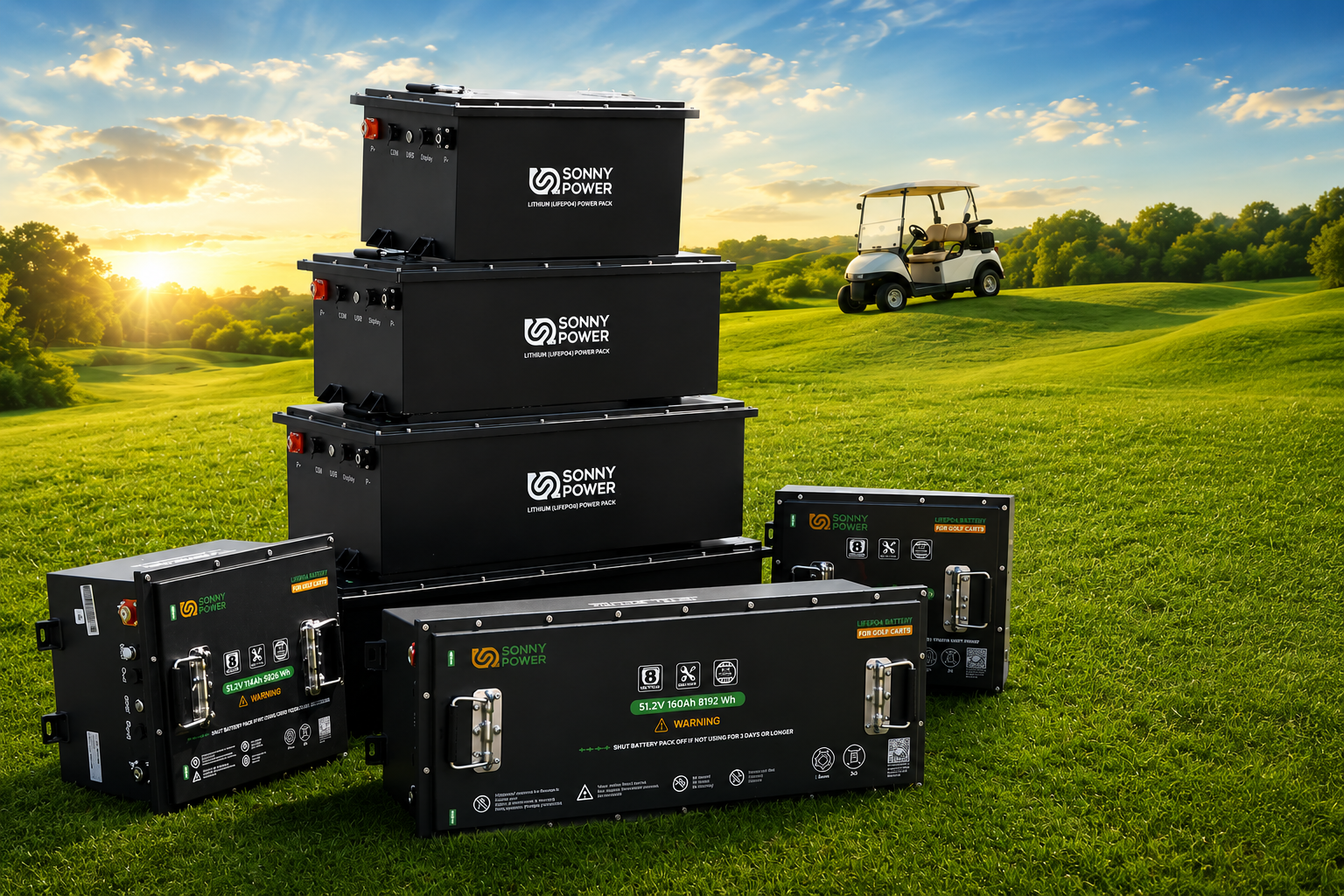
Golf cart ownership used to come with an accepted frustration. Every few years, the batteries needed replacing — heavy, expensive, never quite delivering the range the spec sheet suggested, and degrading in a way that became obvious before most owners were ready to deal with it. That frustration got accepted as part of owning a cart rather than a problem worth solving differently.
Lithium ion golf cart batteries changed that calculation. Not gradually — pretty abruptly once owners started making the switch and realising the difference wasn’t incremental.
Range That Actually Matches What’s Advertised
Lead-acid batteries have a gap between rated capacity and real-world usable capacity that most buyers don’t fully understand before purchasing. The rated figure assumes ideal conditions — moderate temperature, slow speed, flat terrain, and cells that are relatively new. Deviate from any of those variables, and the range drops noticeably.
Lithium-ion golf cart batteries close that gap considerably. Real-world range holds much closer to specification regardless of speed, terrain, or temperature. More importantly, lithium can be discharged to around twenty percent usable capacity without damage. Lead-acid shouldn’t go below fifty percent without accelerating cell degradation — which means a lithium pack with the same headline capacity actually delivers nearly twice the usable range before needing a charge.
For property owners covering large acreage, resort operations running carts across extended grounds, or anyone who finds their current cart running out before the day does — that difference is the whole point.
Charging That Works Around Actual Schedules
Lead-acid charging is slow and unforgiving. A partial charge followed by another partial charge accelerates a process called sulphation that degrades the cells and shortens the lifespan of an already time-limited battery. Full cycles required, slow overnight charging preferred, no shortcuts without consequences.
A golf cart lithium battery charges faster and handles partial top-ups without penalty. Plug in during a lunch break, add an hour of charge between uses, and stop the charge at any point without damaging the cells. The battery doesn’t require management the way lead-acid does — it just charges when plugged in and performs when needed.
Fast charging compatibility shortens full charge times dramatically compared to lead-acid equivalents. For commercial operations where cart availability throughout the day matters, that recovery time difference has real operational value.
Weight Reduction That Changes How the Cart Feels
A standard lead-acid battery pack adds significant weight to a golf cart — weight that sits in the cart permanently and affects everything from acceleration to braking to frame wear over years of use.
Lithium-ion golf cart batteries weigh a fraction of an equivalent lead-acid setup. The cart accelerates more responsively, climbs inclines with noticeably less effort, and handles with a lightness that owners coming from lead-acid notice on the first drive. Less weight also means less long-term stress on the cart’s mechanical components — motors, controllers, and frame all benefit from carrying less mass every day.
What to Look For in a Lithium Conversion
Battery management system quality matters enormously. A lithium pack without proper BMS protection — overcharge protection, over-discharge cutoff, thermal management, cell balancing — is a lithium pack that won’t deliver the lifespan or safety the technology is capable of. The BMS is what separates a quality lithium conversion from a cheap one.
Compatibility with the existing charger and motor controller also needs confirming before conversion. Not all lead-acid chargers work correctly with lithium chemistry.
Sonny Power supplies lithium-ion golf cart batteries and complete conversion services — LiFePO4 chemistry, proper BMS included, free pick-up and delivery across Greater Houston and free nationwide shipping. Full range at SonnyPower.
Lead-acid is a known quantity with known limitations. Lithium removes most of them.















Leave a Reply